
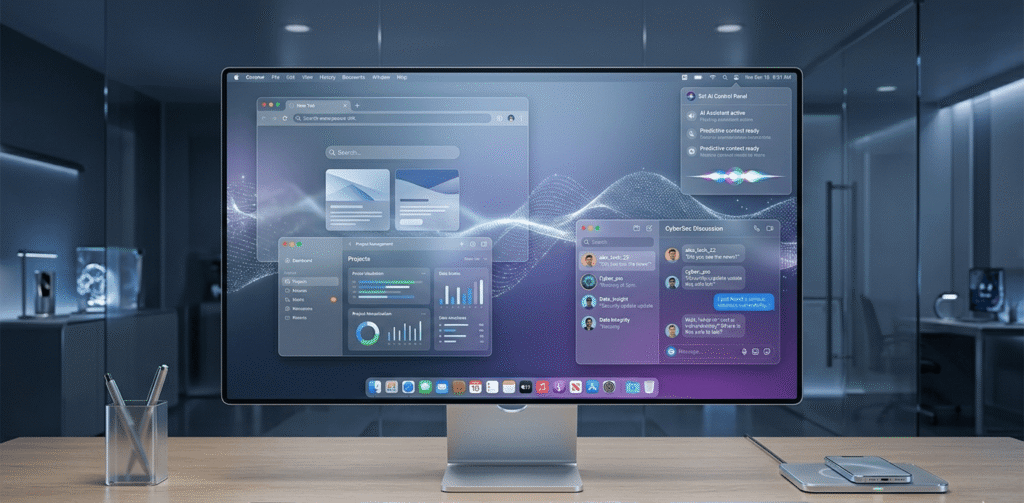
Apple is reportedly refining the Liquid Glass interface while expanding Siri AI capabilities in macOS 27.
Apple is now reportedly entering the refinement phase for macOS 27, following mixed reactions to the new Liquid Glass interface in macOS 26 Tahoe. It is expected to enhance readability, refine visual effects and resolve usability issues raised since the redesign launched in Apple’s software infrastructure, the company reports.
The visual makeover aimed to modernize Mac while keeping everything consistent across iPhone, iPad, and Mac platforms, but the process hasn’t been smooth for Macs. The change reportedly impressed many on the demo but posed some practical problems for many of its users as soon as it was used in the real world. Now, Apple doesn’t seem to be ready to change the design language, but to revamp it.
Liquid Glass came with a More Futuristic Look
One of the most prominent visual modifications of macOS Tahoe was the Liquid Glass interface. The design was inspired by translucent surfaces, layering and dynamic lighting, to make the software more immersive and modern for Apple. The redesign included:
- Transparent menus and sidebars
- Enhanced shadow effects
- Floating interface panels
- Glass-like textures across system apps
- Dynamic depth effects that react to movement and background content
Apple reportedly had in mind Liquid Glass as a design theme to be followed in the future to create a common look and feel for all its devices. Particularly, its interface was optimized to work with newer OLED-based hardware, to make transparency effects seem cleaner and more refined, especially when dealing with deep blacks and enhanced contrast. It seems to have been effective on new iPhones, newer iPads, and Apple Watches. But Macs posed another problem.
Why macOS Tahoe Received Criticism
The biggest complaints, as reported, had nothing to do with aesthetics alone, but with readability and usability. It is reported that a lot of users enjoyed the futuristic look, but found some aspects of the interface cumbersome for extended periods of use. The following areas were identified as problematic:
Control Center
The new translucent Control Center panels reportedly made icons and text harder to distinguish against varying backgrounds. In a few instances, shadows and blur effects degraded clarity, rather than enhancing it.
Finder
Layered transparency effects in finder windows could sometimes be distracting, especially if several finder windows overlapped. Users who rely on dense file management workflows reportedly found the interface less practical than previous versions.
Sidebar-heavy Applications
Apps with navigation sidebars were another weak point. The glass textures and transparency occasionally reduced contrast between menu items and backgrounds, making text appear less sharp.
Dense Productivity Interfaces
Spreadsheet-style layouts, long lists, and professional workflow applications reportedly suffered the most. Transparency and lighting effects had an appealing look but may not be readable for a prolonged period of time. Even something as simple as a readability problem can have an impact on productivity for the creative professional or power user who spends a good portion of every day on Mac devices.
The Problem May Be Hardware-Related
One important reason behind the criticism may be the difference between Mac displays and Apple’s mobile devices. Liquid Glass is said to have been developed with OLED displays in mind. In contrast to traditional LCDs, OLED displays can handle contrast, transparency and dark shadows with greater ease, for each pixel can be illuminated independently. However, LCD technology is still used on most Macs.
This means that some of the transparency and blurriness effects that are seen on iPhones and OLED iPads seem not to be as refined on Macs. Blacks may appear grayer, translucent overlays may cause greying up of texture and translucent overlays may produce loss of texture sharpness. This hardware mismatch may explain why the same design language feels more polished on mobile devices than on desktop systems.
Apple Is Reportedly Refining Rather Than Replacing the Design
Despite the criticism, Apple reportedly remains committed to Liquid Glass as a long-term design direction. Instead of reversing course, the company is believed to be preparing a “slight redesign” for macOS 27 that improves the implementation of the interface while keeping the core visual identity intact. The upcoming refinements are expected to focus on:
- Better transparency behavior
- Cleaner shadow rendering
- Improved text clarity
- More consistent contrast levels
- Better sidebar readability
- Reduced visual clutter
- Improved software polish overall
According to reports Apple sees the problems as the software execution issues, but not a sign that the design idea was flawed. That is, even though it is a sign of the future of their ecosystem, the company realizes that the present Liquid Glass must be improved.
macOS 27 May Be an “iOS 8 Moment.”
The situation is said to be similar to the switch from iOS 7 to iOS 8 that Apple made 10 years ago. Apple’s release of iOS 7 in 2013 completely reshaped the look of iOS, featuring flatter icons, transparency effects and brighter colors. The initial one was very bold but had been criticized for some readability problems, too many motion effects, and some problems with the interface.
Apple used the next year to fine-tune the experience with iOS 8, making it more user-friendly without straying from the new look. macOS 27 could do the same. Apple is unlikely to provide a radical overhaul, but rather an optimization, refinement and stability update that will make things easier to do on a day-to-day basis.
Siri and Apple Intelligence Could Become Bigger Priorities
Apple is also predicted to make significant advancements with AI in macOS 27 and future versions of the operating system. According to reports, the company has some big plans for Siri updates, which include:
- A new Siri interface
- A standalone Siri application
- More conversational interactions
- Improved contextual awareness
- More proactive assistance
- Wider Apple Intelligence integration
- Better task completion capabilities
According to Apple, Siri is on the path to becoming a more powerful AI system that can perform multiple tasks instead of just voice commands and respond more naturally to users. This would also bring Apple right into the mix with AI assistants from OpenAI, Google and Microsoft.
AI Features Could Become More Deeply Integrated Across macOS
Rather than confine AI to specific applications, Apple is now said to be working on embedding it into its operating system. Could be improved by:
- Smarter search functionality
- AI-assisted writing tools
- Enhanced productivity suggestions
- Context-aware notifications
- Improved automation workflows
- Better summarization features
- AI-powered app interactions
Apple is expected to continue emphasizing on-device AI processing for privacy reasons, although cloud-based capabilities may also expand for more advanced tasks.
Performance and Battery Optimizations Are Also Expected
Alongside the visual and AI upgrades, macOS 27 is reportedly being developed with a broader focus on refinement. Expected improvements include:
- Faster overall system performance
- Better battery efficiency
- Reduced bugs and glitches
- Improved animation smoothness
- Better memory management
- More stable multitasking performance
Overall, it’s clear Apple is being more cautious about making sweeping changes this year, making improvements to what people already have rather than everything new.
Performance and Battery Optimizations Are Also Expected
MacOS 27 is said to be developed with a wider lens on refinement, even as it gets visual and AI tweaks. The design language may have originally been created with those future products in mind. Current Mac hardware designs are also beginning to age:
- The MacBook Pro design was first introduced in 2021.
- iMac re-designed in 2021
- In 2022, the MacBook Air was redesigned.
Over the next several years, as Apple upgrades its hardware offerings, the software could more naturally fit into the futuristic vision that Apple is heading in.
WWDC 2026 Could Reveal Apple’s Full Vision
Apple is expected to officially unveil macOS 27 during the Worldwide Developers Conference 2026 on June 8. This event will feature:
- Refined Liquid Glass visuals
- Siri AI upgrades
- Expanded Apple Intelligence features
- Performance improvements
- New developer tools
- iOS 27 and iPadOS 27 updates
The rumors suggest that macOS 27 will not be the Mac overhaul. Instead, it could represent Apple’s effort to perfect a bold visual and AI strategy that still needs refinement before reaching its full potential. For users frustrated with readability and usability concerns in macOS Tahoe, that refinement process may arrive at exactly the right time.
About the Author