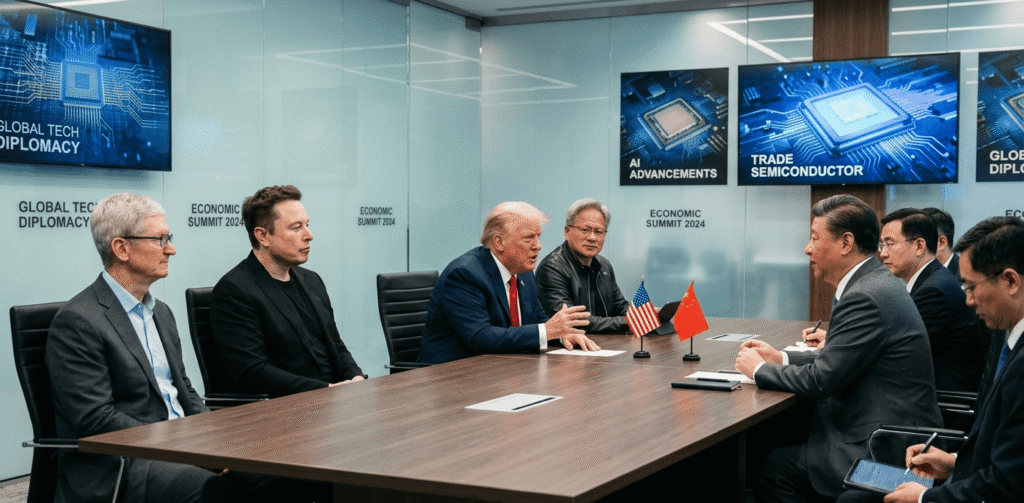
Top American tech leaders joined Trump during high-stakes meetings focused on AI, trade, and semiconductor tensions with China.
Perhaps a more surprising focus for the upcoming visit to China is the entourage of American business leaders that will accompany US President Donald Trump. During meetings with Chinese officials, executives of some of the world’s most influential technology, finance, manufacturing and consumer companies will join Trump, underscoring the extent to which business and geopolitics have merged in the U.S.-China relationship.
Some of the most prominent delegates to watch include Nvidia’s Jensen Huang, Apple’s Tim Cook and Tesla/SpaceX’s Elon Musk. The involvement in the talks underscores the growing role of technology and AI in the diplomatic and economic negotiations between Washington and Beijing.
As Trump is set to meet with Chinese President Xi Jinping amidst ongoing tensions regarding trade, semiconductors, artificial intelligence development, and national security, the visit is anticipated to be one of the most significant US-China diplomatic encounters in years.
Technology and AI Take Centre Stage
Many of the behind-the-scenes discussions of the trip will be about the future of AI and semiconductor supply chains, as many of the leading tech executives will be present. The most symbolic of all guests is Jensen Huang of Nvidia, one of the most important companies in the global AI race. NVIDIA’s graphics chips are integral to much of the world’s cutting-edge AI infrastructure, and the company is at the epicenter of the rising tensions between the US and China regarding chip exports and AI progress.
Interestingly, Huang was not included in the list of the group members initially. One of the greatest surprises about the trip, however, was that he boarded Air Force One during a layover in Anchorage, Alaska. NVIDIA later confirmed Huang’s attendance in Trump’s invitation to help in the administration’s economic and technological agenda. The presence of his attendance is an indicator of the nature of semiconductors as a geopolitical asset, not an ordinary commercial product.
Apple and Tesla Face High Stakes in China
The presence of Tim Cook and Elon Musk underscores the amount of political tension that American technology firms continue to face in China despite the large amount of business they still have there. Apple heavily depends on the Chinese manufacturing and supply chain to produce iPhones and other hardware. China also continues to be a key market for Apple. A decline in the relations between the US and China would pose severe operational and financial risks to the company.
Tesla is in an equally tricky situation. China is one of the most significant markets for the growth of EVs, and Elon Musk’s electric vehicle company has one of its most important factories there. Meanwhile, Tesla battles pricey competition from local Chinese electric car makers in the rapidly diversifying Chinese EV market. The presence of Musk indicates that the administration is seeking out key technology executives to be directly engaged in talks that could affect trade and industrial policies in the future between the two countries.
Finance Giants Also Join the Delegation
The delegation also represents several strong Wall Street executives, outside Silicon Valley and the AI companies. Larry Fink of BlackRock is among the executives from Goldman Sachs, Citi, Visa, Mastercard and Blackstone. Their involvement indicates the economic importance of the journey. Yet China continues to be closely tied to world financial markets, manufacturing systems, and multinational investment plans, even as it engages in years of political competition. China is nonetheless deeply integrated into the global financial markets, manufacturing systems and multinational investment strategies, despite years of political rivalry.
Despite U.S. pressure for tighter controls on strategic technologies, many U.S. financial companies remain keen to gain deeper access to Chinese markets. The presence of banking and payment industry giants also indicates that talks may be more than just about tariffs and manufacturing, and could go into digital payments, cross-border finance and investment access.
Semiconductor Tensions Remain a Major Issue
A notable visitor is Sanjay Mehrotra from Micron Technology. It was only about a year ago that the Chinese government banned the use of some Micron memory chips in key infrastructure projects, saying it was for national security reasons, making the technology company a huge symbol of the ongoing technology tussle between the United States and China. The prohibitions had a major impact on Micron’s business in China and were generally interpreted as a form of counteraction to U.S. export sanctions against Chinese technology companies.
One of the most sensitive issues between the US and China is semiconductors. Washington has progressively stepped back from advanced chip sales to China, especially chips used in AI and military technologies. China, on the other hand, has been pouring huge resources into developing its own semiconductors to lessen its dependence on U.S. technology. This background is particularly important because there are executives in this room such as Jensen Huang and Sanjay Mehrotra.
The Delegation Reflects Broad American Business Interests
The group that will travel with Trump is broad-based, reflecting the number of sectors that are dependent on US-China relations. The delegation also includes executives from aerospace giant Boeing, agricultural powerhouse Cargill, biotechnology firm Illumina, and industrial technology companies.
The variety of industries represented also demonstrates that the US-China relationship is not just about AI or about the trade tariff. It involves everything from aviation and healthcare to agriculture, energy, finance, manufacturing, cloud computing and consumer technology. Access to China—stable, that is—is very important to the long-term survival of many companies.
Iran and Global Geopolitics Will Also Shape Discussions
Technology and trade will be a central highlight of the summit, but geopolitical tensions will also play a part. Those negotiations between Trump and Xi Jinping, which were reportedly delayed by the ongoing conflict between the United States, Israel and Iran, were also put on hold. With China still heavily reliant on Iran’s oil imports, the war is another topic of conversation.
Trump is likely to try to coerce China into playing a role in the peace talks with Tehran. China also has a good reason not to allow prolonged instability, as any break in oil supply lines may lead to a reduction in the purchasing power of the world and have negative impacts on China’s exports. This signifies the deep intertwining of trade, energy, and military relations in the US-China talks.
A Fragile Trade Relationship Still Exists
Trump’s visit to China comes after years of volatile trade relations between the two countries. A previous tit-for-tat tariff war between the two countries, where import duties on some products surpassed 100% before temporary tariff suspensions were agreed following previous diplomatic negotiations. There were some efforts to defuse the tensions following Trump’s earlier meeting with Xi in South Korea, but there are still many issues that haven’t been resolved.
On both sides, technology constraints, intellectual property conflicts, industrial subsidies, and national security issues remain influential in policy-making. Meanwhile, when it comes to the economy, neither country can economically untether itself from the other. Chinese manufacturers, supply chains and consumers remain key resources for American companies, and American access to foreign markets and technology remains critical for China.
The China Trip Could Shape the Next Phase of the AI Era
The most impactful lesson from this journey is the implications for the future of artificial intelligence and world tech competition. The executives accompanying Trump are not run-of-the-mill business executives. These are the companies that are playing an increasing role in shaping the nation’s national security, economic competitiveness, digital infrastructure, and leadership in AI.
NVIDIA is one of the most dominant companies in the field of AI hardware for today’s machine learning systems. Apple makes a difference in the world of consumer technology. Tesla has a head start in the key areas of electric vehicle innovation. BlackRock is a force that impacts the flow of global capital. Boeing is still a key player in the aerospace industry and in trade with other nations.
It is the clearest indication yet that this will be a new era in which technology firms will become as much a part of the global competition as governments. The trip could end up being viewed not just as a diplomatic visit between two world powers, but also as a pivotal event in the evolving dynamics between the governments and the private technology giants as they increasingly collaborate in charting the future of the global economy.
About the Author