
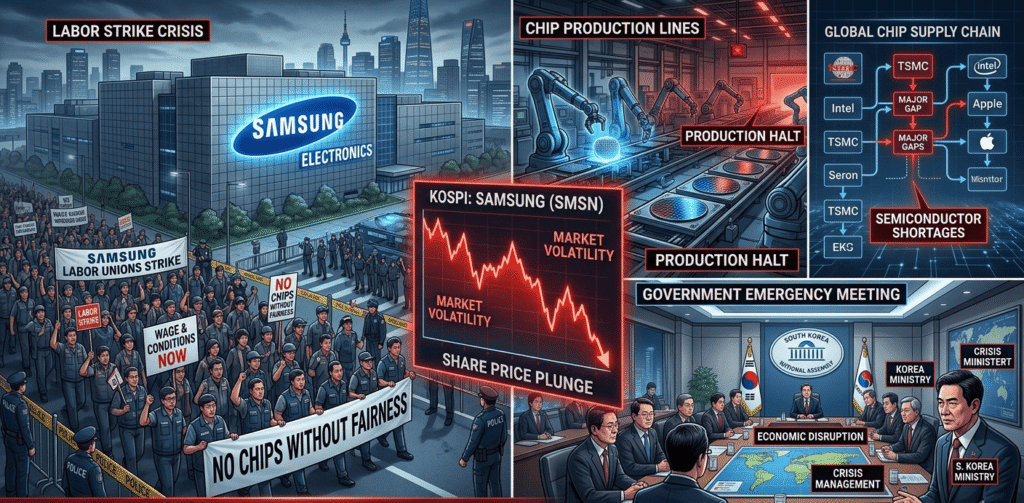
Samsung faces growing strike pressure as South Korea pushes for an urgent labor agreement to protect semiconductor production.
South Korea’s Samsung Electronics is facing a major labor issue with over 47,000 employees set to go on strike, which could have far-reaching consequences on the economy and international semiconductor supply chains. The projected strike, which is scheduled to start May 21, has resulted in an immediate call to action from South Korea’s political establishment, including President Lee Jae Myung and Prime Minister Kim Min-seok.
The conflict is over Samsung’s performance-based bonuses, which labour unions want increased, and its compensation policies, which they want made more transparent. The strike threatens to cost the government “huge losses” in the Samsung and overall South Korean economy, which is hugely reliant on the technology giant.
The situation is closely watched by investors as Samsung is a key player in global semiconductor manufacturing, memory chips, smartphones and exports of electronics. The markets of technology could be impacted if production ever gets interrupted for any extended period.
South Korean President Calls for Balance Between Labor and Management
In an interview with social media on Monday, President Lee Jae Myung publicly expressed a desire to find a compromise between the two sides before the issue gets worse. He stressed the need for the equal respect of the rights of labor and the management rights of the company.
Lee believes extreme interpretations on either end will ultimately negatively impact businesses and workers. His comments came amid growing worry within the South Korean government that a prolonged strike might also hurt national economic stability at a critical juncture for the semiconductor industry.
The president’s statement follows a series of moves by government officials that have been aimed at forcing Samsung management and labor unions to strike a deal before the deadline. If talks break down, authorities are becoming more concerned about the economic impact.
Final Negotiations Seen as Critical
The Samsung management and union representatives on Monday had their last set of talks. Both sides are trying to steer clear of one of the biggest labor disturbances in the company’s history.
The union’s primary demand involves changes to Samsung’s bonus system. Workers are requesting performance bonuses equal to 15% of Samsung’s operating profit. They are also seeking the removal of payout caps and the introduction of a more formalized and transparent bonus structure.
Samsung management has reportedly proposed a lower offer to provide a one-off, special compensation package and 10 per cent of operating profit for bonuses. Yet, this disparity between the two is still quite large.
Representatives of the labor say that the workers are entitled to higher wages for the Samsung is profitable and has a strong position in the global market. Meanwhile, management seems to be taking a tight grip on costs as the semiconductor industry is in a very competitive situation.
Samsung Shares Rise Despite Strike Fears
Interestingly, shares of Samsung Electronics rose sharply despite concerns surrounding the strike. The stock climbed as much as 6.65% on Monday as investors reacted positively to hopes that negotiations could still prevent a full-scale labor shutdown.
Some analysts believe markets are pricing in the possibility of a government-backed resolution before the strike officially begins. Some contend that the labor dispute could be seen as a short-term worry relative to Samsung’s longer-term significance in the field of artificial intelligence chips, memory manufacturing, and advanced semiconductor manufacturing. However, the uncertainty level is high as short interruptions to semiconductor manufacturing can have reverberating effects on global technology supply chains.
Government Warns of Severe Economic Damage
Kim Min-seok, South Korea’s prime minister, issued the sharpest threat yet about the potential strike. If the labor dispute threatens to have a serious adverse impact on the national economy, the government may resort to “emergency adjustments,” he said.
South Korean labor law gives the government the power to temporarily halt industrial action for up to 30 days if it believes a strike may have serious effects on the nation’s economy or public life.
If semiconductor production is halted, the ramifications financially could be immense, Kim said. He said damages to the economy will be at least 1 trillion won, or $665 million, at first glance.
But if the production of chips is disrupted, the overall economic effect may be far more devastating. The manufacture of semiconductors is extremely sensitive, and a disruption may cause the company to have to scrap wafers already on the production line. If production issues worsen, those indirect losses could go up to as much as 100 trillion won, Kim said.
Samsung’s Importance to South Korea’s Economy
The labor dispute is receiving extraordinary political attention because Samsung remains deeply connected to South Korea’s economy. Government officials highlighted that Samsung Electronics accounts for nearly 23% of South Korea’s exports and roughly 26% of the country’s total stock market capitalization.
The presidential office also noted that Samsung’s annual revenue represents approximately 12.5% of South Korea’s gross domestic product. Very few companies globally hold such influence over a national economy.
This concentration has been a source of economic power and weakness to South Korea since long. The success of Samsung has contributed to technological leadership, exports and employment. Meanwhile, reliance on a few large companies makes them vulnerable to labor strikes, geopolitical conflicts and technology industry stagnation.
Such concentration concerns have grown in prominence in recent years, particularly given the evolving dynamics of world semiconductor markets, which are driven by artificial intelligence infrastructure investment, and reduced consumer electronics spending.
Semiconductor Industry Under Pressure
The announcement of a potential strike comes on top of the already competitive global semiconductor industry and escalating geopolitical tensions. Samsung is still one of the world’s biggest manufacturers of memory chips and high-tech semiconductors. The company has direct competitors like SK hynix, TSMC and Micron Technology in several key chip markets.
While AI demand has provided semiconductor companies with a massive opportunity and a source of new revenue, it has also driven up the need to keep production going. Samsung’s disruption could affect supply chains in the field of AI systems, smartphones, cloud computing, and consumer electronics. The labor negotiations are attracting attention from technology firms worldwide, due to Samsung’s semiconductors’ contribution to the global supply of devices.
Union Claims Previous Rally Hurt Production
The labor union has already attempted to demonstrate its influence over production operations. According to union statements, a rally held on April 23 involving approximately 40,000 workers significantly disrupted manufacturing activity.
The union has reported a 58% drop in production at the foundry and a 18% drop at the memory chip division during the strike. The figures have not been independently confirmed by Samsung management but they do illustrate the quantum of risk in the business that Samsung is facing.
The union also estimated that, if Samsung continues to see production interruptions, the strike could cost the company an estimated 30 trillion won ($20 billion). These numbers make it clear how seriously the government takes bringing the two sides closer to compromise.
Samsung Chairman Issues Rare Public Apology
Also involved in the debate over the weekend was Samsung chairman Lee Jae-yong, who made a public apology to customers around the world.
In a labor dispute that is continuing, Lee has apologized for being a cause of “worry and anxiety,” according to South Korean media. However, public apologies issued by Samsung’s leadership are still relatively rare, and show that the situation is not a trivial one.
It is apparent the apology was aimed at reassuring investors, customers and government officials that Samsung is making a concerted effort to solve the problem prior to the onset of the strike.
Global Markets Watching Closely
The possible Samsung strike is no longer simply a domestic labor dispute. Samsung’s involvement in semiconductors, smartphones, memory chips, and electronics manufacturing have made it a significant worldwide business story.
The fallout from the negotiations may not just affect South Korea. This shortage of semiconductors, disruption in supply chains and increased technology cost may impact businesses and consumers around the globe.
Currently markets are hopeful that final negotiations and government pressure will avoid a strike. Despite the ongoing high tension and union demands, however, the future of Samsung and the wider technology industry remains uncertain.
About the Author