
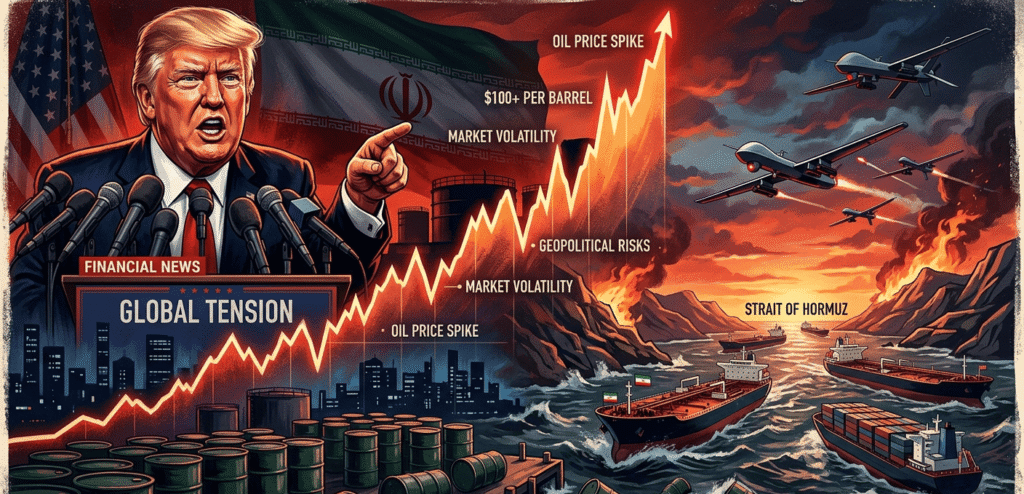
Oil markets surged after Trump warned Iran that time is running out for stalled peace negotiations.
Oil prices surged Monday as U.S. President Donald Trump warned Iran to “tune in” to his “clock is ticking” message as peace talks languish over the past week. The new geopolitical issue soon affected the energy markets, as energy traders and investors reacted to the threat of reduced availability of global oil supplies.
Brent crude futures were up 1.85% to $111.28 a barrel and U.S. West Texas Intermediate crude advanced 2.32% to $107.87 a barrel. Investors remain concerned about supply disruptions, after Iran’s success in closing off one of the world’s vital energy shipping corridors, the Strait of Hormuz.
The situation in recent times has again made energy security a topic of the international community’s agenda. Now the markets will be closely watching the diplomatic and military situation in the region, wondering if it will escalate to a new level, causing even more price hikes and economic uncertainty in the world.
Trump Intensifies Pressure on Iran
Escalating the tensions over the weekend, President Donald Trump publicly threatened Iran to hasten towards a peace agreement. Trump made the comments in a social media post, saying “time is of the essence” and he showed signs of “severe consequences” if talks fall through. His comments were in the wake of reports that talks between Washington and Tehran are at a new deadlock.
Rhetoric, of course, had an immediate impact on market sentiment, with the tone of the White House evident in the rhetoric. What Trump said appeared to be an indication that force may be used if other options fail to bring about a solution. In early Asian trading hours, the uncertainty over U.S. actions helped drive up oil prices.
Analysts say Trump’s remarks were meant to ramp up pressure on Tehran as it works toward a second meeting of the nuclear talks. The belligerent tone, however, could also make it more difficult to make a diplomatic headway, as both sides are still clashing on essential requirements and security assurances.
Strait of Hormuz Remains the Biggest Concern
The Strait of Hormuz is one of the main reasons for the recent increase in oil prices. The narrow waterway transports almost 20% of the world’s oil and LNG imports. News of any disruptions to the area are immediately felt in the markets around the world.
The closure of the shipping route was a result of military strikes carried out earlier this year by the United States and Israel in Iran. In the years that have come since, both shipping firms and insurance providers and energy traders have had increasing worries regarding the security of business shipping vessels traveling through the area.
A prolonged disruption could make oil supplies tight in the world, energy experts say. The Strait of Hormuz is a major route for oil imports to many Asian economies such as China, Japan, South Korea, and India. Transportation risk is also driving up supply chain and shipping and insurance costs throughout the energy industry.
Peace Talks Continue to Stall
The U.S. and Iran continue to struggle in negotiations, while international efforts have been undertaken to alleviate the situation. Iranian media sources reported neither the Iranian capital had enough on Washington’s part on their new offer for peace.
Iranian authorities threatened to “make the talks impossible” if the US does not make yet more concessions, according to reports from the semi-official Mehr news agency. The absence of any sign of improvement has raised concerns about the possible length of the fighting.
Both governments are far apart on sanctions, military action and other regional security matters, according to diplomatic watchers. As the talks stall, financial and energy markets around the world are bound to be jittery.
Energy Markets React to Growing Uncertainty
Since a series of conflicts between Iran, Israel and the United States have escalated earlier this year, oil markets have been subject to unprecedented volatility. Investors are not just taking in military news – they are also paying attention to political statements and diplomatic signals.
If there is a greater risk of geopolitical events in the major oil-producing areas, traders can expect prices to increase as they try to anticipate any supply shortages. Global oil demand remains fairly strong while demand risks are on the rise, making the current situation very sensitive.
When the oil price rises, it can rapidly impact worldwide inflation, transportation expenses, and economic expansion. With that said, rising costs of fuel and energy could push up the costs of living in countries already grappling with the issue of cost of living.
Concerns About Wider Regional Conflict
The situation has heightened to worrying levels with reports of attacks against neighbouring countries by drones. During the war, Iran has allegedly attacked with the help of Israel, Bahrain and the United Arab Emirates.
A drone attack has caused a fire near the Barakah Nuclear Power Plant in Abu Dhabi, the UAE authorities have said on Sunday. According to officials, three drones were brought into the country from the west. Two drones were caught, but the third is said to have hit an electrical generator on the inner perimeter of the facility.
There were no reports of harm or radiation, though it was a serious worry that it may result in more serious regional conflict. Such an attack on critical infrastructure could add to the instability of the Middle East and further taint the energy market, security experts warn.
Investors Fear Supply Shock
Financial markets are increasingly worried that there may be a substantial disruption in global oil supplies. As tensions between the two countries continued to escalate, and the prospect of further closure of the Strait of Hormuz grows, it will be difficult for the oil exporters to maintain normal levels of oil supply.
A number of foreign oil companies are already working on contingency measures for the Gulf region. Shipping companies are also changing their shipping routes and upgrading their security measures for their commercial vessels.
Even the simple prospect of disruption can impact pricing, according to analysts, as markets are sensitive to uncertainty. In general, investors like a stable supply situation and the geopolitical risks now being faced are making it extremely unpredictable for those involved in energy trading.
Impact on Global Economies
A rise in oil prices will have an impact on both the developed and developing economies. The price increase of fuels usually results in higher transportation expenses, production expenses and energy bills for households.
If the world’s inflationary pressures start to creep back again because of the price for energy, then the central banks of the world have to deal with further pressure. The recent Middle East tensions came on top of the downturn in many economies and the abiding inflation fears.
The most severe economic impacts may be felt in countries where a significant fraction of energy needs is sourced from imports. Rising fuel prices over an extended period of time threaten to have a significant impact on businesses in industries like aviation, logistics, and manufacturing.
Markets Watching Trump’s Next Move
Now investors are watching closely for any more hints from the White House. President Trump is reportedly expected to sit down this week with national security advisers in order to consider the options for his actions on Iran.
A new escalation in the military situation may lead to another significant increase in oil prices. Meanwhile, any positive signs of diplomacy could help ease energy markets and ease some of the recent volatility.
Global markets are expected to continue to be volatile over the next couple of weeks. Traders, governments and companies are all watching with anticipation as uncertainty over the Middle East conflict persists.
Conclusion
As U.S.-Iran tensions escalate, oil prices were once again on the rise. President Trump’s threat to “ticking” has done little to calm tensions and sparked renewed concerns that peace talks could break down, leading to more violence in the Middle East.
The biggest worry on the global energy markets continues to be the Strait of Hormuz due to its significance in international oil transportation. Meanwhile, negotiations remain deadlocked and drone strikes are causing further uncertainty in the already volatile area.
There are still diplomatic possibilities, but markets are getting ready for further volatility. In the coming months, if tensions are not eased, other countries and consumers may be impacted by rising oil prices and economic pressures in the near future.
About the Author