
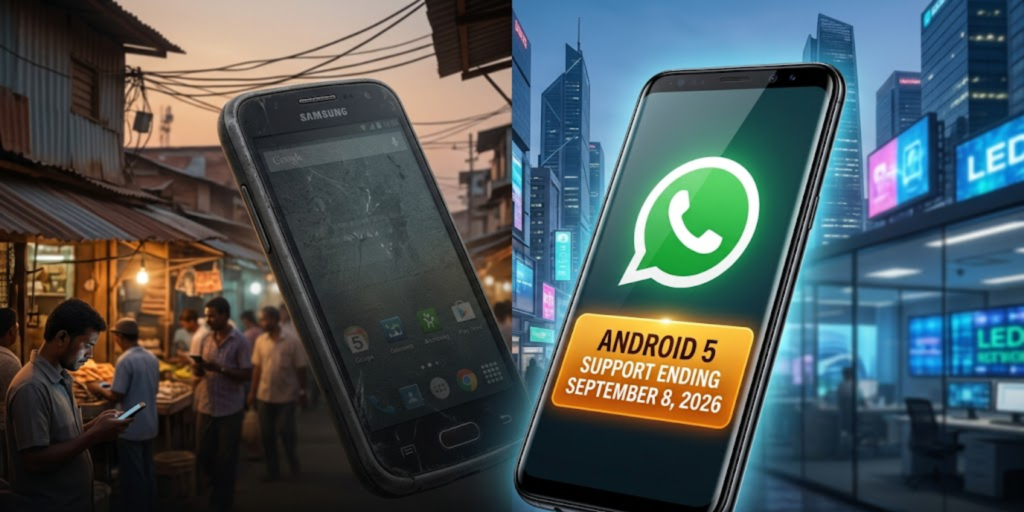
Millions of users will need to upgrade devices as WhatsApp phases out support for Android 5 on September 8, 2026.
WhatsApp is also planning to discontinue support of Android 5.0 and Android 5.1 devices by September 8, 2026, which will impact millions of users worldwide, especially in developing countries like Pakistan, India, Brazil, and some regions within Southeast Asia. To a large number of users who continue to use older smartphones, this is not a mere update, but it is an imposed upgrade that may require them to lose access to one of the most crucial communication systems in the world.
The move is indicative of a larger trend in the mobile industry: older operating systems are becoming less and less compatible with the requirements of modern apps. With the development of messaging applications incorporating more sophisticated encryption, AI-enabled functions, multimedia, and more user-friendly interfaces, older systems are failing to keep up.
The reason why WhatsApp will cease to support Android 5
The issue that led to the decision of WhatsApp is a technical restriction. Android 5.0 (Lollipop), which was released in 2014, and Android 5.1 are more than 10 years old. These systems do not have the new APIs, security models, and performance optimization that the modern applications need.
In industry reporting, WhatsApp is currently working on developing new features like floating chat bubbles, enhanced security layers, and enhanced multimedia management. Such improvements will need new Android releases that are capable of dealing with current background processing, memory, and encryption requirements.
Being compatible with the old systems compels the developers to be restrictive in terms of innovation. All new features have to be tested with old structures, which is slowing the development process and making maintenance more expensive. With the loss of Android 5 compatibility, WhatsApp can now use modern Android features to the fullest.
Who Will Be Impacted the Most?
The number of users on the Android 5 is comparatively low in the world but it is still millions of users. The effects are skewed towards emerging markets, whereby smartphones are held longer before replacement.
Other countries like Pakistan, India and Brazil continue to have large user populations of older Android devices. These are in most instances entry-level phones or mid-range phones that were never meant to have software upgrades past Android 5 or Android 6.
These phones cannot be updated to newer versions of Android by just updating the software as new devices. They are unable to upgrade to newer operating systems because of their hardware limitations.
WhatsApp is not merely a messaging app to many users, but a fundamental communication platform, which they use to stay in touch with their families, carry out business dealings, organize education, and stay in touch with their communities. Loss of access implies that a significant means of communication has been lost.
The Deadline of September 8: What Users Should Do
WhatsApp has already started to roll out the in-app notifications, informing the users of the impending cutoff. Affected users will have to act before September 8, 2026, to prevent being left without access.
1. Android Version Check
To ensure that they have the correct version of their system, users can check:
Settings Android Version.
In case the device has Android 5.0 or 5.1, it will stop being supported in the deadline.
2. Save Chat History
Users are supposed to save their conversations before changing devices. Backups on WhatsApp are through:
- Google Drive backup through app settings.
- On-device local storage backup on the device.
This guarantees that messages, media files and chat history can be recovered to a new phone.
3. Update to a Supported Device
To remain in WhatsApp users have to upgrade to Android 6.0 or more. Options include:
- Buying a new smartphone.
- Purchasing a second-hand device that can run Android with more recent versions.
- Selecting budget smartphones that are nonetheless at the minimum requirements.
To a substantial number of users in the lower-income markets, this move constitutes a huge financial strain.
iPhone Users (So far) are spared
This change does not affect the users on Apple devices. WhatsApp is also compatible with iPhones running iOS 15.1 and above, and compatible iPads.
The Apple ecosystem is more likely to have a longer software life cycle and users upgrade devices more often. This helps lessen the amount of highly outdated devices that are actively in use as opposed to the Android fragmented ecosystem.
Why are older Android versions being abandoned?
Android is a very discontinuous ecosystem. Compared to Apple, where the majority of users use rather up-to-date versions of iOS, Android devices can be based on a variety of system versions, producers, and hardware capacities.
Android 5 devices do not support a variety of essential features of modern apps:
- Advanced encryption protocols
- Great memory and battery life.
- Modern app frameworks.
- Updates on security against contemporary threats.
Consequently, the risks are more to both the developers and users as a result of the continued support of such systems. The use of outdated devices is susceptible to malware, information breaches, and malfunctioning.
Alternative Messaging Apps: Only a partial solution
Those who are not able to upgrade now should think of other messaging apps like Telegram, Signal, or Viber. But it is not always feasible to change apps.
Network dependency is the key challenge. Messaging applications can only work when you have contacts who also use them. As WhatsApp controls the entire communication in the world, the majority of social and professional networks are still connected with it.
Consequently, the change in platforms can be fragmented and not a complete replacement. The users might be left using some apps rather than abandoning WhatsApp altogether.
The Bigger Picture: Digital Inequality and Planned Obsolescence
There is a social problem beyond the technical explanation, which is digital access inequality. In the developed nations, replacement cycles of smartphones are usually short-lived, usually every two or three years. Conversely, in developing economies, users often stick to the same device because of economic pressures.
This leaves a loophole where software will be advancing at a higher rate than the hardware replacement cycles. With large applications like WhatsApp ceasing to support older operating systems, inhabitants of less affluent areas are impacted more than others.
The outcome is some sort of digital exclusion. The right to use the necessary communication equipment is linked to the possibility of purchasing newer technology. This is not a question of convenience to many users- it is a direct consequence to access to education, work and social connection.
The reasons why tech companies make these decisions
As a developer, it is high time to abandon outdated system support and move forward. The need to support operating systems that are a decade old decelerates innovation and adds complexity to the engineering process.
By focusing on newer Android versions, WhatsApp can:
- Improve security standards
- Add new functionalities such as AI tools and more media sharing.
- Maximize the performance of contemporary devices.
- Reduce maintenance overhead
The changes enable the platform to keep up with a fast-changing messaging environment. But this efficiency is achieved at a price: users of older hardware are slowly falling behind.
What Will Occupy September 8, 2026?
Devices with Android 5.0 or 5.1 will not be able to:
- Log in to WhatsApp
- Send/receive messages.
- View chat history without backup.
- Get security patches or bug patches.
Practically, the app will cease to operate on the devices that it does not support. Users who update their phones will be able to restore backups and use the service as usual, but users who do not will be permanently blocked off.
Conclusion:
WhatsApp is technically correct in its decision to drop Android 5 because it is in accordance with industry standards. The current communication systems demand current infrastructure and the old systems can not be sustained forever.
But the actual effect is not technical–it is social. Millions of users, mainly in the developing regions, will be compelled to either upgrade or lose access to an important communication tool. To others, the switch will be easy. To others, it will be a financial and logistical burden that will be hard to bear.
About the Author