
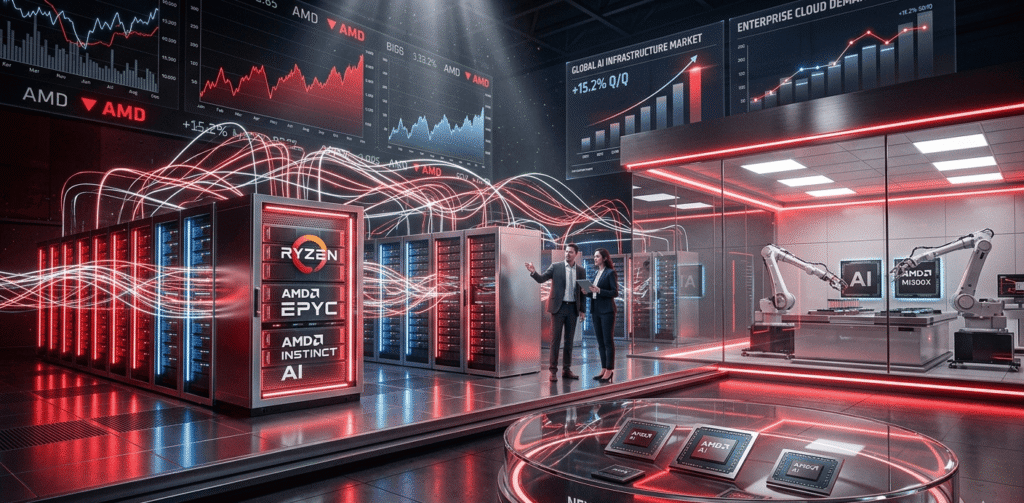
AMD strengthens its AI position after strong earnings, but investors now expect broader infrastructure leadership.
AMD is getting ready for an even tougher challenge in the AI market following impressive earnings. AMD is preparing for an even greater test in the realm of AI following impressive earnings. Advanced Micro Devices, better known as AMD, gave investors what they wanted in terms of a solid quarterly profit. The company saw better-than-anticipated revenue growth, impressive growth in the data center business, and continued strong demand for artificial intelligence infrastructure. However, the back-and-forth rhetoric about AMD stock has now strayed from the beat to the earnings themselves.
The question now is whether AMD can leap from being a chip supplier to a major player in AI infrastructure, a business model that can more directly challenge top companies such as Nvidia. That’s important since the AI market is not just a sale of a high-powered chip. Investors look increasingly for product proof that companies can provide entire ecosystems, including: hardware, networking, software, deployment tools, and enterprise integration. There is good momentum to be found in AMD’s latest quarter, but it will take more widespread execution throughout the AI stack to maintain it.
Strong Earnings Strengthened AMD’s Position
Wall Street had several points of optimism as a result of AMD’s new earnings release. Its first-quarter revenue came in at more than $10 billion, and its Data Center segment turned in $5.8 billion, a big increase from the previous year.
Largely due to a strong performance in the EPYC server processor and Instinct AI accelerator segment, the group delivered strong performance. The products have been a key part of AMD’s strategy to tap into the fast-growing AI infrastructure market.
The company also gave sound forward-looking guidance, predicting that revenue growth and margins would remain flat in the next quarter. This further bolstered investor confidence in the company’s continued involvement with the AI boom as one of the big players.
But the numbers don’t usually get the attention of financial markets for long. After a company demonstrates its ability to create growth, investors start to pose increasingly difficult questions regarding sustainability, profitability and future positioning. The next step with AMD is to establish that its AI enterprise can evolve into a sustainable platform strategy, and not just a fad.
The AI Infrastructure Race Is Changing
AI is a rapidly changing field. Early in the AI bubble, much of the attention was on graphics processing units (GPUs), as it was believed these chips were essential to the training and application of advanced AI systems. The effect was quite beneficial to firms like Nvidia, which have built strong market positions. As AI deployments grow in size and complexity, however, infrastructure demands are also outpacing the limitations of accelerators.
To run in the modern world, AI systems must employ CPUs, memory management, networking technologies, storage optimization, orchestration software, and inference management. It’s this wider infrastructure landscape that AMD would like to cement itself.
AMD is now focusing more than ever on pairing its EPYC CPUs with its Instinct GPUs to build on-ramps for artificial intelligence that can be used to power enterprise and hyperscale deployments. This is a significant move as it allows AMD to compete on the basis of more than just raw chip power. On the contrary, it is not about offering a single AI solution; it’s about offering customers comprehensive AI infrastructure solutions.
EPYC CPUs Are Becoming More Strategic
AMD’s server-side CPU sales have always been considered a market share play. The company continued to move its way up the mountain of competition in the server processor market with performance and competitive pricing. However, the importance of CPUs within AI systems is growing quite a bit.
Coordination between accelerators, storage systems, scheduling operations, and data movement is crucial for AI workloads. CPUs are the sort of control rooms that enable these operations to run efficiently. This trend further enhances the strategic significance of AMD’s EPYC portfolio.
EPYC processors are becoming more than just supporting hardware; they are becoming central components of the infrastructure for AI deployments. This opens more opportunities for AMD to grow as customers commit to investing in AI accelerators; they could also opt into using AMD CPUs as a part of a unified platform strategy. This bigger positioning may ultimately enable AMD to build more repeat business with enterprises, instead of just selling hardware.
Enterprise Partnerships Could Become Crucial
As for some of the more interesting developments since AMD’s earnings announcement, it was the company’s announcement of a partnership with Rackspace Technology. The two companies announced their intention to work together to develop a governed Enterprise AI Cloud platform for regulated industries and sovereign AI workloads. The proposed infrastructure would be a mix of AMD’s Instinct GPUs, EPYC CPUs, and Rackspace’s enterprise cloud services.
It’s important because enterprise AI implementation is vastly different than that of the hyperscale giants. Security, governance controls, predictable infrastructure and operational accountability are essential in large corporations, financial institutions, healthcare providers and government organizations. These customers have concerns with deployment management, just as much as with raw computing power.
As AMD becomes a part of enterprise systems, it has the potential to greatly increase its long-term AI opportunity. Nevertheless, cautiousness has been the trend in investments. The deal is still a memorandum of understanding, not a final, big deal revenue contract. It indicates strategic intent but the challenge lies with AMD to demonstrate the value of commercial deployments based on such partnerships.
Networking and Software Remain Critical Challenges
The hardest aspect of Networking and Software in relation to the expansion of AI for AMD is perhaps the most difficult part. The reason Nvidia has been so successful is that it has more to offer than just chips. Strategies to efficiently construct AI clusters are provided by NVIDIA, which offers comprehensive hardware, networking, and software ecosystems.
AMD is trying to meet the competition in a more open and flexible world. The company has been developing networking technologies with partners, such as OpenAI, Microsoft, Intel, and Broadcom, to enhance AI training infrastructure. AMD is also using its Pensando networking technology to enhance its infrastructure capabilities.
Another one of the company’s major focus areas is its software ecosystem, including ROCm. To be considered a viable competitor in the field of AI infrastructure, the software stack from AMD needs to be adopted by developers and enterprises for running large-scale AI workloads. This is one of the most difficult in the AI business as software ecosystems can establish long-lasting customer loyalty and a switching cost.
Investors Are Looking Beyond Revenue Growth
The market’s response to AMD’s earnings underscores an intriguing aspect of contemporary AI investing: the significant volatility driven by news. This has been a crucial lesson in today’s era of investing in AI: the marked market fluctuation in response to news. Rising revenues are no longer enough to keep the pony race going. Now, investors want to see the profitability, enterprise adoption, margin expansion and longevity of the platform.
AMD’s stock experienced a pullback after its post-earnings rally despite the positive financial results. This does not necessarily indicate weakness. Instead, it reflects the market’s shift from enthusiasm toward deeper evaluation.
The next phase for AMD depends on execution across multiple fronts simultaneously. The company needs to keep growing its AI revenue and boost margins, expand software uptake, forge enterprise connections and demonstrate networking prowess. That’s a much tougher challenge than just shipping more chips in the midst of a good AI cycle.
Competition Remains Intense
AMD’s opportunity is huge, so is the competition. Although Nvidia’s grip on the AI accelerator market is strong, it still has significant software integration, networking, and developer ecosystems benefits. Meanwhile, other companies, such as Intel, are rapidly investing in technologies around AI infrastructure.
Industry-wide risks also exist such as export restrictions, manufacturing limitations, supply chain risk and price pressure. While demand for AI infrastructure continues to be strong and robust, sustaining leadership in this space will require constant innovation and execution.
Conclusion
In its most recent quarterly earnings announcement, AMD has shown it has real momentum in the field of AI infrastructure. The impressive growth was driven by strong demand for EPYC processors and Instinct GPUs, further solidifying AMD’s position as one of the key players to gain from the AI boom.
AMD now needs to prove that it can evolve into a complete AI infrastructure platform capable of supporting enterprise deployments, networking operations, software ecosystems, and long-term customer relationships. Success in these areas would allow the company to compete on far more than chip performance alone. The market has already paid off for AMD’s growth. The next step hinges on how well the company can provide sustainable leadership in AI infrastructure in a fiercely competitive sector.
About the Author