
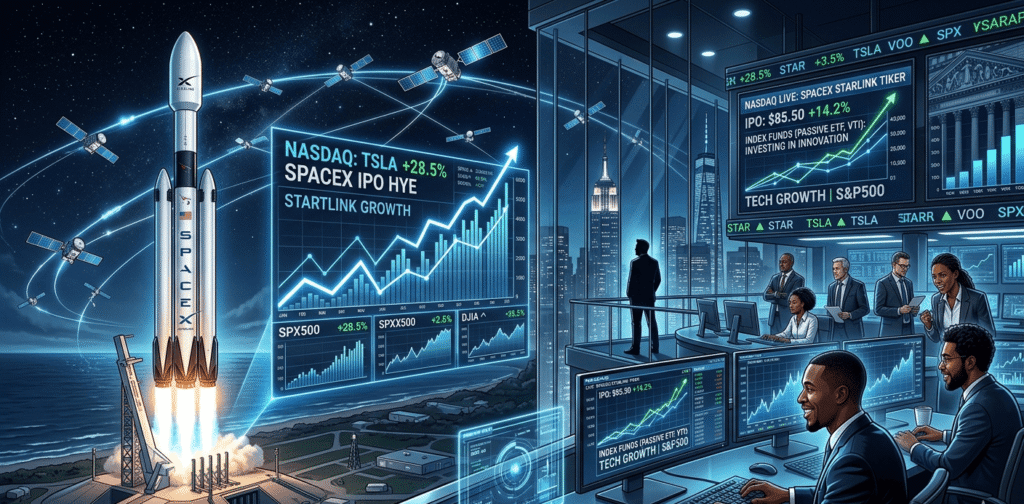
SpaceX’s potential IPO could become one of the largest index-driven stock events in modern market history.
The possibility of SpaceX’s IPO may not be just another big public offering as of May 14, 2026. The conversation has gone way beyond rockets, satellites and Elon Musk. Now the real story is whether the market is structured to accommodate one of the largest and most powerful private firms ever assembled and will it will tolerate passive investing and the inclusion of its name on indexes.
The value at which the company is expected to go public, the date of the IPO and the volume the stock gains during its first day of trading are the main topics of IPO coverage. But SpaceX may become something different entirely. If the company enters public markets near the valuation range currently being discussed, the IPO could evolve into an index-demand event where forced institutional buying shapes the stock price as much as the business fundamentals themselves.
That changes how investors should think about the offering. The key question is no longer simply whether SpaceX is a great company. The more important question is whether the stock could become expensive because market mechanics force buyers into a limited public float before investors fully understand the underlying economics.
The IPO Story Changed in May 2026
The most important recent development is not a new rocket launch or another Starlink deployment milestone. The biggest shift is the growing discussion around index inclusion rules. Reports suggest that major indexes may accelerate the process for adding extremely large newly public companies. If SpaceX qualifies quickly for benchmarks like the Nasdaq-100 or eventually the S&P 500, passive investment funds may have to purchase billions of dollars worth of shares shortly after the IPO.
This is where the situation becomes unusual. In a normal IPO, investors decide whether they want exposure to a company. In a mega-cap IPO tied to index demand, many funds may be required to buy the stock regardless of whether they believe the valuation is attractive. That creates a completely different dynamic from a traditional technology listing. It also raises concerns about price discovery during the early weeks of trading.
SpaceX Is a Real Business, Not Just a Hype Story
The possibility of inflated demand does not mean the company lacks substance. SpaceX has already revolutionized the aerospace industry in a way that would have been unthinkable. It has significantly lowered the cost of launch and boosted the frequency of its launches with its reusable Falcon 9 rockets. The company’s satellite internet platform, Starlink, has grown into a global communications network with millions of users. SpaceX has also become deeply integrated into government and defense infrastructure through contracts with NASA and the U.S. military.
Unlike many speculative IPO candidates, SpaceX already operates at an enormous scale. Recent financial reports indicate that the company generated billions in EBITDA during 2025, with Starlink now contributing the majority of overall revenue growth. That matters because the investment case is no longer based purely on future dreams about Mars colonization. SpaceX now has a viable business that has real customers, recurring revenue, and strategic importance. But a solid company can be a bad business if investors pay too much for it.
Starlink Is Quietly Becoming the Core Business
Many investors still think of SpaceX primarily as a rocket company. That picture is increasingly outdated. Starlink is becoming the economic center of the company. Satellite internet subscriptions are recurring, scalable, and potentially far more profitable over time than launch operations alone.
Starlink’s growth gives SpaceX exposure to multiple massive industries simultaneously. The company now sits at the intersection of telecommunications, defense technology, cloud infrastructure, direct-to-device mobile connectivity, and potentially AI-driven global data systems.
This is one reason the valuation discussion has become so aggressive. Investors are not simply valuing a launch provider. They are valuing a company that could eventually function as a global communications backbone. That broader narrative makes the IPO more compelling, but it also makes valuation more difficult because SpaceX lacks a clean public-market comparison.
Scarcity Could Drive the Stock Higher
One of the most important factors in the IPO may be the size of the public float. If only a relatively small percentage of shares become publicly tradable at launch, demand could overwhelm supply very quickly. That demand may come from retail traders, hedge funds, institutional investors, and passive index products all at once.
This creates what many analysts describe as a scarcity premium. Investors may bid the stock higher simply because there are not enough shares available to satisfy market demand.
Scarcity can create extraordinary momentum during the early phases of trading. However, it can also distort valuation and separate price from fundamentals. The danger is that investors may confuse forced buying pressure with proof that the stock is fairly valued.
The Governance Structure Is a Serious Issue
Another major concern surrounding the potential IPO is governance. It’s been reported that Elon Musk might still have a massive voting majority with a dual-class voting system. Even though public shareholders may have economic interests in the firm, they may have little influence on major corporate decisions. This structure is not unusual in modern technology IPOs, but the scale of control reportedly being discussed is drawing criticism from institutional investors and pension funds.
The issue is not whether Musk is visionary. Most investors already accept that he is one of the most influential technology entrepreneurs of his generation. The concern is whether public investors are receiving enough shareholder protection relative to the valuation they are being asked to pay. Strong businesses with weak shareholder rights can still become problematic investments if management priorities eventually diverge from investor interests.
Index Inclusion Could Distort Early Trading
The most overlooked risk may be how quickly passive capital enters the stock after listing. If SpaceX joins major indexes rapidly, billions of dollars in automatic purchases could enter the market within weeks. Index funds do not evaluate valuation the same way active investors do. Their mandate is simply to replicate benchmark exposure.
That means passive funds may buy shares regardless of whether the stock appears expensive. For retail investors, this creates a complicated environment. Early price increases may reflect forced demand rather than long-term conviction about future cash flows. This is why some analysts describe the IPO as a market-structure event rather than a traditional investment story.
What Investors Need From the S-1 Filing
The final S-1 filing will be one of the most important documents to analyse for the IPO. Investors require much more detail regarding Starlink’s economics, such as customer growth rate, churn rate, operating margins, hardware subsidies, and average revenue per user. They also require clarity on the profitability of rocket launches, government defense orders, the cost of development of Starship, and money committed to AI technology or satellite launch.
The filing shall also explain the insider sales, voting power and lockup arrangements, as well as the specific size of the public float. If not for those disclosures, the IPO is more story than substance. Disciplined investing requires a compelling story.
Why Starship Still Matters
While the focus of the conversation has shifted toward financials, due to the rise of Starlink, Starship is still at the core of the long-term thesis. Once operational on a large scale, Starship could have a significant impact on the cost of space launches and the commercial value of space infrastructure. The vehicle could also provide a platform for additional satellites, lunar exploration, launching of other cargo missions to space, and even new industries based on the orbiting facility for manufacturing or the space-based computing.
A lot of the extreme optimism about SpaceX’s valuation has to do with the idea that Starship will ultimately revolutionize the economics of accessing space. The potential is huge, but the investors must still distinguish the technology potential from the current financial reality.
Retail Investors Should Be Careful About Timing
The biggest mistake retail investors make during blockbuster IPOs is assuming public availability automatically creates safety. In reality, the first weeks of trading are often the least predictable period in a stock’s lifecycle. Underwriter stabilization, media hype, limited float, and speculative momentum can all distort pricing.
The best play might not be to rush into the IPO right away. This can include going into a lockup, reviewing quarterly filings, and letting the market set its valuation range. Great companies do not always produce great entry points on day one.
SpaceX Could Reshape Public Markets
The broader significance of the IPO goes beyond aerospace. SpaceX could become the clearest example yet of how trillion-dollar private companies interact with modern passive investing systems. If the stock enters major indexes quickly, it may expose weaknesses in how benchmarks handle giant companies with limited float and concentrated insider control.
This could influence future IPO structures across the technology sector. The offering may ultimately become as important for public-market mechanics as it is for space investing itself.
Conclusion
The SpaceX IPO may become one of the most important public offerings of the decade. The company itself is real, strategically powerful, and financially meaningful. Its dominance in launch infrastructure and the rapid growth of Starlink give it a business foundation that few IPO candidates can match.
At the same time, investors should not ignore the structural risks surrounding the deal. Low float, aggressive valuation expectations, rapid index inclusion, and concentrated voting control could create a market environment driven as much by forced demand as by fundamentals. That tension is the real story. The business may deserve a premium valuation. The IPO structure still has to justify one.
The best way is to prepare – not to panic – for now. Investors need to pay attention to the future filings, do some careful economics and avoid getting caught up in the euphoria we feel about the company versus the discipline of the stock price. The best long-term prospects probably will come after the initial excitement has subsided and the market has been given enough information to truly appreciate SpaceX’s potential as a company based on its actual results, not scarcity.
About the Author