
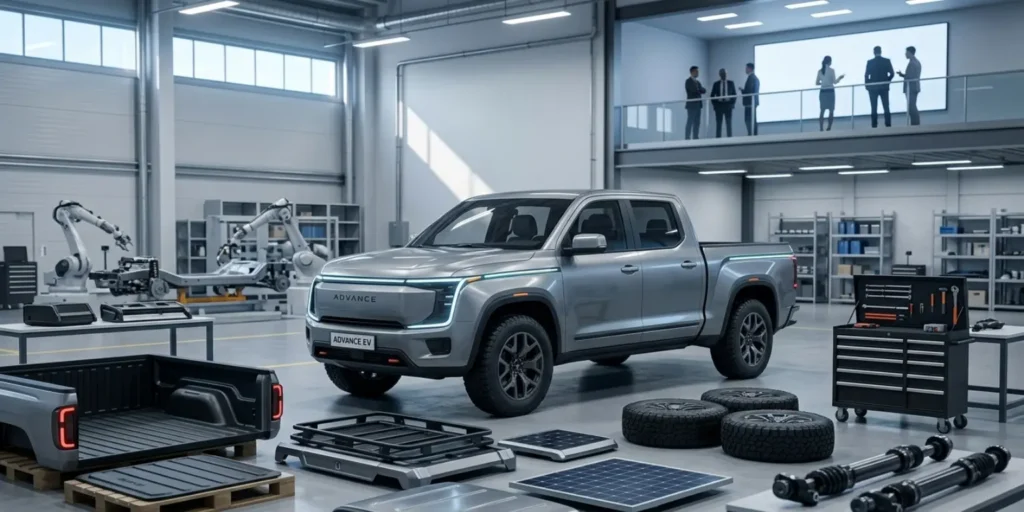
Slate Auto secures $650M to bring a budget-friendly, customizable electric pickup truck to market.
Electric vehicle startup Slate Auto has secured a fresh $650 million in Series C funding as it moves closer to launching its first budget-friendly electric pickup truck. This latest round brings the company’s total funding to approximately $1.4 billion, signaling strong investor confidence despite a challenging EV market.
The funding round was led by TWG Global, a firm run by Mark Walter and Thomas Tull. While the company did not disclose all participants, it acknowledged support from “visionary investors,” adding to an already notable backer list.
Backed by Big Names Including Jeff Bezos
Slate Auto’s investor base includes prominent figures and firms such as Jeff Bezos’ family office, General Catalyst, and Slauson & Co. This backing gives the company both financial strength and strategic guidance as it navigates the competitive EV landscape.
The company also benefits from deep operational roots tied to Amazon. Jeff Wilke co-founded it, and many senior leaders—including those in mobility, e-commerce, and HR—previously held roles at Amazon.
More recently, Peter Faricy, a former Amazon Marketplace executive, stepped in as CEO. Meanwhile, former CEO Chris Barman transitioned to the role of President of Vehicles.
A Different Strategy in a Tough EV Market
Slate Auto’s funding arrives during a turbulent period for the U.S. electric vehicle industry. Major automakers are scaling back EV plans, partly due to the removal of the $7,500 federal tax credit. Companies like Tesla have seen declining sales, while startups such as Rivian and Lucid Motors continue to face challenges in scaling production.
Against this backdrop, Slate Auto is taking a notably different approach. Instead of targeting the premium segment, the company is focusing on affordability—a largely underserved part of the EV market.
The Affordable EV Truck Strategy
Slate Auto plans to launch a bare-bones electric pickup truck priced in the mid-$20,000 range, significantly lower than most EVs currently available. Earlier projections suggested a price of around $27,000, with hopes of dipping below $20,000 when federal incentives were still in place.
What makes the offering unique is its modular design. Customers will be able to customize the truck with add-ons, including an SUV conversion kit priced at roughly $5,000. This flexible model allows buyers to start with a basic vehicle and upgrade over time, potentially expanding the product’s appeal.
Final pricing details are expected to be announced in June, which will be a crucial moment for gauging market competitiveness.
Strong Early Demand Signals
Despite broader market uncertainty, Slate Auto has already generated significant consumer interest. The company reports more than 160,000 refundable reservations for its upcoming truck.
This level of demand is notable, especially given the absence of federal incentives. It suggests that there is a real appetite for affordable EV options, particularly in the pickup segment, where prices have traditionally been high.
One of CEO Peter Faricy’s primary tasks will be converting these reservations into actual purchases—a critical step for validating the company’s business model.
Manufacturing Plans Underway
To support production, Slate Auto is investing heavily in infrastructure. The company is spending several hundred million dollars to renovate a former printing facility in Indiana, which will serve as its primary manufacturing site.
This facility is expected to play a key role in enabling the company to meet its production target of launching vehicles by the end of 2026. Scaling manufacturing efficiently will be essential, especially as many EV startups have struggled with delays and cost overruns.
Can Slate Auto Succeed Where Others Struggle?
Slate Auto’s strategy stands out in an industry dominated by high-priced electric vehicles. By targeting affordability and offering customization, the company is attempting to tap into a broader consumer base.
However, the challenges are significant. The EV market is becoming increasingly competitive, and the removal of government incentives adds pressure on pricing. Additionally, converting strong reservation numbers into sustained demand will require flawless execution.
Still, with $1.4 billion in funding, experienced leadership, and backing from high-profile investors, Slate Auto has positioned itself as one of the more intriguing players in the next phase of EV adoption.
The Bigger Picture
Slate Auto’s latest funding round is more than just a capital raise—it reflects a shift in how companies are approaching the EV market. As premium segments become crowded, the next wave of growth may come from affordability and accessibility.
If Slate Auto can deliver on its promise of a low-cost electric truck without compromising too much on quality, it could open up an entirely new segment of EV buyers. The road ahead remains challenging, but the opportunity is equally significant.
About the Author