
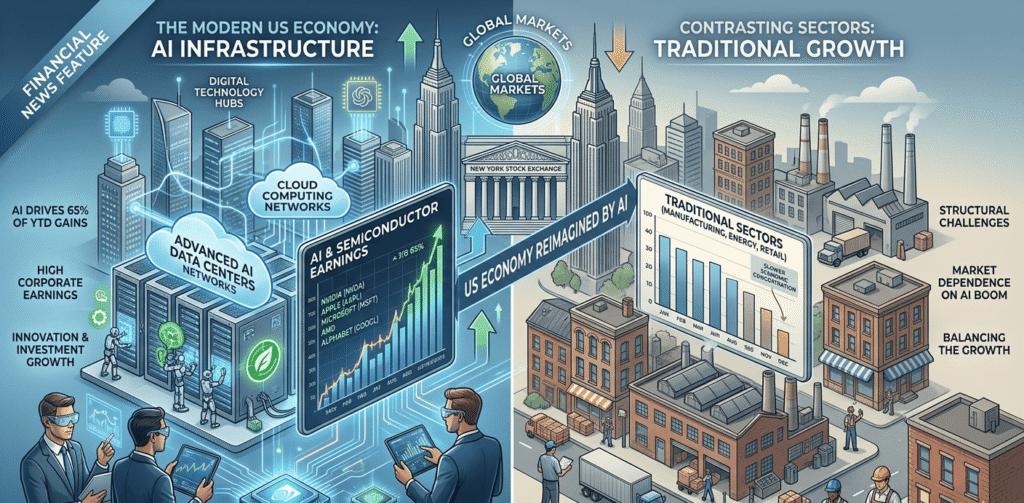
Artificial intelligence has become a major force behind corporate profits, stock market performance, and investment activity across the United States.
The American economy continues to display resilience despite growing signs of underlying imbalance. Consumer spending remains relatively strong, corporate profits stay near record levels, and stock markets continue attracting investor confidence. However, several important economic indicators suggest the overall picture may be less robust than headline figures imply.
Economic growth has slowed during recent quarters, creating questions about the sustainability of current expansion. While many businesses continue reporting healthy financial performance, income growth has moderated and employment creation remains weaker than expected. These developments have encouraged economists and investors to examine the foundations supporting current economic strength.
The central concern is not necessarily that the economy faces immediate danger. Instead, analysts increasingly question whether economic growth is sufficiently broad across industries and households. Evidence suggests that much of the recent strength stems from a relatively small segment of the economy connected to artificial intelligence development and infrastructure.
Artificial intelligence has become a dominant growth driver
Artificial intelligence currently represents one of the most powerful investment themes shaping global markets. Companies involved in AI hardware, software, cloud computing, and data infrastructure have attracted enormous amounts of capital. Investors continue betting that artificial intelligence will transform industries and generate substantial long-term profits.
The AI ecosystem includes semiconductor manufacturers, hyperscale cloud providers, data center operators, networking companies, and infrastructure suppliers. These businesses have experienced extraordinary growth as organizations worldwide increase investments in artificial intelligence technologies. Revenue growth and profitability within these sectors have significantly exceeded performance across many traditional industries.
As a result, artificial intelligence has become more than simply a technology trend. It increasingly influences corporate investment decisions, stock market performance, economic growth expectations, and broader investor sentiment. The success of AI-related companies now affects how many people evaluate the overall health of the American economy.
Corporate profit growth remains highly concentrated
One of the most important observations involves the concentration of corporate profitability. While aggregate profit figures appear exceptionally strong, much of that strength originates from a relatively small group of AI-related companies. Outside these sectors, many businesses face slower growth, margin pressure, and more challenging operating environments.
Corporate profits as a share of economic output have reached historically elevated levels. Market-wide profit margins also remain near previous highs, creating the impression that American businesses broadly enjoy exceptional financial health. However, closer examination reveals that many industries are not experiencing the same level of success.
The distinction matters because investors often rely upon aggregate data when valuing financial markets. If a significant portion of profitability comes from a limited number of firms rather than the broader corporate sector, overall market valuations may appear stronger than underlying economic conditions actually justify.
Stock market leadership has become increasingly narrow
The American stock market continues reaching impressive valuation levels despite concerns about economic growth. Much of this performance stems from a handful of large technology and artificial intelligence companies that dominate major market indexes. These firms command enormous investor attention and increasingly influence market direction.
A relatively small group of AI-linked corporations now represents a substantial share of total market capitalization within major stock indexes. Their rapid growth and strong earnings have helped push overall market valuations higher. Consequently, stock market performance may not fully reflect conditions experienced by the majority of listed companies.
This concentration creates both opportunities and risks. Strong performance among leading technology firms can support broader investor confidence and wealth creation. However, it also means that market stability becomes increasingly dependent upon continued success within a limited number of sectors and companies.
Employment growth tells a different economic story
While corporate profits remain strong, labor market data presents a less optimistic perspective. Historically, periods of strong profitability often coincide with substantial job creation as businesses expand operations and invest in growth initiatives. Recent trends, however, suggest a different pattern.
Many of the companies generating the largest profits from artificial intelligence require relatively fewer employees compared with traditional industries. Advanced technology firms often achieve substantial revenue growth through automation, software, and scalable digital infrastructure rather than large workforce expansions.
As a result, employment growth has remained comparatively weak despite strong corporate earnings. This disconnect raises concerns regarding the durability of economic expansion. If profits continue increasing without corresponding job creation, household income growth may struggle to keep pace with broader economic activity.
Consumer spending remains supported by wealth effects
Consumer spending continues serving as a critical pillar of economic growth throughout the United States. Despite slower income growth and weaker labor market momentum, household spending has remained surprisingly resilient. One explanation involves the growing importance of wealth effects.
Higher-income households benefit significantly from rising stock market values because a larger share of their wealth is invested in financial assets. As AI-related companies drive equity prices higher, affluent consumers experience increases in net worth. This wealth appreciation often encourages continued spending and investment activity.
Lower-income households face a different reality. Many remain more dependent upon wages and employment income rather than investment gains. Consequently, they experience greater pressure from slower wage growth, inflation, and labor market uncertainty. This divergence contributes to growing differences in economic experiences across income groups.
A self-reinforcing cycle currently supports growth
Artificial intelligence has created a powerful feedback loop that currently supports economic expansion. Strong investor enthusiasm drives capital into AI-related companies and infrastructure projects. These investments generate higher profits and rising stock valuations, which in turn strengthen consumer and business confidence.
As market values increase, wealthier households continue spending. Their spending supports economic demand, helping businesses maintain revenue growth. Positive financial results further reinforce investor optimism regarding artificial intelligence and future economic prospects.
This dynamic has helped sustain economic momentum despite broader challenges. Capital expenditure remains elevated, financial markets stay strong, and confidence within technology sectors remains high. However, the effectiveness of this cycle depends heavily upon continued belief in the long-term profitability of artificial intelligence investments.
Investor confidence plays an increasingly important role
Confidence has always influenced financial markets, but its importance may be especially significant in the current environment. When economic growth becomes concentrated within a narrow group of industries, investor expectations carry greater weight in supporting overall market performance.
Artificial intelligence currently benefits from exceptionally high expectations regarding future returns. Investors assume that companies developing AI infrastructure, software, and services will generate substantial profits for many years. These expectations justify significant investment spending and elevated market valuations.
Should confidence weaken, however, the effects could extend beyond technology stocks alone. Reduced enthusiasm could slow investment activity, weaken stock market performance, and diminish household wealth effects. Because many parts of the economy now depend indirectly upon AI-driven optimism, changes in sentiment could have broader consequences than many investors currently anticipate.
The greatest risk lies in economic concentration
The primary concern surrounding America’s current economic strength is not necessarily overvaluation or technological failure. Instead, it involves concentration. Economic growth, corporate profits, market performance, and consumer confidence increasingly depend upon the success of a relatively narrow segment of the economy.
Artificial intelligence undoubtedly represents a transformative technology with significant long-term potential. Many AI-related businesses continue generating impressive financial results while driving innovation across multiple industries. These achievements help explain why investors remain enthusiastic despite broader economic uncertainties.
Nevertheless, concentration creates vulnerability. If expectations regarding artificial intelligence infrastructure, platforms, or profitability become less optimistic, the consequences could extend throughout financial markets and the broader economy. Wealth effects may weaken, consumer spending could slow, and investors might reassess assumptions regarding American economic exceptionalism.
A strong economy with narrower foundations
The United States remains one of the world’s strongest and most dynamic economies. Corporate innovation, technological leadership, and capital market strength continue supporting growth. Artificial intelligence has become a major source of opportunity and investment, helping sustain confidence during a period of economic transition.
However, the foundations supporting current strength appear narrower than headline indicators suggest. Much of the optimism surrounding profits, stock prices, and investment activity originates from a concentrated group of AI-related companies. Outside that ecosystem, growth often appears more moderate and uneven.
For now, the system continues functioning effectively because investors believe artificial intelligence will deliver extraordinary future returns. Whether that belief remains justified over the long term may ultimately determine not only the future of technology stocks but also the trajectory of the broader American economy.
About the Author