
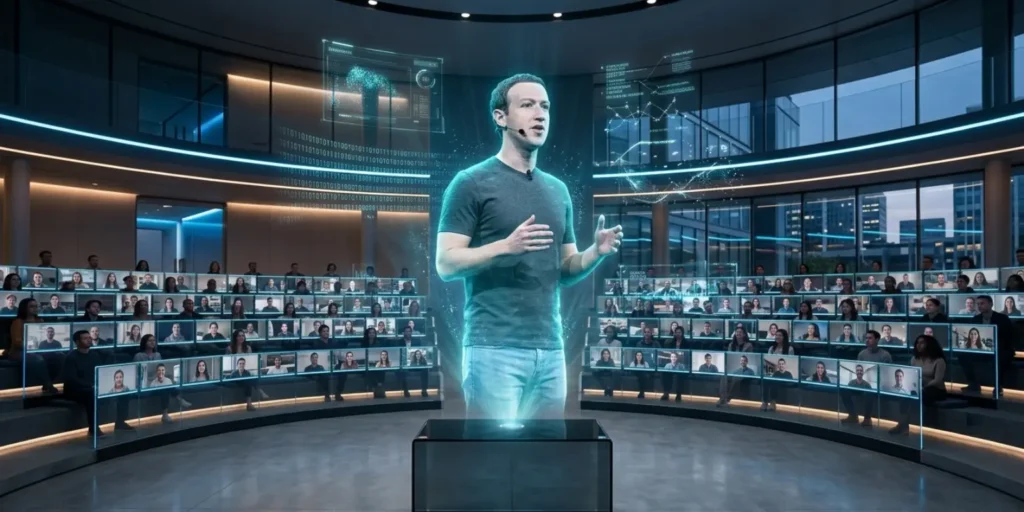
Meta develops a photorealistic AI version of Mark Zuckerberg to transform leadership communication at scale.
In one of the most striking developments in corporate AI adoption, Meta Platforms is building a photorealistic artificial intelligence version of its CEO, Mark Zuckerberg. The system is designed to interact with tens of thousands of employees in real time, effectively scaling the CEO’s presence across the organization.
At first glance, the idea may sound experimental or even symbolic. In reality, it represents something far more significant: Meta is actively deploying its own AI infrastructure internally at the highest level of leadership. This transforms massive AI spending into a working, testable product inside the company itself.
What the “AI Zuckerberg” Actually Does
The AI version of Zuckerberg is not just a chatbot. It is being built as a photorealistic, conversational avatar capable of engaging employees naturally, answering questions, and delivering information as if the CEO himself were present.
This project is separate from another internal initiative—a “CEO agent”—which focuses on productivity tasks like summarizing data, preparing briefings, and assisting with decision-making. The AI Zuckerberg, by contrast, is about communication and presence.
If successful, it allows a single executive to interact with a workforce of nearly 80,000 people without the traditional constraints of time, meetings, or recordings. That alone could redefine how large organizations handle leadership communication.
Turning AI Spending Into a Real Product
Meta’s AI ambitions are backed by enormous investment. The company has committed tens of billions of dollars annually toward AI infrastructure, including data centers, chips, and model development.
Projects like the AI Zuckerberg convert that abstract spending into something tangible. Instead of simply talking about AI capabilities, Meta is using them internally in high-stakes scenarios. This approach—often described as “eating your own dog food”—signals confidence in the underlying technology.
It also provides a powerful testing ground. Every interaction between employees and the AI system generates feedback, identifies edge cases, and improves performance before the technology is ever released to external customers.
How This Impacts META Stock
Shares of META are already supported by a highly profitable core business. Meta generates strong margins through its advertising ecosystem across platforms like Facebook, Instagram, and WhatsApp. The AI Zuckerberg initiative adds something different: strategic optionality. It suggests that Meta is not just an advertising company using AI, but a potential enterprise AI provider.
This distinction matters for valuation. Advertising-driven businesses typically trade at lower multiples than software or enterprise AI companies. If Meta successfully expands into enterprise AI solutions, investors may begin to assign it a higher earnings multiple. In other words, the AI project doesn’t immediately boost revenue—but it expands what the company could become.
The Enterprise AI Opportunity
The broader opportunity lies in enterprise AI agents—systems that can assist, communicate, and automate tasks within organizations. This market is expected to grow rapidly over the next few years.
Meta enters this space with several advantages. Its Llama models provide a strong AI foundation. Its existing user base gives it massive scale. And now, its internal deployment offers a real-world demonstration of how such systems can work.
If Meta can prove that an AI CEO improves efficiency, engagement, or productivity, it could package similar solutions for other companies. That would open a completely new revenue stream beyond advertising.
Comparing Meta’s Strategy to Competitors
Meta is not alone in integrating AI into its operations. Companies like Microsoft and Google are also embedding AI deeply into their ecosystems.
However, Meta’s approach stands out. While Microsoft focuses on productivity tools and Google emphasizes research and intelligence, Meta is betting on realism and human-like interaction.
By creating a digital twin of its CEO, Meta is exploring whether people engage more effectively with AI that feels human rather than purely functional. This could become a key differentiator if the approach proves successful.
Risks and Challenges
Despite its potential, the AI Zuckerberg project carries real risks. A photorealistic AI system must meet high expectations. If it produces inaccurate responses, behaves inappropriately, or feels inauthentic, it could damage internal trust.
There is also a broader question of acceptance. Employees may be skeptical of interacting with an AI version of leadership, particularly in sensitive or complex discussions.
Additionally, the lack of insider buying—even as executives sold shares—adds a layer of caution. While not necessarily bearish, it suggests that leadership is not signaling strong conviction through personal investment at this moment.
What Investors Should Watch
For investors, the key is not the novelty of the AI Zuckerberg itself, but what follows. The most important signal will be whether Meta begins to generate meaningful enterprise AI revenue.
If future earnings reports show growth beyond advertising—particularly in AI-driven business solutions—it would confirm that projects like this are more than experiments. Until then, the initiative should be viewed as a long-term bet rather than a short-term catalyst.
The Bigger Picture
Meta’s decision to build an AI version of its CEO reflects a broader shift in the technology industry. AI is moving from research labs into real-world applications, including leadership, communication, and decision-making. By deploying AI internally at the executive level, Meta is effectively turning itself into a live testing environment for its own technology. This gives it a unique advantage: the ability to refine products using real organizational complexity before selling them externally.
If the experiment works, it could redefine how companies think about leadership, communication, and AI integration. If it fails, the financial impact will be minimal—but the lessons learned could still shape future products. Either way, the message is clear: Meta is not just investing in AI—it is actively building its future around it.
About the Author