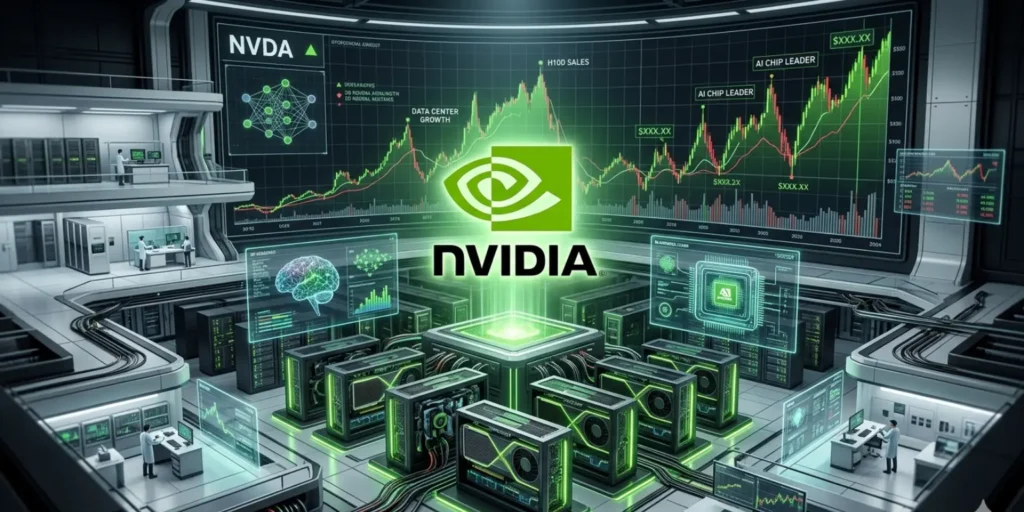
NVIDIA leads AI chip innovation in 2026 with $1 trillion in confirmed orders and next-gen platforms driving growth.
NVIDIA reports a confirmed $1 trillion in orders through 2027. These are not projections—they are actual purchase commitments. At GTC 2026, Jensen Huang unveiled:
- Vera Rubin platform
- Groq 3 LPU from the $20B Groq licensing deal
- Chip roadmap extending to 2028’s Feynman architecture
Currently, NVDA trades at $167, roughly 21x FY2027 earnings, down 21% from its October all-time high.
NVIDIA at a Glance: Key Metrics
| Metric | Value |
|---|---|
| Ticker | NVDA (NASDAQ) |
| Stock Price | ~$167 (March 2026) |
| Market Cap | ~$4.1 Trillion |
| FY2026 Revenue | $215.9B (+65% YoY) |
| Q4 FY2026 Revenue | $68.1B (+73% YoY) |
| Q1 FY2027 Guidance | $78B (vs $72.6B consensus) |
| Data Center Revenue (Q4) | $62.3B (+75% YoY, 91% of total) |
| Non-GAAP Gross Margin | 75.2% |
| Forward P/E | ~21x (FY2027E) |
| Analyst Consensus | Strong Buy (42 analysts) |
| Avg Price Target | $273 (range: $150–$380) |
| Order Backlog | $1 Trillion+ through 2027 |
Insight: NVDA trades at a forward P/E significantly lower than Apple (29x) and Microsoft (32x), despite revenue growing 65% annually.
Why NVIDIA Is Different
NVIDIA has evolved from a gaming GPU company into the backbone of AI infrastructure.
- NVDA now provides full-stack AI compute solutions: racks, software, networking, and inference-specific processors.
- The Groq acquisition emphasizes inference as the key driver, not just training.
- Dynamo software layer pairs Groq 3 LPU with Vera Rubin GPUs, delivering 35x inference throughput per megawatt versus Blackwell.
Q4 FY2026 Earnings Highlights
- Revenue: $68.1B (+73% YoY, +20% sequentially)
- Data Center: $62.3B (+75% YoY, 91% of total)
- Gaming: $3.7B (+47% YoY)
- Professional Visualization: $1.32B (+159% YoY)
- Automotive & Robotics: $604M (+6% YoY)
Margins and Cash Flow:
- Non-GAAP gross margin: 75.2%
- Free cash flow: $13.5B in Q4
- Cash and short-term investments: $37.6B
- Stock repurchase: $14.1B in Q1
Guidance: Q1 FY2027: $78B (exceeds $72.6B consensus)
Chip Roadmap: Vera Rubin, Groq 3, and Feynman
Vera Rubin (2026-2027)
- 10x reduction in inference token cost
- NVL144 rack: 8 exaflops AI performance, 100TB memory
- Samples shipping to tier-one cloud providers
Groq 3 LPU
- Volume production at Samsung, ships Q3 2026
- Optimized for ultra-low-latency token generation
- Disaggregated inference: Vera Rubin + Groq 3 = 35x throughput per megawatt
Feynman Architecture (2028)
- 3D die stacking, custom HBM memory, TSMC A16 1.6nm node
- Paired with the Rosa CPU and LP40 LPU
CUDA Moat: Widening the Lead
- 4M+ developers trained on CUDA
- Optimized for major AI frameworks (PyTorch, TensorFlow, JAX)
- Tools: cuDNN, TensorRT, NCCL, Dynamo for disaggregated inference
- Enterprise AI teams face high migration costs, ensuring customer lock-in
The Hyperscaler and Sovereign AI Boom
- Hyperscaler AI capex (2026E): ~$600B
- Amazon AWS: $100B+
- Microsoft Azure: $80B+
- Google Cloud: $75B
- Meta: $60-65B
- Sovereign AI: Nations like Saudi Arabia, UAE, India, Japan, France, and Canada invest billions in domestic AI infrastructure.
Wall Street View
- 42 analysts: consensus Strong Buy
- Average 12-month price target: $273
- Post-Q4 earnings dip of 5.5% reflects a short-term selloff, historically followed by upward momentum
Bull Case: $300+ Target
- AI infrastructure spending accelerating ($3-4T by 2030)
- Inference workloads are continuous revenue drivers
- Vera Rubin drives forced upgrades
- Enterprise software and robotics add optionality
Potential upside: $320-$350 stock price by 2027
Bear Case: $130-$160 Risk
- AMD + OpenAI partnership gains traction
- Hyperscalers building internal chips
- Valuation mirrors Cisco 2000-style bubble
- China’s export restrictions
- Power grid constraints for AI data centers
TurboQuant and the Jevons Paradox
- Google Research’s TurboQuant increases GPU throughput 8x without reducing memory requirements
- Lower inference costs lead to higher GPU demand, supporting NVDA’s dominance
Competitor Comparison
| Company | AI Revenue | Market Share | Gross Margin | Key Advantage | Risk |
|---|---|---|---|---|---|
| Nvidia (NVDA) | $194B | 86% | 75% | CUDA + full-stack | Valuation, custom chips |
| AMD (AMD) | ~$12B | 5-8% | 50% | Price/performance | ROCm maturity |
| Broadcom (AVGO) | ~$16B | 8-10% | 65% | Custom ASIC expertise | Customer concentration |
| Intel (INTC) | ~$3B | ~2% | 40% | x86 + foundry | Execution track record |
NVDA Stock Positioning Strategy
- Dollar-cost average 5-10% portfolio allocation
- Complement with AMD, Broadcom, and semiconductor ETFs (SMH, SOXX)
- Rebalance quarterly; use stop-loss at ~$145
NVDA Stock Forecast 2026
| Scenario | Year-End 2026 Target | Assumptions |
|---|---|---|
| Bull | $300-$350 | Vera Rubin accelerates growth, China eases, 35-40x P/E |
| Base | $240-$280 | 30% revenue growth, stable margins, hyperscaler spending steady |
| Bear | $130-$160 | Capex slowdown, AMD/custom silicon gains, China tensions, P/E compresses |
Conclusion: NVDA as the “Tax on AI Progress”
- AI infrastructure spending is accelerating
- $1 trillion order backlog provides unprecedented revenue visibility
- NVDA is not just a chip company; it is a toll booth on the AI highway
- Risks exist, but the market has priced many into the current 21% pullback
Investor takeaway: Dollar-cost average into NVDA, hedge with AMD and Broadcom, and hold 3-5 years to capture Vera Rubin and Feynman cycles.
About the Author