
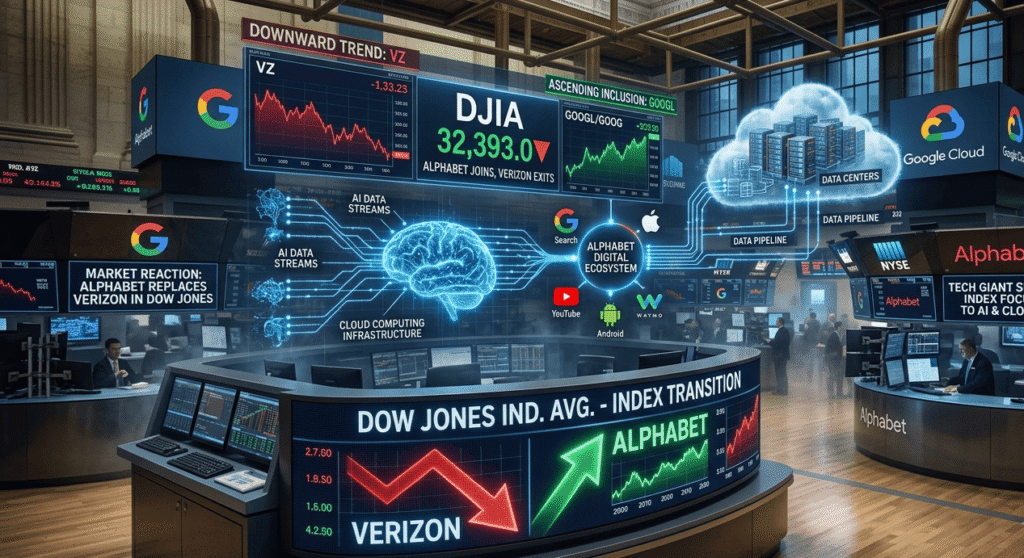
Alphabet will join the Dow Jones Industrial Average on June 29, replacing Verizon in a significant index reshuffle.
On June 29, Alphabet Inc., the parent of Google, will officially join the Dow Jones Industrial Average in a major shakeup of one of the most-watched stock indexes on earth. S&P Dow Jones Indices, which administers the world-renowned benchmark, announced that Verizon Communications will be dropped from the 30-company index as part of the revamped list. The decision underscores the expanding role of artificial intelligence, cloud computing and digital advertising in today’s economy.
The move is another major evolution for the Dow, which in recent years has pulled further toward tech-oriented companies. Although it used to consist primarily of large, industrial powerhouses, the index has gradually transformed to reflect wider trends in the U.S. economy. It also underscores how central digital platforms have become to both businesses and consumers; add Alphabet.
Market analysts see the decision as an acknowledgement of how powerful Alphabet has become on various fronts. The company became one of the most, if not the most, powerful technology companies in existence through products like Google Search, YouTube, Android, and its cloud computing division.
Verizon Exits the Dow After Years of Membership
The removal of Verizon from the index puts an end to its status since 2004 as a member of the Dow’s telecommunications duopoly. Even though this has been among the largest wireless carriers in much of the U.S. economy for decades, its strategic relevance with respect to the benchmark now seems low compared with before October 2023.
Back in the day, telecoms were a massive part of market indices due to their necessary infrastructure and consistent cash flows. But this rapid growth in cloud, AI and digital ecosystems has driven investor focus on tech names.
Verizon rakes in billions of dollars a year and is still one of the biggest providers in the nation. However, with sluggish growth in the telecom space, Alphabet looks even more enticing for inclusion in premium indices. Withdrawal does not signal weakness in Verizon’s business in the first place. Rather, it highlights how index managers regularly rebalance their portfolios to align with the industry groups powering today’s market action.
Dow Managers Aim to Reflect Modern Market Trends
Market watchers say the change seeks to give the Dow more exposure to faster-growing parts of the economy. Artificial intelligence, Cloud Computing and Digital Advertising Related Industries Have Seen Huge Growth in the Past Few Years
Theme 1: Alphabet is at the Center of Many of These Trends. The company is investing heavily in AI opportunities with its Gemini products and numerous enterprise AI services. Its cloud computing division is still going toe to toe with the giants of the industry.
The decision continues a more general modernization trend within the Dow. Index managers have moved in recent years from keeping the same old companies to opting for firms that reflect new economic power. According to financial analysts, artificial intelligence has emerged as one of the key investment themes in world markets. With the profile of Alphabet, the Dow gets more exposure to this quickly rising segment.
Recent Dow Changes Show a Shift Toward Technology
This was not the first major reconstitution of the Dow in recent years. The index took out Intel Corporation and Dow Inc from the Dow Jones Industrial Average while adding in NVIDIA Corporation and The Sherwin-Williams Company also for 2024. Then, many customers were looking at Nvidia’s inclusion as recognition of the unprecedented demand for AI chips and accelerated computing technologies. Sherwin-Williams made the cut as one of a few older businesses due to its robust business and market strength, despite being in old-school paint.
Continuing this trend with Alphabet replacing Verizon As market performance has become more concentrated among technology-related companies, their representation within some of the largest indexes has also gained increasing importance. CHANGES TO THE DOW Capture how the index has morphed over time initially as its 12 industrial companies expanded into a wider measure of the U.S. economy While the index still has a mix of manufacturers and consumer companies, it has been swamped by tech firms compared with 2002.
The Dow Remains a Prestigious Benchmark
However, despite all of the gripes over the years, Dow membership is still a high-profile trophy to have. The Dow is limited to only 30 members, whereas the S&P 500 tracks a broader benchmark of 500 companies. Many regard inclusion as blue-chip status for a company because of the relatively small size of the index. Membership can provide improved corporate visibility and potentially impact how investors feel about the company.
The Dow has been around longer than a century and is still one of the most famous stock indexes in the world. While professional investors generally pay even less attention to the Dow than they do the S&P 500, it still gets a lot of media coverage. Closing: After this plunge, Alphabet joining the Dow would be just another step in the growth path of this company. Google started as a search engine back during the late 1990s when it was only a small startup and has expanded into one of the biggest corporations on Earth, having crazy levels of influence.
Critics Say Dow Selection Process Remains Subjective
Although the Dow enjoys massive name recognition, critics have contended for decades that its process for deciding stocks is opaque. The Dow does not follow similar numerical rules for membership like many other indexes. Rather, a committee decides the inclusion of the companies based on factors like reputation, economic importance and sector representation. Changes made this way allow index managers a fair amount of room to operate.
Certain segments of the market contend that per this flexibility, the Dow is somewhat quicker to translate in the economy. Others argue that it also adds an element of subjectivity that can make inclusions seem arbitrary. There are no hard thresholds that firms must meet regarding market capitalization, profitability or revenue expansion—which is the source of controversy whenever a company gains or loses entry. Alphabet does not appear to be the exception that proves the rule.
Unique Weighting System Creates Additional Debate
The Dow is also notable for being price-weighted. Whereas the S&P 500 weighs companies by market size, the Dow weighs them by share price. What this implies is that companies with higher stock prices can have a bigger impact on index movements regardless of their overall size. In effect, the common stock of Goldman Sachs is much more expensive than most of the other Dow members and is thus able to place a meaningful weight on each passing day of the index.
Despite Alphabet’s stock price having a greater impact than the majority of index constituents, it is nevertheless a lower contributor to overall movement in an index. Investors need to understand that the structure of the Dow is vastly different from capitalization-weighted benchmarks. Opponents say that price weighting is antiquated and gives a distorted picture of the market. Its defenders argue that the methodology serves to uphold historical continuity and give its index a character of its own.
ETF Investors Will Soon Own Alphabet Shares
This is not just symbolic change. Because millions of investors own financial products that are structured to track the Dow, they will soon get exposure to Alphabet automatically. When the index composition changes, exchange-traded funds and index funds linked to the Dow must reorder their portfolios. So index funds like the widely held SPDR Dow Jones Industrial Average ETF will buy shares in Alphabet and sell Verizon stock to track the refreshed benchmark.
Investors thus could wind up owning a piece of Alphabet — without ever having purposely purchased the stock. Around an implementation date, this automatic rebalancing process can produce several trades. Index-tracking funds got billions under management, and sometimes a new addition to a big benchmark can help just briefly for newly included stocks.
What Alphabet’s Inclusion Means for the Future
The same big-picture metamorphosis is being felt in other corners of the globe. Technology companies can have an equally growing influence on economic growth, business investment and consumer behavior. AI, cloud infrastructure and digital services will still be key long-term investment themes through the end of the decade -_for years to come. With last month’s edition of Alphabet, Dow managers are implicitly accepting that reality.
It is debatable whether the move enhances the role of the Dow in gauging U.S. economic activity. A few could argue, though, that the Alphabet is the lifeblood of any business today. With the continued evolution of markets, changes to the Dow seem inevitable. For now, Alphabet’s inclusion is just the latest development in the long-running evolution of one of Wall Street’s defining benchmarks.
About the Author