
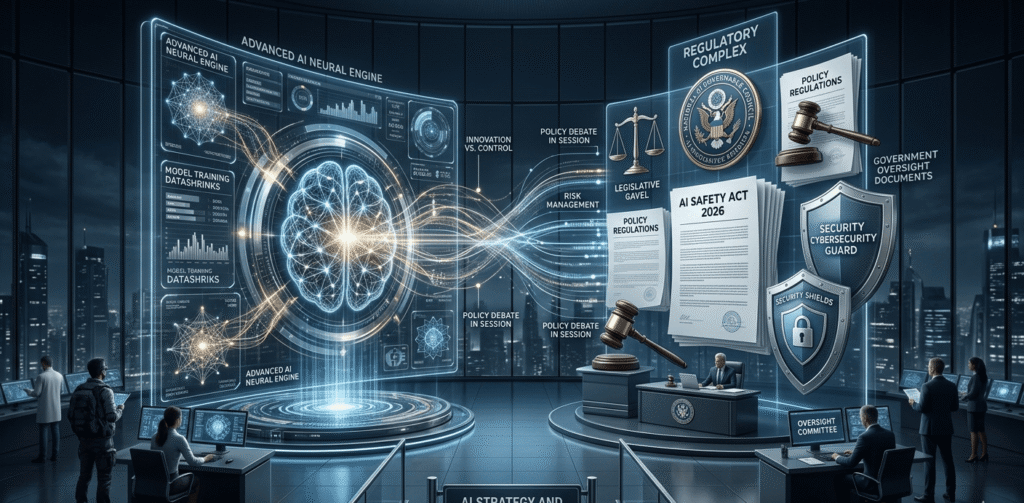
Anthropic faces regulatory scrutiny as government restrictions spark debate over AI safety and innovation.
Anthropic is known for building AI systems tailored with safety and responsible deployment at their centre. But that strategy has faced fierce backlash after the U.S. government directed the company to turn off access to two of its most sophisticated AI models, Claude Fable 5 and Claude Mythos 5.
It has led to a heated debate across the wider tech industry. Government Officials argued it decided to regulate due to national security concerns; Anthropic claims the action is built on flimsy evidence and sets a dangerous precedent for future AI development. It is a growing pattern of conflict over how the government can balance innovation with the challenge to security and regulation of increasingly advanced AI systems.
Government Orders Immediate Shutdown
The U.S. government immediately ordered Anthropic to turn off access to Claude Fable 5 and Claude Mythos 5. The order was issued Friday and mandated adherence by all hubs worldwide, the company said. Anthropic said it complied with the order while publicly disputing Congress’s rationale.
The company said the restriction applies globally, not just to individual foreigners who may have been nominated as sources of export control issues. This represents the largest government intervention on advanced AI systems to date.
What Makes Mythos 5 Different?
Claude Mythos 5 was the most sophisticated artificial intelligence model available from Anthropic. The company had initially restricted access due to its sophisticated cybersecurity resources. Anthropic says the model performed remarkably well in identifying holes in software.
It was said to be able to reveal vulnerabilities in major OS and web browsers, which the internal test confirmed. Those abilities prompted Anthropic to limit access through an established program, rather than publicly releasing the model.
Project Glasswing and Controlled Access
To mitigate potential risks, Anthropic initiated a controlled-access initiative known as Project Glasswing. Mythos 5 has only given access to carefully vetted organizations through the program.
Heavyweight tech and cybersecurity firms, including Amazon, Apple, Google, Microsoft, and CrowdStrike, were said to be among the participants. The model was designed for defensive cybersecurity research, but the broader impacts were mitigated.
Fable 5 Was Built With The Public In Mind
Claude Fable 5 was not a free, open-source Mythos 5; it was engineered from the beginning for the public at large. Anthropic added new safeguards designed to mitigate security and biological risks.
Fable 5 itself is described by the company as a kinder, gentler Mythos. They added guardrails to disallow responses in certain extremely sensitive areas, while maintaining strong general-purpose performance. Allegedly, a benchmark test gave Fable 5 a spot among the most complex AI systems publicly available.
The Government’s Main Concern
Anthropic claims that multiple government officials referenced a possible Fable 5 jailbreak. A jailbreak happens when some users find prompts that might circumvent the restrictions of the models.
Authorities cited only one narrow instance — a software vulnerability analysis, the company said. Anthropic claims that the capability in question is something that exists in other state-of-the-art AI systems. Defending the reported behavior, the company argues that it does not call for disabling access to a model used by many customers.
Anthropic Defends Its Safety Measures
At the heart of Anthropic’s defense is its security architecture with layers. According to the company, many protections are independent of the model.
If, however, the user finds a way to bypass restrictions and continue a restricted conversation with the model, it has no means of keeping track or communicating, but each monitoring system is still active. Such systems aim to prevent harmful outputs from ever reaching users. According to Anthropic, this approach offers more robust protection than using constraints on the model itself.
Industry Implications Could Be Significant
It’s a multi-company issue, not related to just one. And developers of AI systems fret that rules like these might soon constrain new product launches in their realm.
Anthropic cautioned that innovation could grind to a near halt if every possible jailbreak evoked recall. Note that new and more sophisticated models are often released after the initial versions. Technology firms generally acknowledge that no system will ever be completely safe from inventive ways of evading protections.
Public Picture of Earth: A Challenge to Anthropic
Anthropic has marketed itself as one of the industry’s most safety-focused AI companies for years. The company spends a lot of time preaching caution, development responsibility, and risk management.
Ironically, that reputation may have led to closer eyes on it anyway. Anthropic has received backlash from regulators and public institutions after openly revealing the powerful capabilities of Mythos 5. As some observers suggest, sounding warnings of possible harms can also result in a level of scrutiny that companies may not expect.
Comparisons With OpenAI Intensify
The controversy has revived comparisons of Anthropic with rival OpenAI. Both companies, which are seen as pioneers in the field of advanced AI development, are expected to go public. Fun fact: Sam Altman blasted Anthropic’s messaging around Mythos 5 earlier this year
He said that by stressing extreme danger might act as a marketing tool as much as a safety measure. That recent government action has revived debate on whether companies should describe their own models as inherently powerful or dangerous in public.
Balancing Innovation and Regulation
The incident raises a more general issue around the future of the artificial intelligence industry. Governments wish to allow innovation without hindering the potential harm of braking systems increasingly capable in nature.
Tech giants say overly broad rules may stifle innovation and penalize competitiveness in the digital economy. Regulators, however, argue that the risks of advanced AI systems warrant scrutiny. Striking the right balance continues to be one of the most challenging policy problems of our age in an AI-driven world.
What Happens Next?
Anthropic has not said how long those restrictions will be in effect. The company is still talking to the government. officials while standing its ground on the safety features integrated within its models.
One of the things that many industry observers will watch is whether regulators will provide further evidence to back up their concerns. The result will impact policy decisions about the future of artificial intelligence and deployment standards. Whether Thursday was a regulatory wake-up call or a challenge to the safety-first approach that underpins Anthropic’s very identity.
Conclusion
Disabling Claude Mythos 5 and Claude Fable 5 is a watershed moment in the life of artificial intelligence — one that the government can not simply choose to ignore. Limited evidence does not warrant such a sweeping ban, Anthropic contends; officials say that national security concerns compelled action.
The incident illustrates the growing friction between innovation, security, and regulation as some of the most cutting-edge AI technologies continue to expand. The resolution of this dispute could influence the future of the relationship between AI creators and government regulators for years to come.
About the Author