
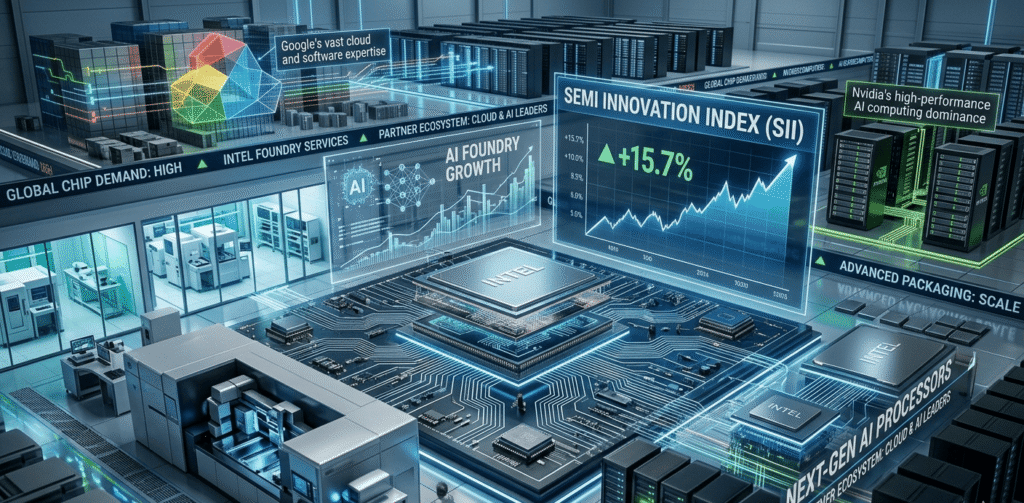
Investor optimism rises as Intel’s foundry business attracts reported interest from Google and Nvidia.
At last, Intel’s foundry business appears to be getting the outside validation it has long sought. According to the reports. Google will leverage Intel for a few million of its custom silicon AI chips, and now Nvidia is also exploring other uses (for obvious reasons).In this case, it’s testing out some of Intel’s new 18A process nodes for a next-gen graphics product. Neither company has confirmed the reports, but investors responded positively. The news pushed Intel shares up 6.5%, as investors were optimistic the company was getting back on track after a recent downturn in its fortunes.
Intel has been pouring money for several years into a contract-manufacturing business that it hopes can be an alternative to industry leader TSMC. The idea of landing big external customers is core to that vision. The disclosure of Google and Nvidia will create a paradigm shift. As a result, investors are beginning to see Intel Foundry as being positioned to be a long-term player for advanced semiconductor manufacturing.
This makes timing relevant against the backdrop of artificial intelligence sustaining demand for yet more advanced chips. The firms creating AI hardware are seeking out manufacturers capable of producing high-end technology. Intel’s path back to glory, however, is reliant on big AI customers — and it could potentially change its whole status in semiconductors. This prospect has exhibited the strongest linkage behind the recent equity rally.
Google’s Reported AI Chip Order Could Be Significant
Industry reports mention that Google will begin manufacturing tensor processing units via Intel next year, and one of the names being thrown around is that it would be through Intel to manufacture more than three million processors as per sources for 2028. These custom chips are the cores of many of the artificial intelligence services and cloud platforms offered by Google. A single order of this size would be a major showing of faith in Intel’s manufacturing prowess. It would also signal faith in Intel’s advanced packaging and manufacturing technologies.
According to reports, Google arrived at this conclusion after extensive tests using Intel’s various packaging options. As AI chips are getting more sophisticated, advanced packaging is becoming much more important. Companies need to be able to quickly make connections between different chiplets in one system. Under its foundry strategy, Intel has made a big bet in this area.
The order is unconfirmed, but the sheer size has caught investors’ attention. Such a sizable commitment would secure Intel with a significant source of future foundry revenue. This could be important as it might persuade some of the other purchasers to give Intel a look for next-generation manufacturing projects. The possible strategic consequences go beyond the revenue opportunity.
NVIDIA’s Interest Provides Additional Validation
NVIDIA has been said to be more in the earlier stages of doing what Google is ramping up on. The AI chip heavyweight is reportedly considering Intel’s 18A manufacturing process and EMIB packaging technology. The project is purportedly for a next-generation GPU that integrates multiple chip parts in one package. For now, Nvidia isn’t committing to production.
Even without an official contract, Nvidia’s score is hugely symbolic. The firm has become recognised as the best of breed in AI hardware. The fact that it is willing to test Intel at its own manufacturing technology indicates increasing confidence in Intel. This is an important sign of technical progress that market participants are looking at.
How Nvidia sees this can make or break Intel Foundry in the spotlight. Most semiconductor operators highly scrutinise the moves of giant tech firms. If Nvidia eventually uses it, Intel will greatly enhance its credibility. For the time being, investors are taking the valuation itself as a step in the right direction.
Why External Customers Matter So Much
The challenge for Intel Foundry has never been just technology. For years, the company has been making chips mostly for its own use. For much of its time, the potential customers wanted proof that Intel could honestly make chips designed by outside companies. Thus, securing large external clients has been key to being able to build trust.
This is precisely the type of customer Intel needs, which is represented by Google and Nvidia. Both companies are at the bleeding edge of AI and high-end computing. How they make decisions impacts the perception of manufacturing partners in the larger technology industry. Securing their business would be a strong validation of Intel’s foundry platform.
Such validation also has the potential for prolonged customer acquisition. Intel would get more customer chips to build on its foundry if other chip designers start feeling more comfortable treating Intel as a manufacturing option. The foundry division would look much better if it had a healthier customer pipeline. It boosts the possibility, which also helps explain the excitement seen around recent reports.
Intel’s Financial Performance Supports Optimism
Recent quarterly results from Intel added some more fuel to the bullish case. The company had announced revenue of $13.6 billion, above its guidance at the time. Management also stated that AI-related products accounted for around 60% of sales. Intel continues to see growing plays for AI-focused solutions, which is evident as demand from the segment makes up a larger chunk of Intel’s business.
In its Data Centre and AI segment, revenue for the quarter was $5.1 billion. It was 22% year-over-year growth and generated operating income of $1.5 billion. The segment remains among Intel’s most profitable units. The pipeline of dollars spent on AI infrastructure is growing and partly mitigating challenges elsewhere.
Management provided current-quarter revenue guidance in the range of $13.8 billion to $14.8 billion. This announcement suggested investors one more positive indicator of stability. The more robust operating performance helped bolster confidence in Intel’s wider turnaround plans. But there are major problems within the foundry division itself.
Foundry Losses Remain a Key Concern
So there was some encouraging news, but Intel Foundry remains in a deep hole of losses. The division reported revenues of $5.4 billion but reported an operating loss of around $2.4 billion. Profits remain just out of reach, but losses have narrowed from previous reporting periods. Investors continue monitoring progress closely.
Semiconductor foundries at the cutting edge of manufacturing, such as Intel or TSMC, typically require massive amounts of capital investment in order to build. Intel has invested heavily in manufacturing facilities, equipment and process development. These investments are a drag on the financial results in the short run. It will have to show — eventually, but not immediately — that such spending can be justified by outside customer demand.
Management has pointed to upgrading yields for its 18A manufacturing tech. Higher yields are necessary since they directly influence productivity and efficiency, which translates into profits. It increases the chances of winning future customers as you execute well on the tech side. It also lends credence to figures in partnerships reported and which might yet materialise.
The Stock Appears to Reflect High Expectations
Intel shares since the rally that has taken them well above the price target of numerous analysts. It’s notable that the stock finished at $124.57, with consensus forecasts well behind it. That implies investors are pricing in a lot of progress already from the foundry business. The growth in expectations has occurred much more rapidly than that confirmed by actual results.
The optimism of the market is also reflected in valuation metrics. Intel has traded the premium to value in terms of earnings that the company is going to make between now and then. Investors seem ready to look past a lot of the current challenges in profitability for long-term growth. This has created a double-edged sword for shareholders.
In other words, if reported customer relationships are eventually converted into official contracts, current valuations may not be so outrageous after all. But if expected deals do not materialise, the stock could later come under pressure. The recent excitement is much based on developments yet to be confirmed. Investors have to deal with this uncertainty.
Key Scenarios Investors Are Watching
The most bullish of those scenarios is that Google confirms the Nvidia order, and then here comes some future commitment from them. Such a result would allow Intel to compete with TSMC in advanced manufacturing. That would probably lead analysts to start reflecting some real foundry revenue into their longer-term estimates. Further progress like that could help the stock gain momentum.
A more moderate result would see Google move forward with its project while Nvidia continues to assess the technology from Intel. That will see foundry losses trimmed gradually, but profitability would remain several years off. If customer momentum kept getting better, investors would likely be patient too. The stock can hover without more proof points.
Bearish scenario: They miss on delays and cancellations or weaker customer uptake. If deals that are reported stay unfulfilled and technical progress slows down, investor excitement could evaporate. A distance between current valuations and analyst targets would be harder to explain. In this situation, stocks may take a serious hit to the downside.
Intel Faces a Critical Period Ahead
Intel will next report earnings on July 28, when investors could use some more clarity. Expect management to relay foundry updates, manufacturing yields and customer interest. Additional details around possible external partnerships, therefore, could be a key determinant for market sentiment. The company continues to be pressured to turn expectations into results.
That the overall investment thesis rests solely on Intel becoming a successful contract manufacturer is becoming more and more of an issue. The demand for AI has created opportunities for alternative semiconductor production partners. Intel is working to cast itself as a prime beneficiary of this trend. That success would reconstruct the company’s model and its competitiveness.
In the meantime, investors are treating more recent reports as proof that Intel’s foundry strategy is gaining steam. It seems like the company is closer than ever to having significant third-party customers on board. Nevertheless, confirmation is still thin on the ground, and material revenue remains years away. Whether that optimism will translate into long-term business success will be known during the coming quarters.
About the Author