
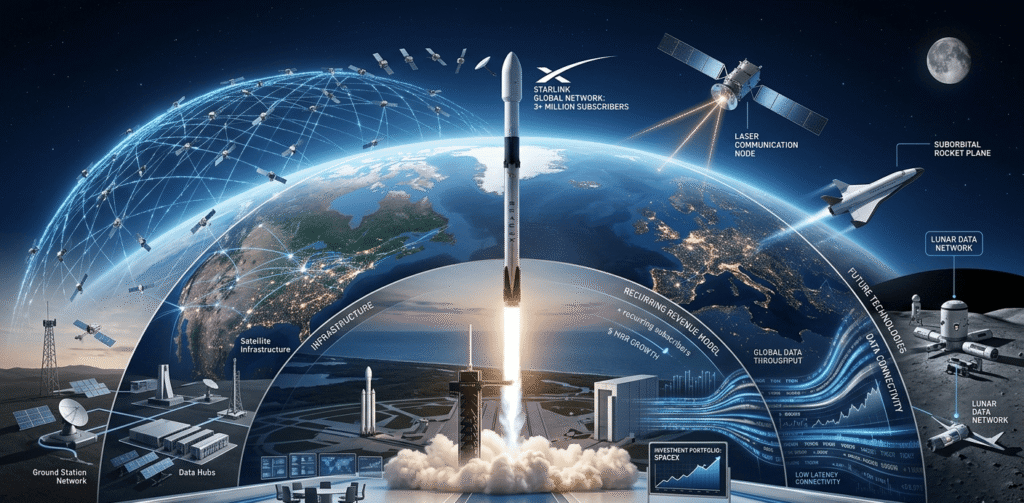
SpaceX's long-term value may be driven by its infrastructure ecosystem rather than launch services alone.
As one of the most hyped IPOs in history, SpaceX will be watched by all financial markets alike. The bulk of those talks centers around rockets, satellites, AI, and founder Elon Musk. Those themes are significant, but may not be the most helpful framework for analyzing the company in public markets. Better yet is thinking of SpaceX as a stack of layered infrastructure instead of an aero company. Businesses that earn this type of revenue, prove to be consistent in operations, and are visible through their reporting are being regarded by investors more highly than ever.
When that happens, the long-term investment case may hinge much less on specific launches and more on whether SpaceX can demonstrate its infrastructure ecosystem is effectively integrated. The most difficult problem for investors will be to ascertain how much of the company’s value lies in its present business and how much in future options that, for the time being, remain largely untested.
Common Mistakes with Traditional IPO Narratives
Most IPO tales reduce companies to easily understood buckets. Many people either refer to SpaceX as a rocket company or one that enables AI. Both descriptions only tell part of the story.
Since successful launches get a lot of news, the launch business stays front and center. On the other hand, milestone events are less more often than not compensated with repeat revenue and forecastable cash generation.
Public markets tend to prefer companies that exhibit steady operating performance across time. This means that one cannot only judge SpaceX based on a metric like the number of rockets launched.
Understanding the Infrastructure Stack
A more robust investment thesis sees SpaceX as a multi-tiered infrastructure stack. Every layer is treated differently in the overall valuation and risk profile of the company.
At its core is the satellite connectivity business, which is based on SpaceX’s Starlink service. It can also become a layer that attracts subscriptions and commercial contracts of recurring revenue.
Above that is on top of the launch infrastructure and moving into the development, more towards Starship. This could extend into future layers of artificial intelligence, data infrastructure, government contracts, and commercial services on top of the existing network.
Base Layer: An Essential Building Block
Whatever the use — every infrastructure business requires a solid foundation. For SpaceX, that base is probably Starlink rather than rocket launches.
Investors will want a closer look at customer growth, service reliability, retention rates and revenue quality. This is a more representative metric for sustainable business performance than an isolated launch milestone
Should Starlink continue to show strong adoption and recurring cash flows, it may become less risky for investors to start valuing future opportunities still technically in development.
Why Recurring Revenue Matters
This makes recurring revenue streams more predictable, which is why public markets typically award them larger market capitalizations. Here’s why Subscription-based businesses can offer a clear view between the lines about future revenue and cash generation.
The continued growth of Starlink’s customer base enables SpaceX to create this structure of recurring economics. User growth, average revenue per customer (ARPC), and service margins will likely be of interest to investors.
The potential for a substantial recurring revenue engine helps temper concerns about the wild swings that can arise in such large-scale aerospace development programs.
Starship Represents the Cadence Layer
Starship is the next necessary level in our valuation system, while Starlink might be the foundation. This program could greatly increase the capabilities of SpaceX, allowing them to enter more markets.
Investors probably won’t look at any single launch and just focus on that. They will focus on evidence of operational repeatability and consistent execution over the multi-quarter horizon. A consistent launch cadence can be a stronger belief booster in management’s commitment to scaling up infrastructure while trimming down on costs versus design goals.
The Role of Artificial Intelligence
Artificial intelligence may be one of the most popular topics in technology investing. Some businesses thrive on AI-related hype, but markets are becoming more isolationist.
At SpaceX, AI becomes relevant only when it provides greater operational efficiencies, opens up new commercial avenues, or creates other revenue streams. Investors will want proof of AI investments directly supporting business performance.
Unless actors can tell clear commercialization paths, AI narratives might stay speculative rather than a value-driving component of the investment thesis.
Governance Will Shape Investor Confidence
Governance is a key determinant of how public investors understand risk. Most valuation multiples are influenced by transparency, accountability and quality of disclosure.
Once public, registration filings, financial disclosures and reporting practices will be scrutinized by investors. Good governance increases confidence around long-term execution.
Due to the complexity of operations at SpaceX, clear communication about capital allocation, strategic priorities and project timelines will be particularly critical.
Watch For Capital Allocations
Infrastructure businesses have high capital intensity (often). Public shareholders will need to see how management is spending across these initiatives.
Most investors tend to prefer more disciplined approaches that focus on projects with observable returns. This is especially important for companies that operate in both mature and experimental markets.
SpaceX will continue to be barraged with questions about the allocation of its resources between Starlink expansion, Starship development, artificial intelligence projects and other long-term goals.
Measuring the First Six Months
Investor perceptions generally set in during the first few months after an IPO and linger for years. The early half of 2023 could be a key assessment time for SpaceX. Reporting consistency, transparency into the operating model and evidence that different pieces of the business are working along a single strategy will be what the markets pay attention to.
Consistency in messaging or unexpected disclosures can also add an element of uncertainty. If this is performed strongly during the period, it should help reinforce the view that SpaceX is worth somewhere in legit growing infrastructure platform space rather than speculative growth story.
The Bull Case for Infrastructure Repricing
In the optimistic case all key pillars of the business gel effectively. While Starlink expands, and a less-than-expected speed for Starship proceeds, new technologies create the right measurement of worth.
In this climate, SpaceX may be starting to feel more like your ever-important purveyor of other cutting-edge infrastructure. They can probably get a premium multiple for recurring revenue and long-term growth in profits as a top echelon company. If SpaceX succeeded across business units, this strengthens the case for SpaceX as a new era infrastructure company.
The Risk of Valuation Fragmentation
This carries out a risk primarily that one of the operating layers for the company would start to diverge. Conversely, if anything else pushes development projects off schedule but recurring revenue remains resilient, investors may reset their growth expectations.
In like manner, enthusiasm to success can be undermined if reporting is not regular or working activity frail. When expectations and execution diverge, public markets are typically quick to react. This risk highlights the importance of alignment between business fundamentals, strategic vision and investor messaging.
Conclusion
Treat the SpaceX IPO as less a traditional aerospace one. Instead of thinking only in terms of rockets or intelligent machines, they should be looking at the company more as a multi-layered infrastructure. Whether recurring Starlink economics, starship execution and future tech initiatives function together as a cohesive and drillable system is what will determine the long-term investment case.
SpaceX could command a large, infrastructure-supported valuation premium if it can prove up reproducibility, transparency and capital discipline. Until that proof comes, investors will keep pushing price to see if the ambitions of the company can result in sustainable Public-Market performance.
About the Author