
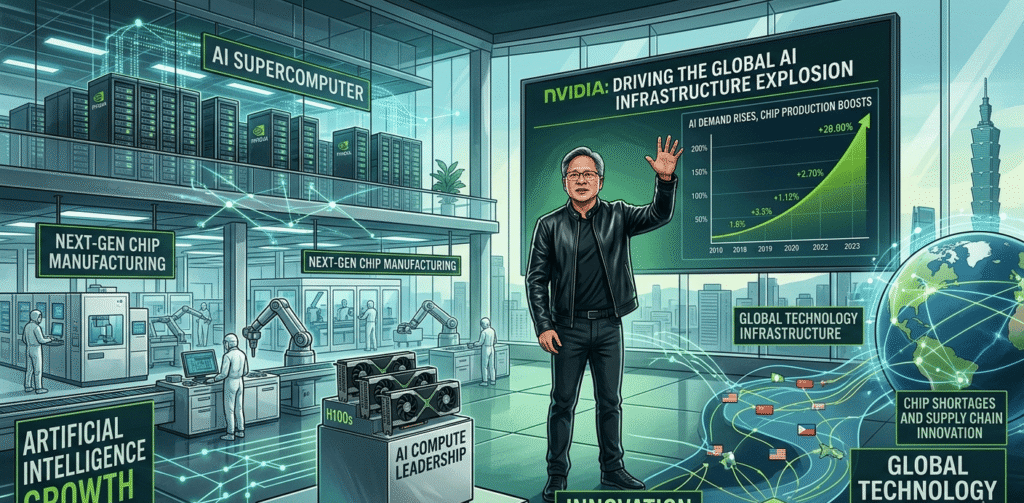
Nvidia CEO Jensen Huang says AI demand remains extremely strong as the company continues managing supply constraints across global markets.
Global financial markets closely monitored comments from Jensen Huang as he addressed industry leaders in Taipei on Tuesday. The NVIDIA chief emphasized that demand for artificial intelligence infrastructure remains exceptionally strong across global markets. While the company has expanded production significantly, Huang acknowledged that supply constraints continue affecting the semiconductor giant’s ability to meet customer demand fully.
His remarks came at a time when artificial intelligence investment remains one of the most important themes driving global technology markets. NVIDIA has become the dominant supplier of advanced AI processors used by cloud providers, enterprises, governments, and research institutions worldwide. Investors often view NVIDIA as a key indicator of the broader health and growth trajectory of the artificial intelligence sector.
Huang’s message was both optimistic and cautious. He stated that NVIDIA possesses enough manufacturing capacity to support “very, very robust growth” in the coming years. However, he also acknowledged that demand continues outpacing available supply, highlighting the extraordinary pace at which artificial intelligence adoption is expanding globally.
NVIDIA maintains leadership in the AI revolution
NVIDIA currently stands at the center of the artificial intelligence boom. Its graphics processing units have become the preferred hardware for training and operating advanced AI models. Technology companies, cloud providers, financial institutions, healthcare organizations, and governments increasingly rely on NVIDIA’s products to support growing AI workloads.
The company’s market valuation recently surpassed five trillion dollars, reflecting investor confidence in its dominant position within the AI ecosystem. This remarkable growth has transformed NVIDIA from a gaming-focused chip manufacturer into one of the world’s most influential technology companies.
Demand for NVIDIA hardware remains driven by several factors. Businesses continue deploying generative AI applications, cloud providers are expanding AI infrastructure, and governments are investing heavily in sovereign AI initiatives. These developments create persistent demand for advanced computing capabilities, ensuring that NVIDIA remains central to future technological progress.
New chip launch intensifies competition
During the conference, NVIDIA also highlighted a newly introduced processor designed to compete more aggressively against rivals. The launch demonstrates the company’s commitment to maintaining technological leadership despite growing competition from established semiconductor firms.
Major competitors include Advanced Micro Devices and Intel, both of which continue investing heavily in artificial intelligence hardware development. These companies aim to capture a larger share of the rapidly expanding AI infrastructure market.
Competition within the semiconductor industry continues to intensify because artificial intelligence represents one of the most lucrative growth opportunities in technology today. While NVIDIA currently maintains a significant lead, rivals are introducing new products and expanding manufacturing capabilities to challenge the company’s dominance in key market segments.
Asian chipmakers benefit from sustained demand
NVIDIA’s comments regarding supply constraints carry important implications for semiconductor manufacturers across Asia. Many of the company’s key suppliers operate within Taiwan, South Korea, Japan, and other regional technology hubs. Continued shortages indicate that demand remains strong throughout the entire semiconductor supply chain.
Manufacturers responsible for producing advanced chips, packaging technologies, and critical components continue operating at elevated production levels. Strong orders from NVIDIA and other AI-focused companies support revenue growth across numerous segments of the semiconductor industry.
Taiwan remains particularly important because many advanced NVIDIA chips are produced through partnerships with Taiwan Semiconductor Manufacturing Company. As artificial intelligence demand grows, companies throughout the region are expected to benefit from increased investment and production activity.
Geopolitical concerns weigh on market sentiment
Despite positive developments within the technology sector, broader market sentiment remained cautious throughout Asia. Investors continued monitoring geopolitical developments in the Middle East, particularly concerns regarding the durability of the ceasefire between the United States and Iran.
Financial markets have become increasingly sensitive to developments involving regional conflicts because they influence energy prices, inflation expectations, and global economic stability. Even positive corporate news often struggles to fully offset concerns regarding geopolitical uncertainty.
The fragile ceasefire remains under close observation because previous diplomatic efforts have experienced setbacks. Investors remain cautious about potential escalations that could affect global trade, commodity markets, and economic growth prospects. This uncertainty contributed to mixed performance across Asian equity markets despite strong technology sector fundamentals.
Asian stock markets experience volatile trading
Regional equity markets experienced significant fluctuations during Tuesday trading. The MSCI Asia-Pacific Index excluding Japan declined slightly as investors balanced optimism regarding artificial intelligence growth against geopolitical risks.
South Korean markets experienced some of the most dramatic movements during the session. The benchmark KOSPI initially surged to a record intraday high before reversing sharply and posting substantial losses. This volatility reflected changing investor sentiment throughout the trading day.
Meanwhile, stock markets in Hong Kong and mainland China demonstrated greater stability. Investors in those markets appeared somewhat less affected by geopolitical developments, helping support broader regional benchmarks. However, caution remained evident as traders continued evaluating potential risks and opportunities.
Oil prices retreat as tensions ease slightly
Energy markets provided another important signal regarding investor sentiment. Oil prices declined modestly as some concerns surrounding Middle Eastern tensions eased. Brent crude fell approximately 0.7 percent, retracing part of its recent gains.
The decline followed reports suggesting limited progress toward reducing regional conflict risks. Lebanon announced a partial ceasefire involving Hezbollah and Israel, contributing to hopes that broader tensions might gradually ease. Lower oil prices generally support economic growth because they reduce costs for businesses and consumers.
However, uncertainty remains elevated. Reports of intercepted projectiles and ongoing diplomatic challenges remind investors that regional stability remains fragile. Consequently, energy markets continue reacting rapidly to geopolitical developments and diplomatic announcements.
European markets begin trading with cautious optimism
While Asian markets struggled to establish clear direction, European futures pointed toward a more positive start. Early trading indicators suggested moderate gains across major European benchmarks.
Pan-European futures rose modestly, while futures linked to Germany’s DAX and Britain’s FTSE 100 also moved higher. Investors appeared encouraged by resilient economic data and ongoing enthusiasm surrounding artificial intelligence investment themes.
European markets continue benefiting from strong technology demand, improving corporate earnings, and expectations that central banks may gradually reduce interest rates. These factors help offset concerns regarding geopolitical uncertainty and global economic risks.
Andrew Left verdict impacts financial industry
Another significant development attracting investor attention involved prominent short seller Andrew Left. A United States jury found Left guilty of securities fraud, according to the Department of Justice.
The verdict represents a major event within the investment community because short sellers have long played a controversial role in financial markets. Supporters argue that they help expose fraud and corporate misconduct, while critics claim they sometimes manipulate markets and damage legitimate businesses.
The case could have broader implications for activist investors and short-selling firms worldwide. Regulatory authorities may increase scrutiny of trading practices, public statements, and market activities involving influential investors. Financial professionals will closely monitor any further developments resulting from the verdict.
Investors remain focused on AI and global risks
The latest market activity illustrates the competing forces currently shaping global financial markets. On one side, artificial intelligence continues driving extraordinary investment, innovation, and corporate growth opportunities. NVIDIA remains a central beneficiary of these trends, supported by persistent demand for advanced computing infrastructure.
On the other side, geopolitical tensions, energy market volatility, and broader economic uncertainties continue influencing investor behavior. These factors create short-term market fluctuations even when long-term growth prospects remain strong.
For now, NVIDIA’s message reflects the broader state of the artificial intelligence industry. Demand remains exceptionally robust, investment continues accelerating, and opportunities appear substantial. Yet supply constraints, geopolitical risks, and competitive pressures ensure that investors will continue monitoring developments closely as the AI revolution enters its next stage of growth.
About the Author