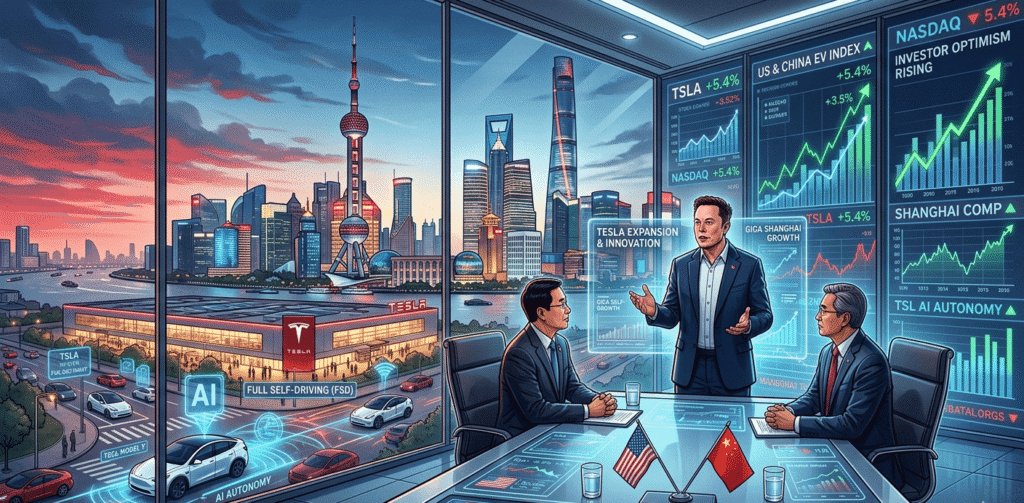
A futuristic Tesla-themed illustration featuring Elon Musk, Tesla vehicles, Shanghai Gigafactory, and U.S.-China diplomacy visuals.
Tesla stock is no longer trading only on robotaxis, Optimus, quarterly deliveries, or the next artificial intelligence presentation. Investor attention has turned to geopolitics, as Elon Musk is accompanying President Trump on the trip to China and potentially could help ease the political discount that Tesla has taken on China investment.
On May 13, 2026, TSLA advanced 2.73% to end at $445.27 in regular trading hours with an upside advance in the pre-market session on May 14. The market’s response suggests greater confidence that improved U.S.-China ties could bolster Tesla’s competitive position in one of the world’s key electric vehicle markets.
The Beijing visit is more than a photo-op or a headline; it is a pivotal moment for the future of European and Chinese–Islamic relations. Now investors are wondering if China can be a “valuation premium” for Tesla again or if the country will become a geopolitical risk.
Why the China Meeting Matters for Tesla Stock
The China trip is important because Tesla’s business is deeply tied to the Chinese economy in multiple ways. China is not simply another market for vehicle sales. It is one of Tesla’s largest production sites, a major export base and probably one of the biggest opportunities for long-term growth of Full Self-Driving software. That translates to changes as small as diplomatic relations having an impact on investor expectations of manufacturing stability, software approvals, trade policy, and local demand.
Over 13 top executives from business and industry, including from semiconductor, manufacturing, finance and technology firms, confirmed their attendance with Trump in Beijing. Musk’s inclusion was immediately noticed, as the future of Tesla will rely on its ability to keep cars in China, while facing growing competition from local EV rivals.
A market-specific agreement doesn’t have to be exclusively targeted at Tesla to have a positive impact. Investors simply need signs that China remains willing to cooperate with large American technology and manufacturing companies despite ongoing tensions between the two countries. That possibility alone can temporarily improve sentiment around Tesla’s China exposure.
Shanghai Remains One of Tesla’s Most Important Assets
One of Tesla’s biggest operational assets in China is its Shanghai Gigafactory. It has now been transformed into a massive production facility that can produce more than 950,000 Model 3 and Model Y vehicles per year. It also forms a critical part of Tesla’s exported vehicle plans, churning out cars for places beyond China’s borders, and with its Shanghai Megafactory project supporting the company’s energy storage plans.
This is why China matters differently for Tesla compared to many other American companies. Tesla is not simply exporting products into China. It is deeply embedded in China’s industrial ecosystem. If trade tensions ease even slightly, Tesla benefits in several ways simultaneously. The cost of manufacturing becomes more predictable, export logistics are easier, and investors will feel more comfortable valuing Tesla’s China operations on a higher multiple. Tesla’s Shanghai location also provides an advantage in scale over other competitors, which is still not as readily translated to other markets.
China Demand Remains a Challenge
Although Shanghai production is vital, Tesla has had trouble in the car market in China in recent months. Recent retail sales figures revealed that Tesla China sold 25,956 cars in April 2026, a year-on-year decrease and a significant drop from the previous month. Meanwhile, sales of the Shanghai-built car continued to be very strong, reflecting a division between the export success of the car and its more mixed domestic performance.
It’s an important distinction for investors. Tesla’s business in China proves it is a very valuable manufacturing platform. But the domestic sales decline reveals the increased competition in the Chinese EV market. Domestic manufacturers such as BYD, Xiaomi, Li Auto, Nio, and XPeng are still making rapid strides, offering competitive pricing and advanced driver-assistance features, as well as robust local brands. That implies more than just a political will to do so. Tesla must do a good job on technology, software, financing, charging infrastructure and customer service.
The Real Opportunity Is Full Self-Driving
The most important part of Tesla’s China story is no longer vehicle pricing. It is software. Investors increasingly view China as a crucial test for whether Tesla can expand its Full Self-Driving ecosystem outside the United States. Regulatory approval for FSD in China would create a much cleaner long-term narrative around Tesla’s AI and autonomy strategy.
Tesla has already stated that progress continues regarding FSD approval discussions in China. If those efforts accelerate after the Beijing meetings, investors may begin assigning greater value to Tesla’s software business rather than focusing primarily on automotive margins. This matters because software economics are fundamentally different from vehicle manufacturing economics.
Vehicle price cuts can temporarily support demand, but they rarely create sustainable valuation expansion. Software subscriptions, autonomous driving features, and AI-driven recurring revenue streams are far more powerful from a long-term market perspective. That is why the market reaction to the China summit is tied less to car sales and more to the possibility that regulatory pathways for FSD become clearer.
Tesla’s Financial Position Gives It Flexibility
Another reason why the market reacts so differently to geopolitical news than other smaller EV companies is because of Tesla’s strong balance sheet. During the company’s last quarterly update, it reported cash and short-term investments of more than $44 billion. The robust cash position will allow Tesla to invest in artificial intelligence infrastructure, expansion plans, robotics, and energy solutions, despite the immediate challenges it faces.
Unlike weaker EV startups, Tesla does not face immediate survival concerns tied to policy changes or temporary demand fluctuations. The bigger issue is valuation. Tesla’s stock price already reflects expectations that the company will evolve far beyond a traditional carmaker. Investors are paying for future businesses tied to AI, autonomy, robotics, and energy infrastructure. China plays a major role in whether those expectations appear realistic.
The TSLA Multiple Depends on China Optionality
At current levels, Tesla stock still trades as a premium growth and AI platform company rather than a conventional automaker. That premium becomes harder to defend if China is viewed mainly as a political risk or a slowing demand market. However, if investors begin treating China as a software and autonomy opportunity again, Tesla’s valuation can expand further. This is why the Beijing trip matters psychologically.
The summit does not need to deliver a direct Tesla agreement to influence market sentiment. It simply needs to reduce the perception that Tesla’s China operations face escalating hostility or regulatory uncertainty. If investors believe China’s risk is stabilizing while Tesla simultaneously advances AI and FSD ambitions, the stock can justify another upward rerating.
Three Signals Investors Should Watch
The next phase for Tesla stock depends on actual developments rather than diplomatic theater alone. The first signal is trade policy. Investors will closely monitor whether the Trump-Xi meetings produce tariff discussions or manufacturing agreements that improve conditions for multinational industrial companies.
The second signal is regulatory progress around FSD approval in China. Concrete updates involving testing permissions, mapping access, or software deployment would matter far more than symbolic political statements. The third signal is weekly data on China deliveries and insurance registrations. Stronger domestic demand trends would support the argument that Tesla can stabilize its market position even as local competition intensifies. Without improvement in at least one of these areas, the recent rally could lose momentum.
The Bull, Base, and Bear Cases for Tesla
The bullish case is relatively straightforward. If the China summit improves trade sentiment, accelerates FSD progress, and supports stronger demand expectations, Tesla could retest the upper end of its 52-week range near $500. The base case is more balanced. Tesla may hold onto a temporary “China meeting premium” while investors wait for concrete policy or regulatory evidence. In that scenario, the stock remains supported by optimism but limited by already-high expectations.
The bearish case is equally clear. If the summit produces headlines but no meaningful changes tied to tariffs, software approvals, or demand trends, Tesla could surrender part of its recent gains. The market may then refocus on slowing China retail sales and the reality that Tesla’s valuation still assumes significant future profit growth from businesses that remain under development.
Conclusion
Tesla stock currently trades on the possibility that China policy risk is easing at the same time the company is trying to expand its AI, autonomy, and software ecosystem globally. That possibility is meaningful because China touches nearly every major part of Tesla’s business model, including manufacturing, exports, energy storage, and Full Self-Driving ambitions. However, investors should separate access from actual results.
A seat at the table in Beijing is politically valuable, but it is not the same thing as regulatory approval, stronger demand, or improved profitability. For the recent rally to hold, Tesla eventually needs concrete evidence that China is becoming an operational advantage again rather than merely a geopolitical headline. Until then, TSLA remains a stock trading on a China meeting premium that still needs real-world confirmation.
About the Author