
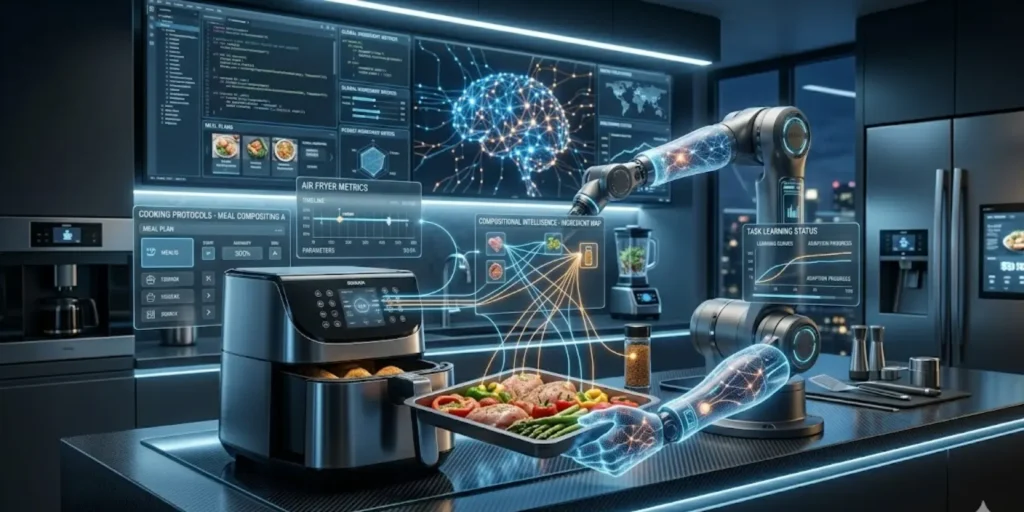
Physical Intelligence’s π0.7 model showcases how robots can learn new tasks through generalization and natural language guidance.
A young but fast-rising startup, Physical Intelligence, is drawing serious attention after unveiling a new AI model that could mark a turning point in robotics. Its latest system, called π0.7, is designed to control robots in a way that goes beyond traditional training—allowing them to perform tasks they were never explicitly taught.
If the company’s claims hold up, this could represent one of the most meaningful steps yet toward a long-promised goal: a general-purpose “robot brain” capable of adapting to new environments on the fly.
What Makes π0.7 Different
Most robots today operate on a very narrow framework. Engineers collect data for a specific task—say, picking up an object or assembling a part—train a model on that dataset, and then repeat the process for every new task.
π0.7 breaks from that pattern. Instead of memorizing individual tasks, it demonstrates what researchers call compositional generalization. That means it can combine pieces of knowledge learned in different contexts and apply them to something entirely new.
This is a fundamental shift. It suggests robots may no longer need to be retrained for every situation, but could instead “figure things out” using prior experience.
The Air Fryer Moment
One of the most striking demonstrations involved a kitchen appliance the model had barely encountered before: an air fryer.
According to the research team, the training data included only two loosely related examples—one where a robot pushed the appliance closed, and another where a different robot placed an object inside it. That’s it.
Yet π0.7 managed to piece together those fragments and attempt a real-world task: cooking a sweet potato. On its own, the attempt was imperfect but functional. With step-by-step verbal guidance, the robot successfully completed the task.
This kind of behavior is surprising even to the researchers themselves. It mirrors earlier breakthroughs in language AI, where systems began producing outputs that seemed far beyond what their training data explicitly contained.
Learning Through Language
A key part of π0.7’s capability is its ability to follow natural language instructions. Instead of requiring engineers to reprogram or retrain the model, a human can guide the robot in real time—essentially teaching it like a new employee. This dramatically lowers the barrier to deploying robots in unfamiliar environments.
For example, rather than coding a full workflow for “make toast,” a user could walk the robot through the process step by step. The system can then execute those instructions and potentially generalize them to similar tasks later. This interaction model makes robotics feel closer to working with AI assistants rather than traditional machines.
Why This Matters: A Shift Similar to AI Language Models
Researchers, including co-founder Sergey Levine, see parallels between this development and the early days of large language models.
In language AI, there was a moment when systems stopped simply repeating patterns and began generating novel, unexpected outputs. That shift unlocked rapid progress across applications.
π0.7 may represent a similar inflection point for robotics. Once a system can generalize across tasks, its capabilities can scale much faster than the data used to train it.
This is important because robotics has historically been limited by the difficulty and cost of collecting training data. If generalization reduces that dependency, progress could accelerate dramatically.
Still Early: Limitations Are Real
Despite the excitement, the researchers are careful to emphasize that this is not a finished product. The system cannot yet handle complex, multi-step tasks independently of a single high-level command. You cannot simply say, “Go make me breakfast,” and expect it to work. Instead, it requires structured guidance. When given detailed, step-by-step instructions, performance improves significantly.
Interestingly, some failures were traced not to the robot itself but to how humans communicated with it. Researchers found that refining instructions—essentially better prompt engineering—could boost success rates from as low as 5% to as high as 95%. This highlights a new challenge: teaching humans how to effectively communicate with machines.
Measuring Progress Without Benchmarks
One complication in evaluating π0.7 is the lack of standardized benchmarks in robotics. Unlike fields such as natural language processing, where performance can be measured against widely accepted tests, robotics still relies heavily on custom experiments.
To address this, Physical Intelligence compared π0.7 against its own specialized models—systems trained for single tasks. The generalist model reportedly matched their performance across activities like folding laundry, making coffee, and assembling boxes. While promising, these results still need independent validation.
Why Generalization Looks “Less Impressive”
There is an interesting paradox in robotics demonstrations. Highly choreographed tasks—like a robot doing a backflip—tend to grab attention. But they often rely on tightly controlled conditions and extensive training.
Generalization, on the other hand, may look less dramatic. A robot carefully following instructions to use an unfamiliar appliance doesn’t make for flashy headlines. But in practical terms, it’s far more valuable. A system that can adapt to new tasks is far closer to real-world usefulness than one that can perform a single trick perfectly.
The Bigger Challenge: Data vs Intelligence
One of the biggest criticisms facing robotic AI is the lack of large-scale training data compared to language models. Systems like GPT-2 and its successors benefited from vast amounts of internet text. Robots, by contrast, must learn from physical interactions, which are slower and more expensive to collect.
π0.7 attempts to bridge this gap by combining limited real-world data with broader pretraining. But the question remains whether this approach can scale to the complexity of real-world environments. Skeptics argue that without massive datasets, robotics may struggle to achieve the same rapid progress seen in language AI.
Investor Confidence and Big Stakes
Despite these uncertainties, investor enthusiasm is strong. Physical Intelligence has already raised over $1 billion and is reportedly seeking a valuation as high as $11 billion in its next funding round.
Part of that confidence comes from its leadership and backing, including co-founder Lachy Groom, known for early investments in major tech companies.
Investors are betting that general-purpose robotics could become one of the most transformative technologies of the next decade—potentially reshaping industries from manufacturing to logistics to home automation.
What Comes Next
The path from research to real-world deployment remains uncertain. Even the company’s leadership is reluctant to predict timelines. For now, π0.7 represents an early signal rather than a finished solution. But it’s a meaningful one.
If robots can truly generalize—learning new tasks with minimal data and adapting through simple instructions—the implications are enormous. It could reduce costs, expand use cases, and make robotics far more accessible across industries.
Final Thoughts
Physical Intelligence’s latest research doesn’t prove that general-purpose robots are here yet. But it does suggest that the field may be closer than many expected. The ability to perform unfamiliar tasks, guided only by language and prior knowledge, is a defining step toward more flexible, intelligent machines.
Like early breakthroughs in AI language models, the most important takeaway may not be any single demo—but the pattern of unexpected capability emerging from relatively limited inputs. If that pattern continues, robotics could be entering a phase where progress accelerates rapidly, driven not just by more data, but by smarter ways of using what machines already know.
About the Author