
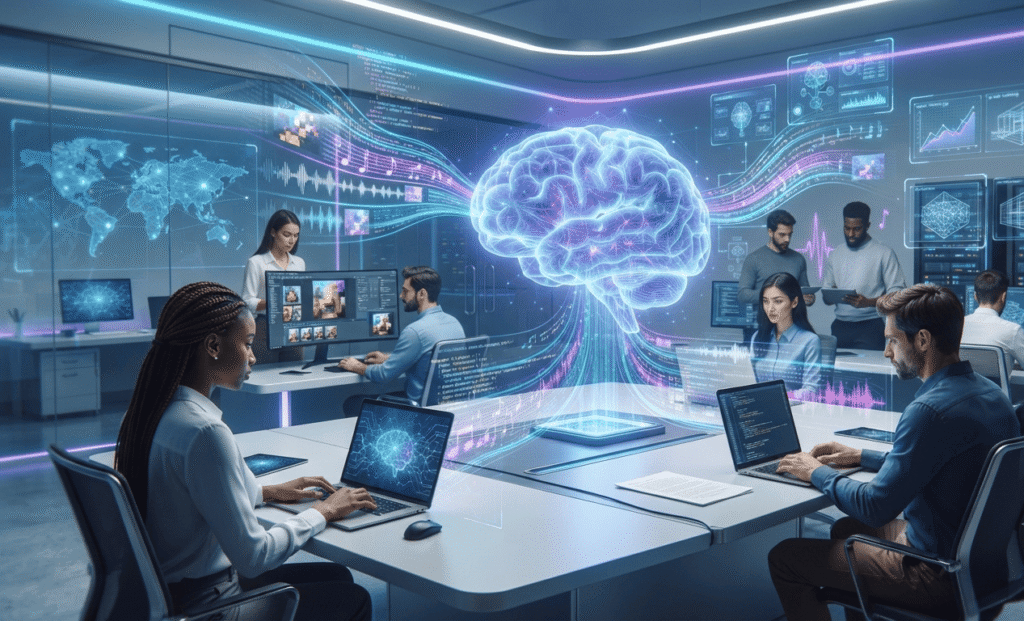
Generative AI creates text, images, code, and other content while transforming productivity across industries.
Generative AI is one of the fastest-growing technologies in the past few years. Now, business students, professionals and occasional users rely on it for writing, designing coding, research and solving problems. Generative AI differs from traditional artificial intelligence in that it works by analyzing existing information and attempts to create new content based on data it has learned from. This capability has changed how humans operate, learn, or communicate.
With the growth of adoption of AI-powered solutions by organizations, comprehending generative AI has gained importance. Understanding how it works, where and how to use it, what its advantages are as well as limitations, will aid individuals and businesses in making more informed technology choices. The following guide covers what beginners need to know, in layman’s terms as simple and friendly as possible.
Understanding Generative AI
Generative AI is a form of artificial intelligence that generates new content rather than just processing existing information. It documents on text, on pictures, video, music, computer code, presentations, and audio files too. These systems learn patterns from vast amounts of data and utilize these patterns to generate new outputs when given prompts or instructions by users.
Generative AI achieves results by generating something altogether new, rather than classification of data or prediction of outcomes in the way traditional AIs work. To cite a simple example, a traditional artificial intelligence model would discover if one email was spam or not, whereas generative AI can compose a professional email from scratch. Such creative capacity makes it applicable in general across tons of industries and daily tasks.
Generative AI is so popular because of the time-saving aspect it brings while improving productivity. Businesses use it to automate repetitive work, and individuals use it in practices of daily life and ideation quickly.
How Generative AI Works
Creatively, what generative AI basically does is it learns patterns on huge volumes of data collected throughout its training. These datasets consist of nearly all human knowledge including books, articles, images, videos, software code and more. The AI observes how words, photos, sound, and other pieces of content are related to each other during its training.
After the training is completed, users provide input to the AI through prompts or questions. The system goes to its massive database and predicts the most likely response given what it knows. It does not scour the web for the answer; rather it creates content by determining the patterns and probabilities in its training data.
As a rule of thumb, the better quality generated content is often the result of less ambiguous prompt. In general, better and more useful results are produced by specific instructions than vague requests. Most users keep iteratively improving prompts until they get the response they want.
Key Technologies Behind Generative AI
Many state-of-the-art technologies lay the foundation for most modern generative AI systems. The machines learn from data in machine learning without the need for specific programming instructions. Deep learning enhances this process using neural networks that imitate some features of how the human brain processes information.
What is a Large Language Model? Generates text that is similar to what humans write. These models are able to generate natural conversations and written content, as they have been trained on grammar, context, writing styles, and language patterns. Powering chatbots, writing assistants and AI research tools used by millions globally.
What do image generation models do differently (they learn visual patterns instead of language) You develop paintings, illustrations, product drawings, and realistic visuals from text descriptions. Other specific-based architectures generate music, videos, and speech as well as software code using similar learning patterns.
Common Types of Generative AI
Generative AI consists of several categories designed for different use cases. Text generation tools include articles, emails, reports, stories, social media posts and marketing content. Such services have gained traction among several user segments including writers, businesses, educators and researchers. Image generation AI generates artwork, advertising backgrounds & graphics, logos, illustrations and product concepts. Typical usage is helping designers to generate initial ideas more rapidly before tweaking the final designs manually.
Code generation AI are used to aid in writing software, identifying errors in coding or helping ensure how to explain complex programming concepts. Video generation Models generate animations, presentations and promotional videos, whereas audio generation systems generate human-like speech and music or sound effects. They train each category to solve different creative or technical challenges in a way that help users do their tasks faster, and more effectively.
Everyday Uses of Generative AI
Generative AI has now entered the lives of millions. It is used by students to explain complex concepts, summarize long documents and organize research material. Created: Lesson plans, quizzes and educational resources with the assistance of AI. Businesses turn to generative AI to compose marketing campaigns, customer emails, product descriptions, and business reports. AI chatbots are also used by customer service teams to provide replies to more generic queries while freeing up human employees for more complicated issues.
Content creators use AI tools to provide video scripts, Blog articles, Podcast outlines and social media content. AI is not only used among graphic designers to generate ideas, but also by software engineers to speed up programming work through AI coding assistants. The business world is rapidly adopting large language models to complement human expertise and augment productivity for healthcare professionals, financial analysts, legal teams, and researchers.
Benefits of Generative AI
Among the most prominent advantages of generative AI is increased productivity. Many tasks that previously took days to complete now can be completed in minutes. This enables professionals to concentrate on strategy, creativity and decision-making rather than repetitive work. Generative AI helps users brainstorm, which encourages creative thinking. You can have writers quickly overcome a block, designers speed up the exploration of multiple concepts, and marketers crank out campaign ideas with greater efficiency.
Another major benefit is accessibility. Non-technical people can generate professional documents, presentations, images or software prototypes simply by using natural language commands. That opens access to very sophisticated technology to a vastly larger number of people. On the business side, automation allows for a reduction in operational costs. AI enables you to automate processes and reduces the manual labor effort while enhancing consistency at every stage of various business processes.
Challenges and Limitations
Generative AI has some real weaknesses, even though it is an incredibly powerful tool. Hallucination which is when AI models provide wrong information. Important facts should always be checked against other platforms as users cannot fully rely on the content derived from AI. Privacy remains another concern. When utilizing AI platforms, organizations need to take extreme care in protecting sensitive business and customer information. More companies too are setting up AI governance policies to ensure that AI is used responsibly.
The use of AI systems has brought the ongoing evolution of copyright issues, since it produces certain content. Ownership, licensing and fair use questions remain subjects of hot legal debate in many places up until today. Bias can even be present in outputs generated by AI since historical bias or unequal representation may also exist in the training data. While developers are working to improve models to mitigate these types of problems, human review is still necessary.
Generative AI Across Different Industries
Generative AI has already been adopted in several industries as part of their daily operations. AI helps summarize medical records, supports clinical documentation, and speeds up pharmaceutical research in the healthcare sector. Financial institutions draft reports and trend analysis, as well as provide better customer assistance. Manufacturing companies use AI for product design, generation of technical documentation and predictive maintenance planning. Retailing generates personalisation of shopping, advertising campaigns and recommendations.
In education, generative AI is used to tailor learning materials, provide tutoring assistance and improve administrative functions. AI is being utilized by legal firms to generate summaries of contracts, categorize case research, and prepare legal documents for attorney examination. Media companies, publishers, entertainment studios and gaming developers use generative AI more and more for content production workflows with human oversight throughout the creative process.
What Are The Best Practices For Using Generative AI
But generative AI is not something that you do ad hoc and in a rush over the weekend. Users must use clear and detailed prompts to explain exactly what they want. This usually produces better results than simply stating what you want but no context, formatting preference or goal. Never base important decisions solely on AI. However, human intelligence is still needed for fact-checking, cross-verification and ethical judgment.
Responsible AI — Businesses need to create proactive responsible AI policies around the areas of privacy, security, intellectual property, and quality assurance. Employees should be trained on when to use AI and when human judgment is needed. And since the technology changes quickly, it is also helpful to keep AI knowledge up to date regularly. Every industry still has New capabilities, regulations, and best practices as it emerges.
The Future of Generative AI
Generative AI will go even further in a few years. Next-generation approaches will also likely comprehend intricate instructions more accurately while generating increasingly realistic text, images, audio, and video. Businesses will still use AI to weave into daily work streams through smarter assistants that can handle multiple things at once. These systems can schedule meetings, process business intelligence data, create reports, and automate tedious tasks under little to no supervision.
AI tutors are personalizing education, adjusting to each student’s unique style of learning. We see artificial intelligence advancing the fields of medicine, facilitating quicker research and more accurate diagnostics while easing communication and understanding between doctors and patients. The most probable future would have human imagination combined with AI capabilities in the creative industries to generate more quality content faster. Automation will obviously increase but creativity, critical thinking, ethics, and decision-making by humans need to be kept. Generative AI thrives when used in the service of enhancing rather than replacing human abilities.
Conclusion
Generative AI is changing the way people produce, innovate and accomplish their day-to-day activities. It improves productivity, creativity, and efficiency in many industries by generating original text, images, videos, software code and other digital data.
Generative AI presents incredible opportunities, but also holds potential for misuse. Users need to fact-check, be careful with sensitive information, know its limitations and supplement AI-generated content with human expertise. Organizations that embrace disciplined artificial intelligence will be a step ahead to take advantage of this technology as it continues to evolve at an astonishing pace.
With the fast evolution of generative AI, its position in business, education, healthcare, research and everyday life will only solidify. This somewhat rough understanding of how it works today is one of the best preparations for using any innovations with AI in the future responsibly and substantively.
About the Author