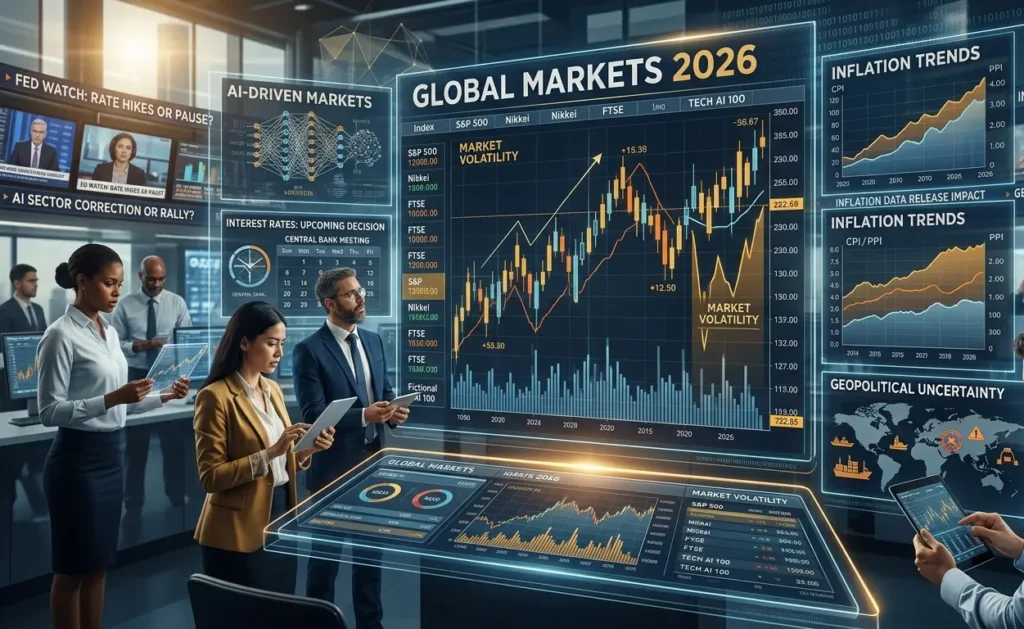
Global financial markets continue to experience volatility as investors react to economic and geopolitical developments.
Market volatility is the number of times financial assets rise and fall over a period of time. Volatility is simply defined as the amount and rate at which markets move one way or another. When stock prices, bonds, commodities, or cryptocurrency rise and fall violently in relatively short periods of time, they are said to be volatile markets.
Investors are still worried about market volatility as global financial markets struggle to digest the impact of increasing interest rates, further development in Artificial Intelligence investments, continuing geopolitical tensions and changing consumer behavior into 2026.
Understanding Market Volatility
Market volatility is the time-dependent measure of asset price variation in relation to its time path. The market experiences large price swings in a highly volatile market, whereas the low volatility moves more gradually.
Stock movements of up to 10% and down by 8% the very next day would make this a highly volatile stock. On the other hand, a stock that only makes just 1% or even 2 percentage points over days shows less volatility. It is important to note that volatility by itself does not determine whether prices are going up or down. Rather, it measures the extent of price movements in both directions.
Why Market Volatility Matters
From individual retirement savers to large institutional funds, volatility impacts nearly every kind of investor.
Periods of heightened volatility can:
- Increase investment risk.
- Create buying opportunities.
- Trigger investor fear and panic.
- Influence portfolio performance.
- Affect business investment decisions.
Having an understanding of volatility can allow investors to think logically about making investment decisions, rather than being prone to making emotional choices.
Top Market Volatility Drivers 2026
This is driven by a combination of several factors influencing market volatility in 2026.
Artificial Intelligence Investment Boom
AI infrastructure spending continuing to ramp up is one of the primary forces shaping markets in 2026. Individual stocks for companies that spend a lot of money on data locations, cutting-edge semiconductors, cloud computing and computer software also moved drastically.
Earnings reports from some of the biggest tech companies are particularly closely watched, given that expectations remain extraordinarily lofty. Good reports usually produce fast rallies, and a small miss can immediately lead to heavy selling.
Interest Rate Expectations
The policy of the central bank remains an important engine for volatility. You are up to October 2023, and the institutions, such as the Federal Reserve, were in control of discussing market prices by changing interest rates.
Higher interest rates generally:
- Increase borrowing costs.
- Reduce corporate profitability.
- Pressure growth stocks.
- Slow economic activity.
Lower interest rates typically underpin stock valuations, as well as investments. Financial markets are experiencing selling off sharply to new economic data as investors continue to reassess expectations for future interest rates.
Inflation Trends
Inflation continues to play a key role in the way markets operate. Higher consumer prices in economic reports can raise worries of more aggressive monetary policy. On the other hand, a slowdown in inflation could strengthen investor confidence.
The market is closely following indicators like:
- Consumer Price Index (CPI)
- Producer Price Index (PPI)
- Wage growth data
- Employment reports
Unscheduled inflation statistics often trigger overnight price moves across equities, bonds and then currencies.
Geopolitical Risks
Global geopolitical events continue to impact market sentiment in 2026.
Events such as:
- Trade disputes
- Military conflicts
- Energy supply disruptions
- Sanctions
- Election outcomes
What can generate uncertainty and cause volatility? As an example, this could be the case for tensions in areas that produce a large share of world oil, which would then contribute to rising oil prices and affect expectations about inflation and financial markets at home.
Economic Growth Uncertainty
The health of the global economy is something investors are always judging. The performance of the economy as seen in growth indicators, employment conditions, manufacturing strength and consumer expenditure, gives analysts a hint about future market trends. Market volatility around this time is typically magnified as investors reevaluate earnings growth expectations due to fears of slowing economic growth or a recession.
Corporate Earnings Season
Short-term market movements are typically driven by company earnings reports. This is kind of like the quarterly earnings released by public companies, which show:
- Revenue growth
- Profitability
- Future guidance
- Capital spending plans
Investors closely watch technology companies, making up a large proportion of big market indexes in 2026. Stocks can move violently when the results are announced, and they differ from what the market expected.
Types of Market Volatility
Market volatility takes several forms.
Historical Volatility
It is also required to note that the historical volatility gives information about how much an asset price has changed in the past. Investors study historical data to assess risk and compare investments.
Implied Volatility
Implied volatility is how investors think about future prices. Implied volatility is a widely used measure of expected future uncertainty, commonly pulled from options markets.
The CBOE Volatility Index (VIX), also known as the “fear index”, reflects future expected volatility in the U.S. stock market. Higher VIX readings are suggestive of greater investor anxiety.
Signs of High Market Volatility
Multiple indicators point towards markets being in a higher volatility regime.
Large Daily Price Swings
Sharp price movements during a single trading session in either direction usually suggest that uncertainty looks to be at its highest.
Rising Trading Volumes
Periods of higher volatility are usually associated with increased trading activity as investors rebalance their positions.
Increased Demand for Safe-Haven Assets
During uncertain times, investors often move money into what is traditionally considered safe.
Examples include:
- Government bonds
- Gold
- Cash equivalents
Elevated VIX Levels
When does a big rise in the VIX mean intensified market stress?
How Different Asset Classes React
Stocks
Often, uncertainty tends to create maximum volatility in the equity markets. Growth stocks and technology shares, in particular, tend to have outsized price movements.
Bonds
Expectations of movement in interest rates can cause volatility in bond prices. Bonds with longer durations are typically more sensitive to rate movements.
Commodities
For commodities (like oil and gold), the volatility index tends to be very high, especially in the midst of supply disruption or geopolitical events.
Cryptocurrencies
Digital assets remain one of the most volatile investments. Cryptocurrency prices are prone to making large moves in a very short time. For instance, Bitcoin and Ethereum have large price fluctuations regularly.
Market Volatility: Is It Good, Or Bad?
You should know about market volatility — it is neither good nor bad. The high-end to the low-end has an effect largely based on an investor’s goal, risk tolerance and time frame.
Potential Benefits
Volatility can present opportunities to buy good-quality assets at prices that make sense. Market declines can provide long-term investors with a buying opportunity with investments at lower valuations. Furthermore, active traders can also benefit from short-term price movements.
Potential Risks
This can induce emotional investing and large losses, particularly when using leverage. Selling up in a panic locks in the losses and prevents future profit recovery.
How Can Investors Tackle Volatile Markets
Maintain Diversification
Diversification involves allocating capital among various asset classes, industries, and geographic regions. The Diversified Portfolio: Diversifying your portfolio can help lower total risk
Focus on Long-Term Goals
Staying focused on financial objectives instead of short-term market fluctuations helps the long-term investor.
Avoid Emotional Decisions
Poor investment decisions are often driven by emotions of fear and greed. One of the ways to reduce emotional responses is to create a disciplined investment strategy.
Review Asset Allocation
Regular portfolio reviews for aligning investments to risk tolerance and financial goals
Maintain Cash Reserves
Having enough emergency savings limits the need to sell your investments as prices fall in a market downturn.
Market Volatility and Artificial Intelligence Stocks
In 2026, AI-related companies have emerged as major drivers of market volatility. Optimism surrounding AI infrastructure investment, chip demand, and cloud computing momentum drove significant price changes in large-cap tech.
Investors Are Still Keeping An Eventful Eye On Companies Like:
- NVIDIA
- Microsoft
- Alphabet
- Amazon
- Advanced Micro Devices
Earnings surprises can lead to big gains or losses as valuations are still high.
Market Volatility Outlook for 2026
The majority of analysts predict volatility on the market will remain stubbornly high for the remainder of 2026. Here are the key factors wiz likely to impact our market:
Central bank policy decisions.
- Inflation trends.
- Corporate earnings growth.
- AI investment spending.
- Global geopolitical developments.
- Economic growth expectations.
Volatility creates uncertainty, but it is also a natural part of the investment process.
Conclusion
Market volatility, time frames and cycles in 2026 — Market volatility is rapid and unusual price fluctuations. Growth/volatility/cyclical rotation, AI investments trends, interest rates speculation, investors’ focus as inflation concerns increase on geopolitical events, and higher yields of treasury in the background of the corporate earnings season are pushing volatility worldwide. Investors who understand the sources of volatility in markets can stay on track, avoid trying to time risk and ultimately make better long-term decisions about their financial future.
About the Author