
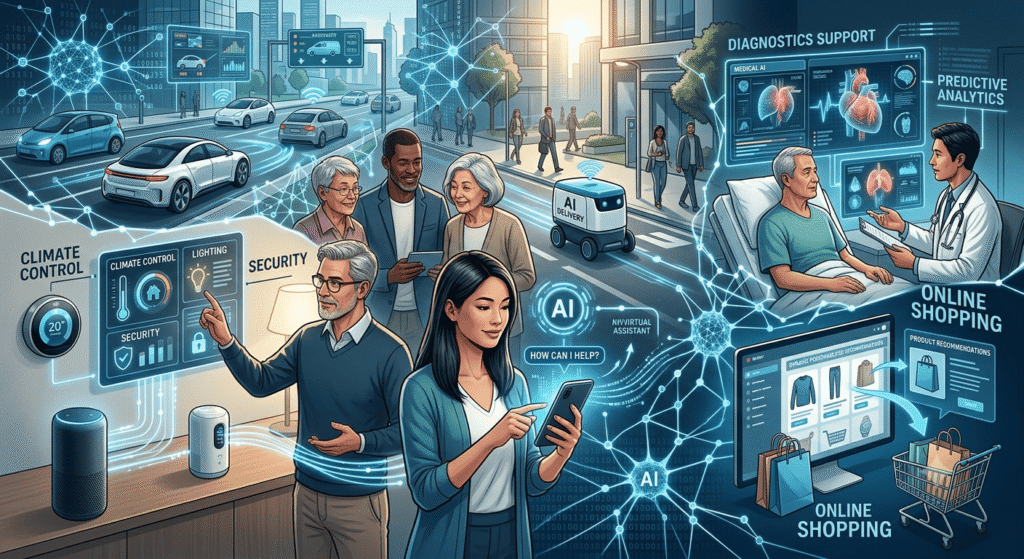
Artificial intelligence is transforming everyday life through smart technologies and automation.
Artificial Intelligence, or AI, has taken a front seat as one of the most relevant technologies of this time. AI is changing how people live, work, and communicate, from smartphones to virtual assistants; the devices give suggestions for buying items online, and fully autonomous cars are managed by artificial intelligence systems. The term might sound mind-boggling, but artificial intelligence is becoming a daily experience for billions of people worldwide. This article will explain what artificial intelligence actually is, how it works and how much it affects our everyday life.
Understanding Artificial Intelligence
AI is defined as computer systems designed to perform tasks requiring human intelligence. These include, but are not limited to, learning, problem-solving, language understanding, image recognition, decision-making, and pattern matching.
Artificial Intelligence, which combines computer science, mathematics, and data analysis and machine learning to create systems capable of mimicking aspects of human thinking. Unlike previous forms of AI, which depended on following a set of predetermined rules, these systems can process data, learn through iterative processes, and improve themselves over time.
How Artificial Intelligence Works
Artificial Intelligence, at its simplest, processes vast amounts of data and looks for patterns within that data.
The normal process generally includes a few steps –
Data Collection
We change the input to an AI system for it to assemble and learn. This data can also come from a variety of sources, including:
- Images
- Videos
- Text documents
- Audio recordings
- Sensors
- User interactions
- Internet searches
The AI system you are dealing with can learn from data that is available to it up to the extent of October 2023, then, this state will perform well. The learning accuracy increases with time if it gets more and more high-quality data.
Data Processing
Computers then structure the data that can be collected and allow for its analysis. Depending on the data, powerful algorithms look for patterns, relationships and trends. An AI image-recognition system might look at millions of photos to learn how to recognize cats vs. dogs vs. cars vs. people.
Machine Learning
Machine Learning is one of the significant branches of AI. Machine learning is the process in which a computer can perform tasks and learn from data without being programmed to do so for every event. It has to discover that pattern on its own, rather than being told what the pattern should be. For instance, an Email service can be trained to identify spam emails from millions of previously marked spam messages.
Neural Networks and Deep Learning
Most state-of-the-art AI systems today are based on Artificial Neural Network technology. Neural networks are computing systems that learn from examples using a structure modeled on the human brain. This means they include layers connected to each other that process data and learn from examples.
The more developed version, known as Deep Learning, employs several layers of neural networks to provide solutions to very complicated issues like speech recognition, language translation and image generation.
Types of Artificial Intelligence
The category of artificial intelligence can generally be divided into some classes.
Narrow AI
Narrow or weak AI is meant to do a specific task.
Examples include:
- Voice assistants
- Recommendation engines
- Facial recognition software
- Navigation applications
This is the most common type of AI system used today.
General AI
General AI simply means machines that can question & do any intellectual task as a human being can do. This is still an active area of research for scientists, but General AI, in the true sense of the word simply not available as yet.
Generative AI
Generative Artificial Intelligence is any type of AI that can generate content, including text, images, music, videos and computer code. To give you an example, these could be AI Chatbots, Image Generators, and Writing Assistants. The novelty of generative AI rapidly gained a foothold because it can help users perform creative and professional tasks.
Artificial Intelligence in Everyday Life
Most people use AI dozens or even hundreds of times every day without knowing it.
Smartphones and Virtual Assistants
Smartphones use AI extensively. Google Assistant, Siri, and Amazon Alexa are all artificial intelligence-based virtual assistant who helps you do your tasks using voice commands.
These assistants can:
- Set reminders
- Send messages
- Make phone calls
- Answer questions
- Provide directions
- Control smart home devices
These systems use AI to translate spoken language and provide responses.
Social Media Platforms
AI is crucial for the functioning of social media applications. The posts, videos and advertisements that Facebook, Instagram and TikTok show users are filtered by AI algorithms.
AI analyzes factors such as:
- User interests
- Viewing history
- Likes and comments
- Sharing behavior
- Time spent on content
This personalization helps to keep users engaged and enhances their experience.
Online Shopping
Artificial intelligence is heavily used by e-commerce companies. Online shoppers receive more personalised product recommendations. AI systems look through customers’ past purchases, browsing history and preferences in order to offer relevant products.
Here are some examples of how those companies utilize the technology:
- Recommend products
- Optimize pricing
- Manage inventory
- Predict demand
- Detect fraud
It also drives customer service chatbots that offer immediate assistance.
Streaming Services
AI recommendation engines are leveraged by streaming platforms to recommend movies, television shows, and music. For example, services like Netflix and Spotify analyse viewing and listening habits to personalize your experiences. These platforms have trained models based on your interests so that they can recommend content to you in a more efficient manner.
Navigation and Transportation
Artificial intelligence has also revolutionized the field of transportation and navigation.
AI is used to power applications like Google Maps and Waze for:
- Predict traffic conditions
- Recommend faster routes
- Estimate travel times
- Identify accidents and road closures
AI processes real-time data collected from millions of users to give authentic navigation guidance. Equally much about the autonomous car technology relies on using artificial intelligence systems that are able to extract road conditions, identify objects on the street and then decide the driving actions.
Email and Spam Filtering
AI-powered systems sift through billions of emails every day. Example: Email providers analyze massive amounts of data to identify spam, phishing attempts and destructive content.
Analyzing both message patterns and historical data, AI protects users from spam or harmful emails. Handling email without AI would be a nightmare.
Banking and Financial Services
AI is also being used more and more frequently by banks and other financial institutions to work toward better security and efficiency. With the help of AI, it targets suspicious transactions and eliminates fraud by comparing data with spending behavior, applying tricks to flag unusual activity.
Financial organizations also use AI for the following tasks:
- Credit scoring
- Risk assessment
- Customer support
- Investment analysis
- Personalized financial recommendations
Today, many mobile banking applications include AI chatbots that provide 24/7 assistance.
Healthcare Applications
AI is playing a growingly immense role in the healthcare sector. AI systems help in classifying medical images, assisting diagnoses, and even detecting diseases at an earlier stage by doctors and hospitals.
AI applications can help:
- Detect cancer in medical scans
- Analyze laboratory results
- Monitor patient health
- Predict disease risks
- Support treatment decisions
AI only helps health professionals, but the ultimate call is always made by humans when it comes to medical decisions.
Smart Homes
Modern-day smart homes use Artificial Intelligence to automate your everyday activities. Smart devices learn how a user behaves when using the device over time.
Examples include:
- Smart thermostats adjust temperatures automatically
- Processing voice commands through smart speakers
- Security cameras recognizing familiar faces
- Lighting systems that adjust according to routines
These technological improvements increase convenience, comfort and energy efficiency.
Artificial Intelligence in Education
Many use AI-related tools in schools to ease the process of teaching and learning. AI can adapt lessons to meet the individual needs of each student, allowing for a more personalized education experience.
Educational AI applications include:
- Language learning assistants
- Automated grading systems
- Personalized tutoring platforms
- Learning analytics tools
These allow for personalized support for students and insights into learning growth.
Benefits of Artificial Intelligence
Every day of life benefits from artificial intelligence.
Increased Efficiency
AI reduces repetitive tasks and enables humans to commit to complicated work.
Improved Accuracy
Artificial Intelligence systems can comprehend huge research data with a high level of accuracy and find out multicollinearity among the detected participants, which indeed decreases human error.
Personalization
This approach is called AI, which tailors unique experiences to individual preferences and behavior.
Faster Decision-Making
AI is used in businesses and organizations to analyze data quickly, using that information to make decisions.
Enhanced Accessibility
Accessibility for the disabled — Voice assistants, translation tools and speech recognition technologies
Challenges and Concerns
On April 13, 2020 By Phanuel M. Gachoka & this site uses Akismet to reduce spam.
Privacy Issues
Privacy and Security: Most, if not all, AI systems collect and analyze personal data.
Job Displacement
Automation will disrupt job markets by deploying labor and eliminating some time-consuming tasks that humans previously performed.
Bias and Fairness
One of the common problems that AI systems can cause is that they can give biased results if we trained on incomplete or biased datasets.
Security Risks
Cybercriminals can use AI to their advantage for malicious intents and conduct fraud or commit cyberattacks.
Ethical Considerations
Society is still trying to find ways for responsibly develop and regulate AI.
The Future of Artificial Intelligence
AI will probably keep spreading into almost every part of life.
Future developments may include:
- More advanced healthcare diagnostics
- Improved autonomous vehicles
- Smarter personal assistants
- Enhanced robotics
- Greater workplace automation
Simultaneously, researchers are also working to prevent the generation of unsafe content and build more interpretable and trustworthy AI systems.
Conclusion
You are no longer om its version of a sci-fi movie – sans malicious AI, of course. It has turned into a natural piece of day by day life, molding how we speak with each other, shop, travel, learn and work. AI systems are trained on vast amounts of data, can recognize patterns and get better through learning — all of which combine to speed up boring repetitive things we do every day making them simple. The significance of knowing the mechanics behind AI is going to escalate for people, corporations at large and society in general as AI continues to develop.
About the Author