
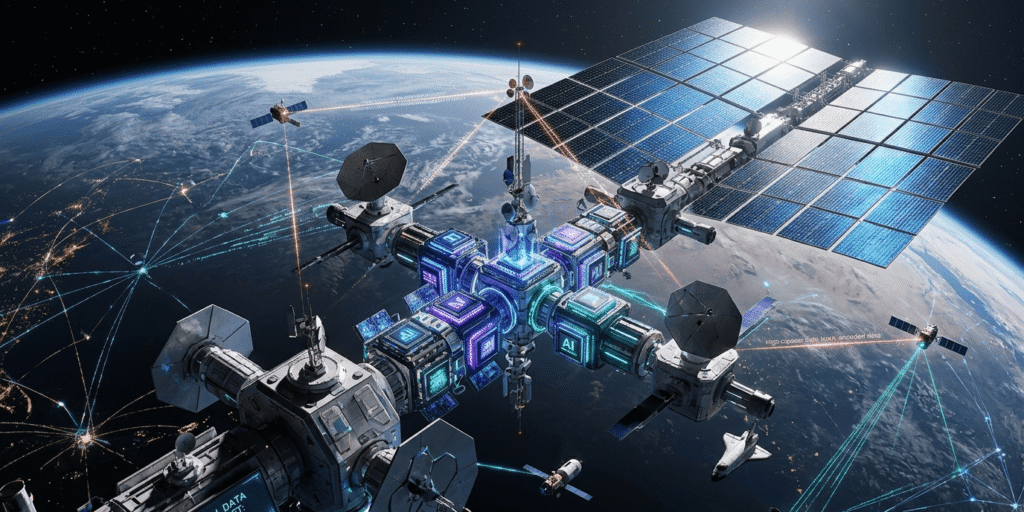
Orbital secures $5 million in seed funding to develop AI-powered data centers in space.
This demand for computing power fueled by artificial intelligence (AI) is sweeping across the globe. In the meantime, companies are quickly expanding data centers to keep up with how neural networks will become more complicated AI models and applications. But every year since 2015, power constraints, environmental regulations, and infrastructure have been holding up deployment on Earth.
One startup, Orbital Up Close, thinks the answer might lie in space. The company was actually the latest graduate of venture capital firm Andreessen Horowitz (a16z)’s Speedrun accelerator program, which concluded in November with a $5 million seed funding round. Orbital announces plans to construct data centers in space that potentially offer large-scale AI computing capacity as needed.
To some, this may sound like something from a science fiction novel; the truth is that investors are very willing to back space projects of any type. Growing belief in the commercial space industry has prompted some venture capital firms to back startups that are going for technology no one would have dreamed possible earlier.
From E-Scooters to Space Technology
Orbital founder and CEO Euwyn Poon has a unique background as an aerospace entrepreneur. Previously, he co-founded the e-scooter company Spin in 2017 and sold it to Ford Motor Company one year later.
Post-Ford, Poon pursued a number of business ideas before he settled on space-based computing infrastructure. Investors associated with the project said he looked at many deals before determining there is a big long-term opportunity for AI data centers in orbit.
His previous work as a serial entrepreneur brought potential investors to his doorstep, even though he had no experience in the space industry. In your portfolio, venture funds these days prefer founders who have good experience in scaling the business and managing operational complexity effectively.
Strong Investor Support Fuels Early Development
Orbital raised a $5 million seed round from an array of backers. Technology venture firms, AI funds, and emerging infrastructure projects joined a16z as participants as well. The funding gives the company resources to start building its core technologies and testing them.
It just so happens that this investment also coincides with shifting views about long-term efforts in orbit. Ten years ago, most investors favored software businesses that could deliver fast paybacks. The success of companies such as SpaceX has fostered greater confidence in these very bold projects today.
Investors are now aware that larger infrastructure opportunities may take a longer time to develop. This dynamic has created stronger access to capital for startups chasing big space technologies than in years past.
So, Why Data Centers in Space?
The thinking behind Orbital itself is fairly simple. AI systems need huge quantities of electricity and computing hardware. Building out enough infrastructure here on Earth to accommodate development typically requires long paper processes, environmental reviews and energy supply challenges.
Space offers several theoretical advantages. Satellites enjoy undisturbed access to uninterrupted solar energy and evade many of the acreage restrictions encountered by terrestrial systems. Proponents of the approach, in turn, say future orbital data centers could run on nearly unlimited renewable energy while alleviating strain on terrestrial infrastructure.
The notion, of course, relies almost entirely on transportation costs. Despite the launch costs having become low, launching hardware to orbit is still prohibitively expensive in order to deploy large networks under present conditions. Orbital argues that future innovations in rocket technology will someday fundamentally alter those economics.
The Business Model of the Starship
Like many of the space infrastructure projects Orbital is pursuing, Zhang said he and his team are counting on a lot of future success from SpaceX and its Starship program. The firm looks for lower launch costs to permit the large-scale financial viability of orbital data centers.
The starting point from which Orbital can iterate on for its long-term vision is still too expensive with current launch systems such as the Falcon 9. According to Poon, at this point, meaningful expansion will only be feasible if Starship commences frequent commercial service with a substantially reduced cost of cargo delivery to space.
And this reliance presents opportunity, but also peril. But if Starship reaches its cost reduction goals, the likes of Orbital could stand to benefit tremendously. But if you are late or behind on the tech roadmap, that could hold up orbital computing infrastructure from becoming an economic reality.
Testing Technology Before Large-Scale Deployment
Orbital does not wait for full-scale operations before testing its technology. The firm intends to perform demonstration missions that are meant to prove out key systems in a space context. The tests will be limited to testing its radiation protection and thermal management capabilities.
The first demonstration mission will fly an Nvidia Blackwell AI chip on a partner satellite. It will assess Orbital’s protective technologies while the experiment is carried out to find out how advanced processors perform in orbit.
Testing will likely open doors for larger-scale missions. The new company aims to utilize some of Nvidia’s Space-1 Vera Rubin-class graphics processing units and hopes to have its first dedicated data-processing spacecraft ready by 2028.
Revenue Plans Start With Linear Growth
Instead of waiting years to deploy huge networks in orbit, Orbital plans to generate cash flow incrementally. The company plans to carry out on a piece-wise basis, inference workloads using single satellites as and when they turn operational.
That strategy echoes tactics already employed at other space computing startups. The service will enable smaller deployments to serve customers while larger constellations are still being developed. Initial revenue generation might also serve as an indicator of market interest in the space-based computing services.
This approach enables Orbital to gain operational experience before working towards its top-level goal. This approach of gradual increase may reduce financial risk while obtaining important technical data through real-world deployments in orbit.
A Vision That Is Too Ambitious For Tomorrow
Orbital has set quite an ambitious long-term goal. Relativity hopes to launch around 10,000 satellites that can collectively offer a gigawatt of distributed computing power. The 100 kilowatts of processing power from each spacecraft.
It would be one of the largest computing infrastructures ever built. This would need major funding, scientific advances and long-term strategic execution. Those working in the industry have predicted that projects like these could ultimately be worth billions of dollars.
Competition is also increasing. Building on similar concepts, multiple startups and established aerospace players are working to develop such capabilities. However, Poon reckons that because demand for AI computing is going to be so huge, many different providers can thrive at the same time.
SpaceX Has Changed Investor Thinking
Investors’ views of the space industry have changed with the evolution of companies like SpaceX. Ideas that would have previously been dismissed as overly ambitious are now receiving serious attention from venture capital firms and institutional investors. The commercial success of reusable rockets has shown that the aerospace revolution can generate huge economic value.
This is a direct product of that changing frame of mind — Orbital. A founder who made a name for himself building an e-scooter company raised millions to chase orbital computing infrastructure. This would have seemed like an unlikely development a decade ago.
Only time will tell if Orbital is capable of reaching its lofty ambitions. Yet the company closing a funding round with such a huge valuation shows that attitudes for space start-ups have changed dramatically. Investors are no longer viewing space as just another exploration frontier, but rather the building block for whole new industries.
Conclusion
Orbital’s $5 million worth of financing marks the next step in building out the next-generation computing infrastructure beyond Earth. The startup, which is led by former Spin founder Euwyn Poon, is banking on growing demand for AI and plans to take advantage of cheaper launch costs in the future.
The company’s plans are still aggressive, but they also rely heavily on technology development in the commercial space industry. But even with a less-than-certain outlook for the markets, investor confidence is rising, new reusable rockets are becoming more commonplace and the growing demand for AI infrastructure keeps presenting opportunities for any bold new venture to come along.
If Orbital can pull this off, it could change the way we think of computing power, energy generation and space in our global digital economy. Currently, though, the company is determined to show that orbiting data centers can go from science fiction to reality.
About the Author