
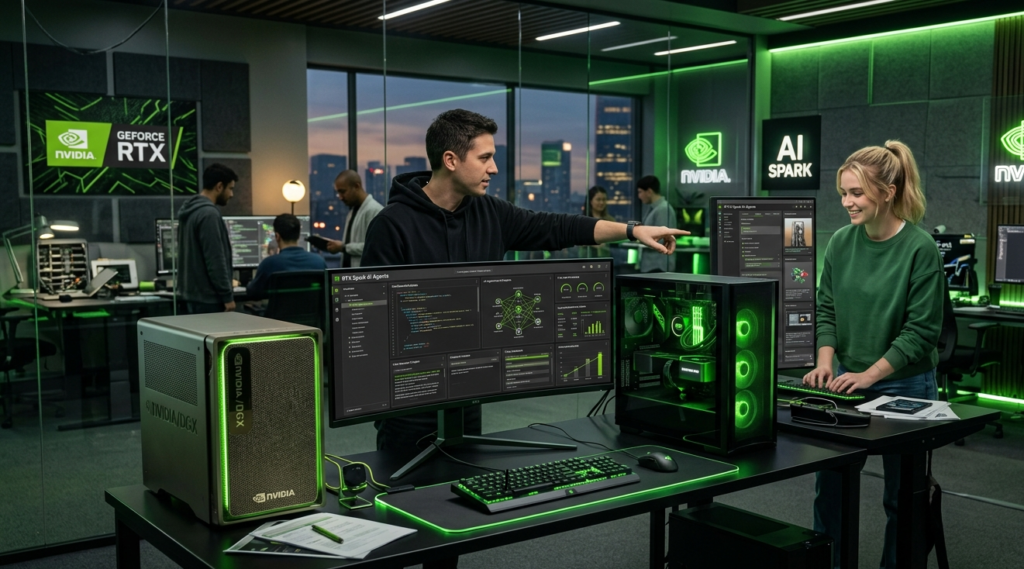
Nvidia expands local AI computing with RTX Spark PCs and powerful AI agents running directly on user devices.
NVIDIA has unveiled a major expansion of its artificial intelligence ecosystem by introducing RTX Spark PCs and extending support for local AI agents across RTX and DGX platforms. The announcement represents a significant step toward bringing powerful AI capabilities directly onto personal computers rather than relying exclusively on cloud-based infrastructure. NVIDIA believes this approach can improve privacy, performance, and user control while enabling more advanced AI-driven workflows.
The launch involves collaborations with several major technology companies and software developers. Industry leaders including Microsoft, Adobe, and Blender Foundation are participating in the initiative. Together, these organizations aim to create a more integrated environment where artificial intelligence can assist users across productivity, creative, and professional applications.
As interest in AI agents continues growing, NVIDIA’s strategy focuses on empowering users to run sophisticated models locally. This reduces dependence on remote servers while providing faster responses and greater protection for sensitive information.
RTX Spark introduces a new category of AI PCs
The centerpiece of NVIDIA’s announcement is the introduction of RTX Spark PCs. These systems are specifically designed to support personal AI agents capable of operating directly on a user’s device. Unlike traditional cloud-based AI services, local AI agents process data on the computer itself, reducing latency and enhancing privacy.
RTX Spark systems feature up to one petaflop of AI computing performance. This level of processing power allows users to run advanced AI models capable of handling complex reasoning, content generation, automation, and productivity tasks. NVIDIA has also equipped these systems with up to 128GB of unified memory to support demanding AI workloads.
The company envisions RTX Spark as a platform for developers, creators, professionals, and enthusiasts who want to incorporate AI deeply into their daily workflows. By combining powerful hardware with local processing capabilities, NVIDIA aims to make advanced AI tools more accessible and practical.
DGX Station targets professional AI workloads
Alongside RTX Spark, NVIDIA introduced a new DGX Station designed for Windows environments. This workstation targets professionals who require higher levels of AI inference performance and computational power. The DGX brand has long been associated with enterprise-grade artificial intelligence systems, and the new desktop version extends those capabilities to individual users.
Professional users increasingly need systems capable of handling large AI models, advanced simulations, and data-intensive applications. The DGX Station addresses these requirements by delivering enterprise-level performance within a desktop form factor. Researchers, engineers, content creators, and AI developers are expected to benefit from the platform.
The workstation reflects a growing trend toward local AI processing. As models become more powerful and applications more sophisticated, professionals seek hardware capable of supporting advanced AI workloads without relying entirely on cloud infrastructure.
Local AI agents gain momentum across industries
Artificial intelligence agents have become one of the most rapidly developing areas within the technology sector. Unlike traditional AI assistants that respond to individual prompts, AI agents can perform multi-step tasks, interact with software, and automate workflows with minimal user intervention.
These systems can search files, organize information, create content, analyze data, and coordinate actions across multiple applications. Their ability to perform complex sequences of tasks makes them attractive for productivity, business operations, software development, and creative projects.
NVIDIA believes local deployment provides several advantages. Running AI agents directly on a personal computer improves privacy because sensitive information remains on the device. It also reduces dependence on internet connectivity and cloud subscription services while providing faster execution for many tasks.
Microsoft strengthens Windows security for AI agents
Security remains one of the most important challenges associated with AI agents. Because these systems can access files, applications, and system resources, developers must ensure that users maintain control over what agents can do. To address these concerns, NVIDIA and Microsoft are introducing new security-focused technologies.
A key component of the strategy is OpenShell, a runtime environment designed for Windows-based AI agents. OpenShell utilizes Microsoft’s new security primitives, allowing developers to establish permissions and restrictions governing agent behavior. These controls help determine which files, applications, and functions an AI agent may access.
The platform also enables intelligent routing between local and cloud-based models depending on privacy preferences. Users can decide when information remains on-device and when cloud resources may be utilized. This flexibility provides greater transparency and control over AI operations.
Developers begin integrating advanced AI capabilities
Several software developers are already preparing applications that leverage OpenShell and Microsoft’s security framework. Among the first participants are Hermes Agent and OpenClaw, both of which aim to bring advanced agent capabilities to Windows environments.
These applications will allow users to perform a variety of tasks through AI agents. Capabilities include searching local files, generating images and videos, managing software workflows, and automating repetitive tasks. By integrating directly into Windows, the agents can interact with multiple programs simultaneously.
The goal is to transform personal computers into intelligent productivity platforms. Rather than simply responding to commands, AI agents can proactively assist users, streamline workflows, and reduce the time required to complete complex activities.
NemoClaw blueprint expands across NVIDIA platforms
NVIDIA is also extending its NemoClaw blueprint across a wide range of hardware products. Support now includes GeForce RTX systems, RTX Pro devices, RTX Spark PCs, DGX Spark, and DGX Station platforms. This expansion ensures a consistent AI experience across different categories of NVIDIA hardware.
The updated blueprint introduces simplified installation processes for both Linux and Windows Subsystem for Linux environments. New deployment tools reduce technical complexity while making AI agent implementation more accessible to developers and advanced users.
Automatic sandboxing further enhances security by isolating AI processes from critical system components. This approach reduces risks while allowing users to experiment with advanced AI applications in a safer environment.
NVIDIA focuses heavily on AI performance improvements
Performance remains central to NVIDIA’s strategy. The company highlighted several collaborations with open-source software communities aimed at improving inference speed and efficiency. One of the most notable partnerships involves the popular llama.cpp project.
According to NVIDIA, optimizations including multi-token prediction significantly improve performance for several advanced AI models. The company reported up to double the inference speed for some agent-focused models while delivering substantial gains across other configurations.
These improvements are important because AI applications often require considerable computational resources. Faster inference allows users to interact more naturally with AI systems while reducing waiting times and improving overall usability.
Multi-GPU support enhances local AI capabilities
Another major development involves enhanced support for multi-GPU configurations. NVIDIA announced that Llama.C++ now includes tensor parallelism capabilities for systems equipped with multiple graphics cards.
Users operating two equivalent GPUs can access up to twice the available memory and approximately 1.8 times the computing performance. These improvements make it possible to run larger AI models locally while maintaining responsive performance.
For advanced users and professionals, multi-GPU support represents a significant advantage. Larger models often produce better results but require greater computational resources. Enhanced scalability allows users to unlock more sophisticated AI capabilities directly on their desktop systems.
ComfyUI receives significant upgrades
NVIDIA also highlighted updates for ComfyUI, one of the most widely used tools for local generative AI workflows. The software has become popular among creators who generate images, videos, and multimedia content using artificial intelligence.
The new classifier-free guidance method reportedly delivers up to twice the performance on systems equipped with dual GPUs. Additionally, users can distribute model chains across multiple graphics processors, improving efficiency for complex workflows.
These enhancements support faster content generation and more responsive creative experiences. As AI-generated media continues gaining popularity, performance improvements become increasingly valuable for professionals and hobbyists alike.
Creative applications embrace AI acceleration
Creative software forms another major component of NVIDIA’s announcement. Adobe is actively optimizing several flagship applications for RTX Spark systems, taking advantage of unified memory, Blackwell GPU architecture, and TensorRT acceleration.
Applications such as Photoshop and Premiere are being redesigned to leverage advanced AI capabilities. NVIDIA says these improvements will enhance editing, compositing, color correction, and content creation workflows. Users can expect faster rendering, improved responsiveness, and expanded AI-assisted functionality.
Adobe also plans to integrate Windows-based AI agents directly into these applications. This integration could allow users to automate editing tasks, organize projects, generate creative assets, and streamline production processes through natural language interactions.
Blender and content creation tools gain AI enhancements
The open-source 3D creation platform Blender is also receiving important upgrades. NVIDIA announced support for DLSS 4.5 Ray Reconstruction within Blender’s Cycles rendering engine. This technology transforms the path-tracing viewport into a more interactive environment while maintaining near-final image quality.
For artists and designers, these enhancements improve visualization and accelerate creative workflows. Real-time rendering allows creators to make adjustments more efficiently and evaluate changes immediately.
NVIDIA is additionally introducing RTX Video Frame Generation technology. The feature can increase video frame rates in real time, potentially doubling or quadrupling playback performance. Support will be available through Python integrations and ComfyUI workflows.
Expanding ecosystem strengthens NVIDIA’s AI vision
Beyond creative software and productivity tools, NVIDIA continues expanding its broader AI ecosystem. Partnerships with organizations such as H Company introduce new computer-use models capable of interacting directly with desktop environments.
These systems can interpret screen content and control keyboard and mouse inputs, even when applications lack dedicated programming interfaces. Such capabilities move AI agents closer to functioning as genuine digital assistants capable of performing real-world computing tasks.
With updates including NVIDIA Broadcast 2.2, Project G-Assist enhancements, and Stream Deck integrations, the company is building an increasingly comprehensive platform for local AI computing.
NVIDIA positions local AI as the future of personal computing
NVIDIA’s latest announcements reflect a growing belief that artificial intelligence will become deeply integrated into everyday computing experiences. By combining secure software frameworks, advanced hardware, and developer-friendly tools, the company aims to accelerate adoption of local AI agents.
The strategy spans consumer devices, professional workstations, creative software, and enterprise applications. Rather than depending entirely on cloud infrastructure, users will increasingly have access to powerful AI systems running directly on their own machines.
As RTX Spark launches later this year and additional software becomes available, NVIDIA hopes to establish a new standard for personal AI computing. If successful, local AI agents could fundamentally change how people interact with computers, applications, and digital content in the years ahead.
About the Author