
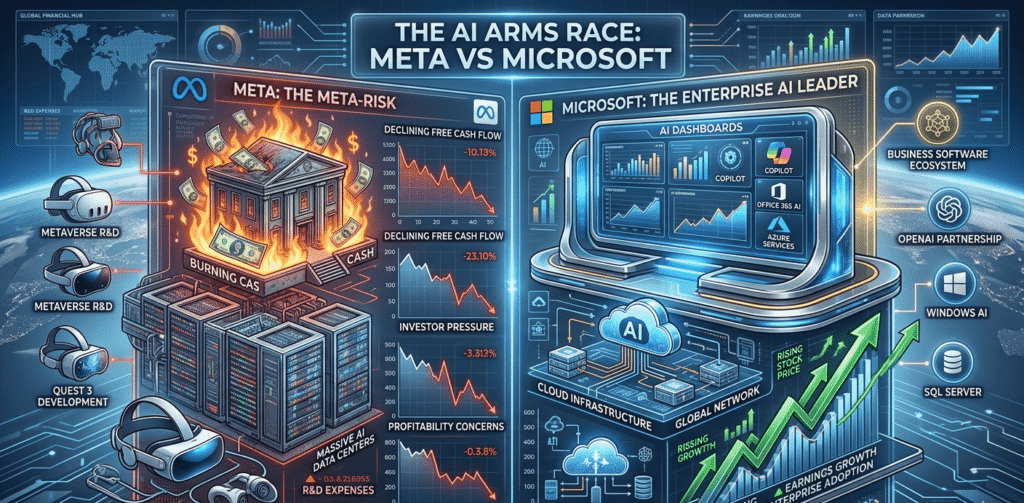
Meta’s massive AI and metaverse spending is raising concerns while Microsoft continues monetizing enterprise AI growth.
Meta came as one of the most significant surprises in 2026 with first-quarter profits of $10.44 per share compared to analyst estimates of $6.66 per share. Revenue rose to $56.31 billion, or over 33% higher than the previous year. It seemed to be another big win for a firm that still owns a significant portion of the digital advertising pie around the world. But the numbers’ story is not nearly as good as the headline.
Much of the earnings surprise was driven by an $8.03 billion tax benefit for the U.S. Treasury Notice 2026, which affects CAMT and the accounting treatment of research and development. The accounting benefit lifted Meta’s effective tax rate to about negative 23% and contributed about $3.13 per share to earnings. The quarter would have been solid anyway, but not anywhere near the blockbuster that investors were initially thrilled by if it hadn’t been for that one-time boost.
This is because the market is no longer just valuing revenue growth. Investors are increasingly focused on how efficiently large technology companies are converting revenue into durable free cash flow while navigating the extremely expensive artificial intelligence race. That is where Meta’s problems begin to emerge.
The Real Story Is the Spending Explosion
Meta is playing the infrastructure game, and spending money accordingly. Management increased its capital spending guidance to $125 billion to $145 billion, due to higher component costs, new investments in AI infrastructure and ongoing data-center expansion. The total capital expenditures (excluding capital sales) in first quarter were nearly $19 billion, an increase of about 47% year over year.
Those numbers are massive even by mega-cap technology standards. The problem is that the spending surge is not yet producing proportional financial returns. Despite strong revenue growth during fiscal 2025, Meta’s free cash flow reportedly declined almost 20% because capital expenditures jumped more than 93% year over year. That changes the investment equation significantly.
For years, Meta’s business model was admired because it combined high-margin advertising revenue with relatively efficient operating leverage. The company generated enormous cash flow while requiring far less infrastructure spending than traditional hardware or cloud-computing companies. Now that advantage is fading. Meta is pouring extraordinary amounts of cash into AI infrastructure, semiconductor procurement, compute clusters, and experimental product ecosystems while investors still lack visibility into the eventual payoff.
Reality Labs Continues to Burn Billions
The clearest symbol of Meta’s spending problem remains Reality Labs. The division lost approximately $4 billion during the quarter and around $19.2 billion during fiscal 2025. Years after Mark Zuckerberg repositioned the company around the metaverse vision, Reality Labs still operates as a massive financial drain with limited evidence of meaningful commercial traction. This long term vision could ultimately be beneficial. In the next decade, mixed reality, wearable computing, augmented interfaces, and AI-powered personal assistants may be among the major industries.
But markets eventually demand measurable progress. Investors tolerated Reality Labs losses for years because Meta’s core advertising business generated enough cash to absorb the spending. The difference now is that AI infrastructure costs are simultaneously exploding across the entire technology sector. Meta is effectively funding two extremely expensive future bets at once: artificial intelligence and the metaverse. That combination is starting to pressure the company’s financial profile.
The AI Monetization Problem
Mark Zuckerberg’s latest strategic pitch centers around “personal superintelligence” delivered to billions of users across Meta’s ecosystem. The vision sounds ambitious. The monetization path remains unclear. While enterprise-focused AI companies have a relatively simple path to monetizing AI infrastructure investments, this is not the case with Meta. Most of the company’s AI initiatives still revolve around future engagement optimization, future advertising improvements, future assistants, and future ecosystem expansion.
That creates a difficult timeline problem for investors. The company is spending enormous amounts of money today while asking shareholders to wait for uncertain long-term monetization opportunities tomorrow. That approach is no longer popular in the markets. The larger AI competition is already yielding clear winners in the fields of cloud computing, semiconductors and enterprise software. Investors are now more likely to like companies where AI requirements are already embedded in revenue growth and customer deal contracts, not just in future presentations. Investors are more attracted to companies that already include AI requirements in revenue growth and customer contracts, not just future presentations.
Microsoft Offers the Opposite Setup
This is why Microsoft increasingly looks like the stronger AI investment. Microsoft is also spending aggressively on infrastructure. The company’s Q3 FY2026 capital expenditures reportedly rose more than 84% year over year to around $30.88 billion. The difference is that Microsoft’s customers are already paying for the AI ecosystem being built.
Azure cloud services, enterprise AI workloads, Microsoft 365 Copilot, GitHub Copilot, cybersecurity tools, and OpenAI-powered software products are generating real commercial demand today. Microsoft is not simply building AI capacity in anticipation of future possibilities. It is monetizing AI adoption in real time. That distinction is crucial. Meta’s AI investments still rely heavily on future consumer behavior. Microsoft’s AI investments already connect directly to enterprise spending trends.
Enterprise AI Is Easier to Monetize
The main difference between enterprise AI and consumer AI speculation is that companies are willing to pay right away when they start to get more productive. Organizations that implement AI tools can quantify cost savings, reduce workflow, gain automation advantages, enhance cybersecurity, and improve operational efficiency. That makes for easy return-on-investment models that are conducive to subscription revenue and long-term contracts. Microsoft is right smack dab in the middle of that ecosystem.
The company already has one of the world’s largest enterprise software networks with Windows, Office, Teams, Azure, Dynamics, GitHub and cybersecurity solutions. When AI is integrated into the product, there are natural channels of earning money. Businesses do not need to radically change their workflows to adopt Microsoft AI tools. They simply upgrade existing systems they already depend on. That creates a far smoother commercialization path than Meta currently possesses.
Meta Still Depends on Advertising
While all the hype is about AI, Meta is still far too reliant on ad revenue. That business is still extremely strong. The combined power of Instagram, Facebook, WhatsApp, and Threads is one of the best advertising ecosystems ever. But there are structural constraints to advertising businesses. The advertising business is cyclical, economically sensitive, and relies on consumer engagement patterns, while also facing regulatory risks and scrutiny regarding data collection and privacy concerns.
AI infrastructure spending, meanwhile, is becoming permanent. Meta is transitioning from a relatively asset-light advertising company into a capital-intensive infrastructure company without yet developing equivalent diversification in revenue streams. That creates valuation pressure. Investors are beginning to question whether Meta deserves premium AI multiples when so much of its revenue still comes from digital ads rather than enterprise AI products or cloud infrastructure services.
The Market Is Becoming More Selective About AI Winners
The early phase of the AI boom rewarded nearly every company associated with artificial intelligence. That phase is ending. Markets are now separating companies into two groups. The first group includes businesses already generating direct AI revenue through semiconductors, enterprise software, cloud services, infrastructure, and productivity tools. The second group includes businesses spending aggressively on AI in hopes of creating future monetization opportunities.
Right now, Microsoft fits much more comfortably into the first category. Meta increasingly looks trapped in the second. That does not mean Meta cannot eventually succeed. It means investors may face a much longer timeline before seeing meaningful financial returns from the company’s extraordinary AI spending.
Meta’s Long-Term Potential Still Exists
It’s essential not to underestimate Meta altogether. That doesn’t mean the company has no clout on the world’s most influential consumer platforms. It still has an unimaginable number of users and it still generates huge advertising profits. Meta also possesses elite AI research talent and enough financial strength to continue investing aggressively for years if necessary.
If the company eventually succeeds in integrating AI deeply into advertising, social commerce, wearable devices, creator tools, and digital assistants, the upside could still be substantial. But investment decisions depend on timing as much as potential. Right now, Microsoft offers exposure to the same AI megatrend with significantly clearer revenue visibility and more predictable monetization.
Why Microsoft Looks Like the Better Buy
Microsoft’s advantage is not that it spends less on AI. Its advantage is that the spending already connects directly to paying customers. Every quarter, Microsoft can point to enterprise adoption metrics, cloud demand growth, AI software subscriptions, and infrastructure consumption tied directly to real businesses deploying AI tools.
Meta is still asking investors to believe that future consumer engagement and platform ecosystems will eventually justify today’s extraordinary costs. That is a much harder proposition in an environment where investors increasingly prioritize cash-flow durability.
Microsoft also benefits from stronger diversification. The company generates revenue from enterprise software, cloud infrastructure, gaming, cybersecurity, productivity tools, and AI services. Meta remains largely dependent on digital advertising while simultaneously carrying some of the largest speculative spending programs in the entire technology sector.
Bottom Line
Meta’s first-quarter earnings looked spectacular at first glance, but much of the surprise came from a one-time tax benefit rather than fundamental operating leverage. The company’s advertising business remains powerful, but its spending profile is becoming increasingly difficult to justify. Management has been increasing capex guidance, while massive AI investments and Reality Labs losses continue to put pressure on free cash flow.
In the meantime, Microsoft is already monetizing the AI transition via enterprise cloud services, software subscriptions and productivity tools utilized by businesses around the world. Meta is investing a ton of cash in the future. Microsoft is already charging customers for it. For investors seeking AI exposure with clearer economics, stronger monetization visibility, and more stable long-term cash flow potential, Microsoft currently looks like the far more attractive stock.
About the Author