
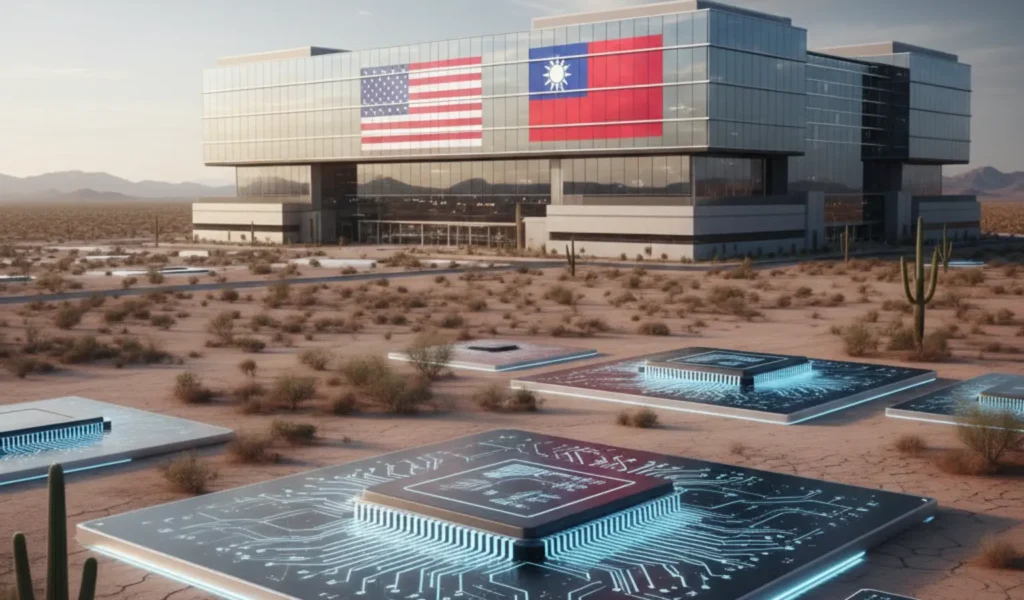
TSMC stands at the center of a proposed $250 billion investment pledge as the United States and Taiwan negotiate semiconductor trade and tariff exemptions.
TSMC sits at the center of a new trade debate following a deal signed this week between the United States and Taiwan. The agreement aligns tariffs on Taiwanese exports with those faced by other major US trading partners, signaling progress on the surface.
However, semiconductors were notably excluded, despite chips forming the backbone of trade between the two economies. That omission has shifted attention to a far larger commitment tied to the relationship: a proposed $250 billion investment pledge, with TSMC at its core.
A Big Promise With Few Details
Last month, Taiwan said its technology companies would invest $250 billion in the US in return for exemptions from future chip tariffs. That number raised eyebrows, not just because of its size but because there has been little clarity about how it would be reached.
Most analysts believe TSMC will carry the bulk of this commitment. The company already spends more on new factories and equipment than any other chipmaker in the world. Over the next three years, its capital spending is expected to far exceed the $101 billion it invested during the previous three-year period. Still, investors are struggling to understand how much more TSMC is expected to build in the US and how that will affect its operations in Taiwan.
Trump’s Trade Strategy Adds Complexity
The uncertainty reflects the broader challenge of operating under US President Donald Trump, whose trade policies often rely on pressure and negotiation rather than clear long-term rules. Industry sources say there is more detail behind the scenes than what has been made public. However, US officials are unlikely to release the full text of the January agreement before Trump meets Xi Jinping in Beijing this April. The goal is to avoid letting Taiwan-related issues complicate relations with China.
One proposal under discussion would allow TSMC to import chips into the US without tariffs, as long as it builds enough manufacturing capacity on American soil. These tariff-free quotas would be passed on to TSMC’s US customers, which are the companies that technically import the chips.
Why TSMC Matters So Much
TSMC has become one of the world’s most valuable companies by making advanced chips for customers like Nvidia and Apple. Its factories produce the processors that power smartphones, AI servers, and high-end computers.
US technology giants such as Google and Microsoft are spending vast sums on AI infrastructure built around Nvidia chips, many of which come from TSMC. Any disruption to that supply would have serious consequences. As one industry insider put it, TSMC is the deal. Without it, the trade agreement has little meaning for the chip sector.
Filling the $100 Billion Gap
According to US Commerce Secretary Howard Lutnick, about $100 billion of TSMC’s earlier commitments to build factories in the US already count toward the $250 billion pledge. Another $30 billion comes from TSMC’s supply chain.
Other Taiwanese companies, including Foxconn, are expanding operations in the US to assemble servers used in AI data centers. But these facilities cost far less than advanced chip factories, usually no more than $20 billion. That leaves a gap of around $100 billion, which analysts say only TSMC has the scale and expertise to fill.
Arizona as the Centerpiece
TSMC has already announced plans to invest $165 billion in Arizona. This includes six chip fabrication plants, two advanced packaging facilities, and a research and development center. The company began volume production for Nvidia and Apple at its first Arizona plant in late 2025.
Lutnick has suggested that TSMC’s US presence could grow even larger, with the aim of moving 40 percent of Taiwan’s chip supply chain to the US during Trump’s term. However, Taiwanese officials have said this target is unrealistic. People familiar with TSMC’s plans say the company may invest another $100 billion to build four additional fabs in Arizona. That would align with analysts’ estimates of what is needed to keep all chip sales to US customers free from tariffs in the long run.
Land, Space, and Long-Term Limits
TSMC recently bought 900 acres of land next to its existing Arizona site, bringing its total footprint there to around 2,000 acres. Analysts believe this could support up to 10 fabs, along with packaging and research facilities.
Even so, TSMC’s US operations would still be smaller than its presence in Taiwan for many years. In Taiwan, the company runs more than 15 fabs on sites far more compact than those in Arizona. For comparison, Intel plans to build eight fabs on a 1,000-acre site in Ohio. TSMC’s factories are expected to take up more space per fab due to larger clean rooms and on-site infrastructure.
Tariffs, Chips, and an Open Question
One major complication remains unresolved. Only a small portion of Taiwan’s exports to the US are standalone chips. Most semiconductors are built into products like servers or smartphones before entering the US. Experts say it may be extremely difficult for US customs officials to identify and value the chips inside those finished products.
As one executive noted, they will believe such tariffs are enforceable only when they see them collected. For now, TSMC sits at the center of a massive investment puzzle. Its decisions will shape not just US-Taiwan trade, but the future of the global chip industry.
About the Author