
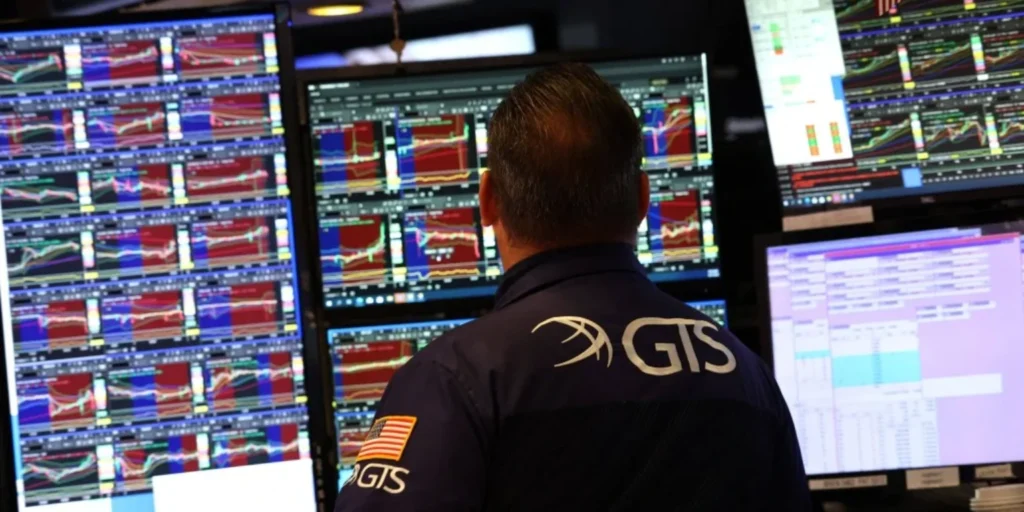
Hong Kong tech stocks fall into bear market territory as investors react to policy fears and global market pressures.
Technology stocks listed in Hong Kong and tied closely to mainland China have entered bear market territory. The sharp drop marks a major shift from the strong rally seen last year. Investors have grown nervous due to tax concerns, global market uncertainty, and fresh worries linked to artificial intelligence.
On Thursday, the Hang Seng Tech Index fell by more than 1 percent. This move pushed the index over 20 percent below its peak reached in October. The decline also marked the sixth straight losing session, highlighting how quickly sentiment has turned against the sector.
Tax Fears Weigh Heavily on Investor Confidence
One of the main reasons behind the recent sell-off is fear of higher taxes on internet services. Investors are concerned that China could raise value added tax on online platforms, following a recent tax increase applied to certain telecom services. That earlier move has raised worries that internet companies could be next in line. These fears have unsettled investors, especially since the tech sector has already gone through years of strict regulatory controls.
Speculation also spread to online gaming and digital transactions. This added to the pressure, as investors worried about new policy hurdles for companies that depend on digital payments and virtual services. Chinese officials stepped in earlier this week to deny rumors of a tax increase on the gaming industry. Even so, the reassurance did little to calm the market, as investors remain cautious.
Analysts Explain the Recent Sell-Off of Hong Kong
Market experts say the fear of tax hikes has been a key trigger behind the downturn. Qi Wang, an investment strategist at UOB Kay Hian, said the market reaction was closely linked to concerns over possible VAT increases.
He explained that the sell-off followed the recent tax rise on telecom services, which made investors nervous about similar measures being applied to internet firms, online gaming platforms, and other digital services. This uncertainty has made investors more sensitive to any sign of policy change, especially in a sector that is still rebuilding trust after earlier crackdowns.
Global Tech Weakness Adds to Pressure
The slump in Chinese tech stocks has not happened in isolation. It has come at a time when global technology markets are also facing pressure. Concerns about artificial intelligence disrupting traditional software businesses have played a role in weakening sentiment worldwide. Phelix Lee, a senior equity analyst at Morningstar, described the situation as a wave of negative news hitting markets at the same time.
He pointed to reports that Anthropic is rolling out an AI plugin capable of automating parts of legal work. This has raised fears among legal technology firms and contributed to a wider sell-off in software stocks. At the same time, concerns have emerged in the hardware side of the AI market. Reports suggesting tension between Nvidia and OpenAI have led to more cautious behavior among investors, especially those exposed to AI-related stocks.
Is This a Correction or Something More?
Despite the sharp drop, not everyone believes the tech sector is headed for a long-term decline. Some investors see the recent losses as a healthy correction after a strong run last year. Morningstar notes that the weakness appears concentrated in areas that had previously performed very well. In other words, the sell-off may be affecting stocks that had risen too far, too fast.
Lorraine Tan, director of equity research for Asia at Morningstar, said she views the move as a normal pullback rather than a sign of deeper trouble. She explained that the declines are mostly seen in sectors that had likely moved above fair value.
Long-Term Outlook Remains Intact for Some Investors
Other asset managers agree that the overall outlook for Chinese tech companies has not changed in a meaningful way. While near-term drivers are limited, the long-term picture still offers reasons for optimism. Vey-Sern Ling, managing director at Union Bancaire Privée, said the sector lacks clear short-term catalysts at the moment. However, he does not believe the fundamentals have weakened.
He also pointed out that recent regulatory noise in areas like travel and e-commerce appears to be isolated rather than part of a wider crackdown. According to him, these issues are specific and not a sign of broader policy shifts. Ling added that concerns over value-added tax remain one of the main uncertainties but have not yet translated into concrete actions against internet platforms.
Valuations and Earnings Offer Support
Despite recent losses, valuations in the Chinese tech sector remain attractive to some investors. Lower prices could provide opportunities for those willing to take a longer view.
Earnings growth also has the potential to recover as demand stabilizes and companies adjust their business models. In addition, artificial intelligence could still serve as a future growth driver, offering new products and revenue streams. While AI has contributed to short-term volatility, many believe it will eventually support innovation and efficiency across the tech industry.
Market Caution Likely to Continue
For now, caution is likely to dominate trading in Hong Kong tech stocks. Investors are watching closely for any signs of policy clarity, tax decisions, or global market stabilization. Until those concerns ease, volatility may continue. Still, many experts believe the recent downturn reflects uncertainty rather than a breakdown in the long-term prospects of Chinese technology companies.
As the dust settles, the sector’s ability to recover will depend on policy signals, earnings performance, and how global tech trends evolve in the months ahead.
About the Author