
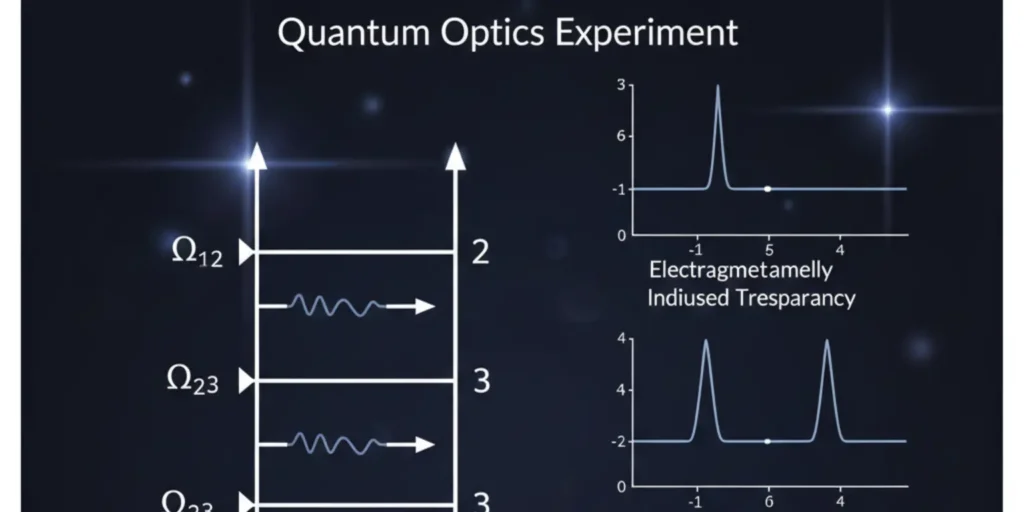
A four level atomic ladder system illustrating quantum frequency mixing and secondary Autler-Townes splitting under periodic driving.
Researchers have introduced a new way to control how light interacts with atoms by using a four-level atomic system. The work shows how quantum frequency mixing can modify transparency effects in atoms and produce a secondary form of Autler-Townes splitting. This achievement opens new paths for precise control in quantum systems and could support future advances in sensing and coherent signal manipulation.
The study was carried out by Sheng Xian Xiao, Tao Wang, and their colleagues at Chongqing University. Their findings show how combining electromagnetically induced transparency with periodic driving can reveal hidden interference effects that were not easily accessible before.
Understanding the Autler-Townes Effect
The Autler-Townes effect occurs when a strong electromagnetic field splits an atomic energy level into two separate peaks. This phenomenon is widely used in quantum optics to study light-matter interactions. In simple systems, the splitting is fixed by the strength of the applied field. However, in more complex systems, additional effects can emerge.
In this research, scientists discovered a second level of splitting within the original Autler-Townes structure. This secondary splitting appears when frequency mixing is introduced in a carefully designed four-level atomic setup.
The Four-Level Ladder Atomic System
The researchers used a ladder-type atomic system with four energy levels. It includes a ground state labeled |1⟩, an excited state |2⟩, and two long-lived upper states |3⟩ and |4⟩. A probe laser was tuned to the transition between |1⟩ and |2⟩, allowing the team to measure how transparent the system became under different conditions.
A control laser was applied between |2⟩ and |3⟩. This laser played a key role in producing electromagnetically induced transparency. Additional fields were then used to connect the two upper states |3⟩ and |4⟩, enabling quantum frequency mixing to take place.
How Quantum Frequency Mixing Changes the System
Quantum frequency mixing allows energy to be transferred between different frequencies through atomic interactions. In this case, the mixing occurred between the two upper states. A strong local oscillator field created two new dressed states with a defined energy gap.
By periodically driving this field, the researchers introduced what is known as a Floquet system. Floquet theory is used to describe systems that are driven in a repeating, time-dependent way. This approach allowed the team to model how multiple frequency components interact inside the atom.
The result was a system where resonant frequencies could be adjusted continuously, even when the applied signals were far from natural atomic transitions. This makes the approach useful for broadband operation and flexible control.
Two Types of Quantum Interference
One of the key discoveries of the study is the presence of two separate interference effects that influence the observed spectra. The first is Floquet channel interference. This type of interference comes from the interaction of different frequency components created by the periodic driving. It directly affects how strongly the dressed states are coupled and controls the distance between the split peaks in the spectrum.
The second effect is loop interference. This occurs when multiple coherent pathways connect the same atomic states, forming a closed loop. This interference changes the shape of the spectral lines and can make one peak broader or narrower than the other. Importantly, the researchers showed that these two effects can be adjusted independently. This means one can control peak separation without affecting line shape symmetry, or vice versa.
Observing Double Autler Townes Splitting
Using theoretical simulations, the team demonstrated how quantum frequency mixing leads to a double Autler-Townes structure. Under certain conditions, one type of interference can be switched off, keeping the peak spacing fixed. Under other conditions, both interference mechanisms act together, creating complex changes in peak spacing and linewidth.
They also found that changing the phase of the periodic drive caused the spectral features to shift in a predictable and repeatable way. This phase sensitivity makes the system useful for extracting information about external microwave fields.
Applications in Quantum Sensing and Control
One of the most promising outcomes of this research is its potential use in quantum sensing. Because the spectral features respond directly to the phase of an applied field, the system could be used to measure alternating electric fields with high precision.
Unlike traditional methods, this approach does not rely on specific natural atomic transitions. This makes it more flexible and easier to adapt to different frequency ranges. The ability to tune both spectral resolution and line shape using a single external control also makes the system attractive for advanced quantum control tasks.
Future Research Directions
The authors note that the current work is based on theoretical modeling and numerical simulation. Experimental verification will be an important next step to confirm the predicted effects.
Future studies may explore time-varying driving signals to enable dynamic sensing. The framework could also be extended to larger and more complex quantum systems, opening the door to new applications in quantum networks and precision measurement.
This work highlights how carefully designed driving schemes can unlock new behaviors in atomic systems and deepen our understanding of light-matter interaction.
About the Author