
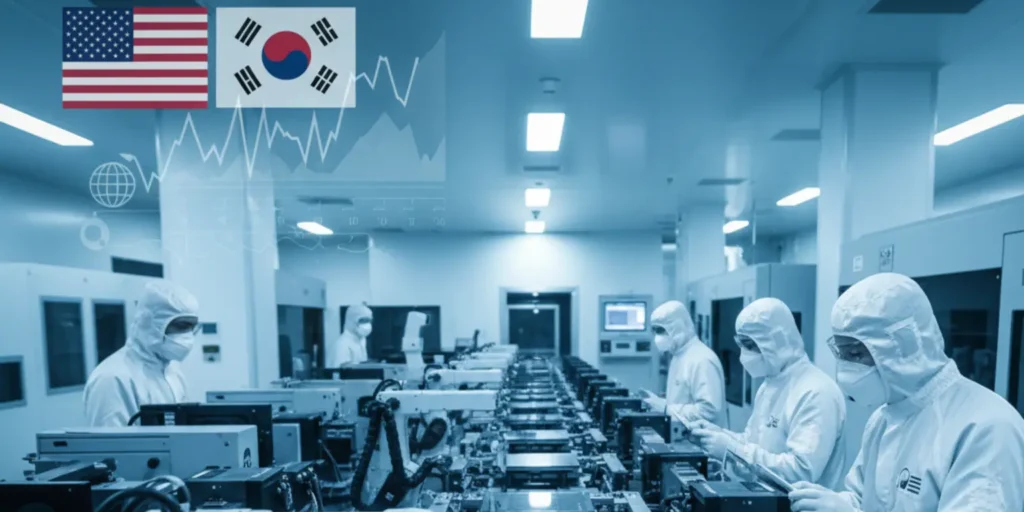
South Korean engineers work in a semiconductor factory, reflecting the impact of U.S. tariffs on AI chips.
South Korea has said that a new U.S. tariff on certain advanced computing chips is unlikely to cause serious problems for its chipmakers in the near term. While the government is watching the situation closely, officials believe the initial measures announced by Washington will not directly affect South Korea’s main semiconductor exports.
The comments come after the United States announced a 25 percent tariff on selected high-end artificial intelligence chips as part of a move to protect national security and encourage domestic manufacturing.
Focus on Advanced AI Chips
South Korea’s Trade Minister Yeo Han-koo said on Saturday that the first phase of the U.S. measures is limited in scope. According to him, the tariffs mainly target advanced computing chips produced by companies such as Nvidia and AMD.
Yeo explained that South Korean firms mostly export memory chips, not the advanced AI processors named in the U.S. proclamation. Because these memory chips are currently excluded from the tariff list, the immediate impact on South Korean companies is expected to be small. He added that the government is being careful not to overreact at this early stage, but remains alert to any changes in U.S. policy.
Caution Over Possible Second Phase
Despite the limited short-term impact, South Korea is not fully at ease. Minister Yeo warned that it is too early to feel comfortable, as there is still uncertainty around future measures. He noted that the U.S. could introduce a second phase of tariffs that may cover a broader range of semiconductor products.
At this point, there is no clear timeline or details on how such an expansion might take place. Yeo said the South Korean government will continue working closely with local chipmakers to prepare for different scenarios and to protect their interests as discussions with the United States continue.
Details of the U.S. Proclamation
On Wednesday, U.S. President Donald Trump signed a proclamation that places a 25 percent tariff on certain artificial intelligence chips. The move is aimed at addressing national security concerns linked to semiconductor imports.
The affected products include Nvidia’s H200 AI processor and AMD’s MI325X chip. These processors are used in advanced computing tasks, including artificial intelligence and high-performance data processing. The proclamation follows a nine-month investigation conducted under Section 232 of the Trade Expansion Act of 1962. This law allows the U.S. government to restrict imports if they are considered a threat to national security.
Exemptions for Data Centers and Other Uses
The White House said the new tariffs are narrowly targeted and include several important exemptions. Chips and related products imported for U.S. data centers will not be subject to the new duties. This is significant, as data centers are among the largest consumers of AI chips.
Other exemptions include chips used by startups, non-data center consumer products, civil industrial applications outside data centers, and U.S. public sector projects. These exclusions suggest that the U.S. is trying to limit disruption to key industries while still applying pressure on specific parts of the global chip supply chain.
Possibility of Broader Tariffs Ahead
While the current measures are limited, the U.S. has signaled that broader tariffs could follow. According to a fact sheet released by the White House, the United States may impose wider duties on semiconductors and related products in the future.
The goal of these potential tariffs would be to encourage more chip manufacturing within the United States and reduce reliance on overseas suppliers, especially those based in Asia. This long-term strategy has raised concerns among major chip-producing countries, including South Korea and Taiwan, which play a central role in the global semiconductor industry.
Warning to Foreign Chipmakers
U.S. Commerce Secretary Howard Lutnick added to these concerns on Friday. Speaking at a groundbreaking ceremony for Micron’s new chip plant near Syracuse, New York, he said foreign chipmakers could face much higher tariffs if they do not invest more in U.S. production.
According to a report by Bloomberg, Lutnick warned that South Korean and Taiwanese companies that fail to expand manufacturing in the United States could be hit with tariffs of up to 100 percent. His comments underline the pressure Washington is placing on global chipmakers to move more of their production to American soil.
South Korea’s Strategic Response
South Korea’s government has said it will stay engaged with both U.S. officials and domestic companies to find the best possible outcome. Officials are focusing on diplomacy, industry cooperation, and close monitoring of policy developments.
For now, South Korean chipmakers are somewhat shielded because their core products are memory chips rather than advanced AI processors. However, the situation could change if future U.S. measures expand to include a wider range of semiconductor products. Industry experts say South Korea will likely increase efforts to diversify export markets and strengthen its role in global supply chains to reduce exposure to sudden policy shifts.
A Situation Still Unfolding
While the immediate effects of the U.S. chip tariff appear limited for South Korea, the broader implications remain unclear. The possibility of expanded tariffs and tougher trade conditions means uncertainty will continue for the semiconductor industry.
South Korea’s cautious response reflects a balance between short-term confidence and long-term concern. As U.S. trade policy evolves, both governments and companies will need to stay flexible and prepared for further changes in the global chip market.
About the Author