Toyota tests electric vehicles as backup power sources for homes during grid outages
When the grid goes down, most homes go dark. But the large battery sitting in your driveway could change that. Toyota is now testing how an electric vehicle can power an entire home during a blackout — technology known as vehicle-to-home (V2H) and vehicle-to-grid (V2G). Here is how it works, what you would need to do it yourself, and why automakers and utilities increasingly see your EV as a home energy backstop.
What Is Vehicle-to-Home (V2H) and Vehicle-to-Grid (V2G)?
Most EV charging is a one-way street: electricity flows from the grid into the car. Bidirectional charging reverses that flow so energy can move out of the vehicle’s battery as well. There are two main versions:
- Vehicle-to-Home (V2H): the EV powers your house directly — useful during an outage, when a typical EV battery holds far more energy than a dedicated home battery.
- Vehicle-to-Grid (V2G): the EV sends energy back to the public grid, often during peak-demand hours, sometimes earning the owner credits or payments.
For context, a mid-size EV battery commonly stores 60–80 kilowatt-hours of energy. A home consumes roughly 30 kWh per day on average, so even a partially charged EV can keep essential circuits running for a day or more during an outage.
How Toyota’s bZ4X Backup-Power Test Works
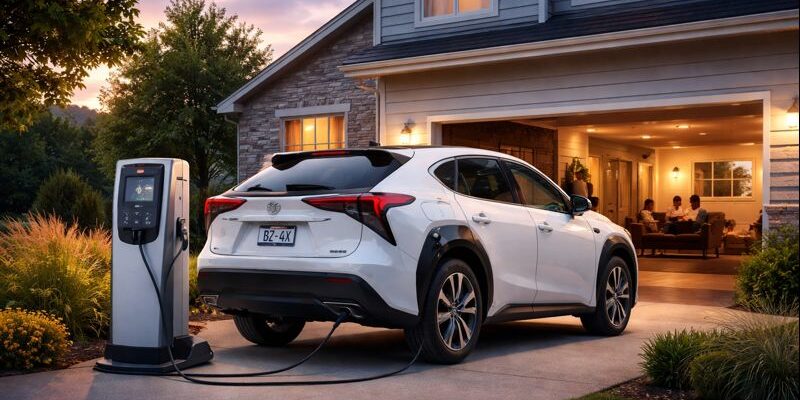
At Toyota’s North American headquarters in Plano, Texas, the company is running a real-world V2H and V2G pilot using a Japanese-market Toyota bZ4X electric SUV. The vehicle is connected to a bidirectional charger built by Fermata Energy, working in coordination with the local utility, Oncor.
Smart software sits at the center of the system, monitoring electricity demand and pricing in real time. The logic is simple but powerful:
- Off-peak: the vehicle charges when power is cheapest and grid demand is low.
- Peak demand or outage: the system either feeds stored energy back to the home or disconnects from the grid entirely, running the house on the car’s battery.
The result is an EV that doubles as a backup power source while easing stress on aging grid infrastructure — a meaningful benefit in a state like Texas, where extreme weather has repeatedly tested grid reliability.
Why Backup Power Matters Now
Power interruptions are becoming more common as electricity demand climbs across the United States. The U.S. Department of Energy projects that the number of plug-in electric vehicles on American roads could reach between 30 million and 42 million by 2030. The U.S. Energy Information Administration expects electricity consumption to rise about 1 percent this year and 3 percent in 2027 — which would mark the strongest four-year demand growth since 2000.
That surge is exactly why parked EVs are so attractive as distributed storage. Toyota estimates that if just four million U.S. electric vehicles had vehicle-to-grid capability, they could collectively store up to 40,000 megawatts of energy. For comparison, nuclear power currently supplies roughly 18 percent of total U.S. electricity generation. In other words, a fraction of the EV fleet could function as a vast virtual power plant.
What You Need to Use an EV as Home Backup
V2H is not yet plug-and-play for every household. To power your home from your car today, you generally need four things:
- A compatible EV that supports bidirectional discharging (not all models do).
- A bidirectional charger or power station capable of pulling energy out of the battery.
- Home integration hardware — typically a transfer switch or dedicated backup panel that safely isolates your home from the grid during an outage.
- Utility coordination, especially for V2G, since sending power back to the grid requires approval and the right interconnection setup.
The upfront cost of the charger and installation is the main barrier today, but prices are falling as more automakers build bidirectional capability into their vehicles by default.
Which EVs Support V2H Today?
The list of bidirectional-capable EVs is growing quickly. Among the most widely cited examples are the Ford F-150 Lightning (with its Home Integration System), the Nissan Leaf — an early V2G pioneer — and newer models from Kia, Hyundai, and other manufacturers now adding the feature. Toyota’s bZ4X pilot signals that the company intends to join that group. Always confirm a specific model’s bidirectional support and the required hardware before buying, as capabilities and regional availability vary.
Does It Damage the Battery?
The most common concern about V2H is battery wear. Toyota’s testing data suggests the worry is overstated: the company reports that battery degradation from vehicle-to-home use is minimal and occurs far less often than many assume. Modern battery-management systems limit how deeply the pack is discharged and how fast energy moves in and out, protecting long-term health. For occasional outage backup — the most common real-world use — the impact on battery life is generally negligible.
Toyota’s Vision: Your Car as Energy Insurance
Toyota leadership frames bidirectional charging as a practical, everyday benefit rather than a science experiment. Christopher Yang, Senior Vice President of Enterprise Strategy and Solutions at Toyota Motor North America, said the company is focused on delivering technologies that reduce energy costs and support sustainability. As data centers and AI infrastructure drive electricity demand even higher, the humble parked EV may increasingly serve as personal energy insurance — and as a building block of a more resilient grid.
Frequently Asked Questions
How long can an EV power a home?
It depends on the battery size and your usage. With an average home drawing about 30 kWh per day and many EVs storing 60–80 kWh, a fully charged vehicle can often run essential circuits for two to three days — longer if you limit use to fridges, lighting, and devices.
Is V2H safe during an outage?
Yes, when installed correctly. A transfer switch or backup panel isolates your home from the grid so power cannot flow back onto lines that utility crews may be repairing — a critical safety requirement called anti-islanding.
Is vehicle-to-home worth it?
For homeowners in areas prone to outages, V2H can replace a standalone home battery or gas generator while using energy you already pay to store in your car. The main trade-off today is the upfront cost of bidirectional hardware.
The Bottom Line
Toyota’s bZ4X pilot is a preview of a future where electric vehicles do far more than drive. As bidirectional charging becomes standard and grid pressure grows, your EV could become one of the most valuable backup-power assets you own — quietly turning every driveway into a small, mobile power plant. For more on the technology shaping energy and transport, explore our Technology coverage.
About the Author