
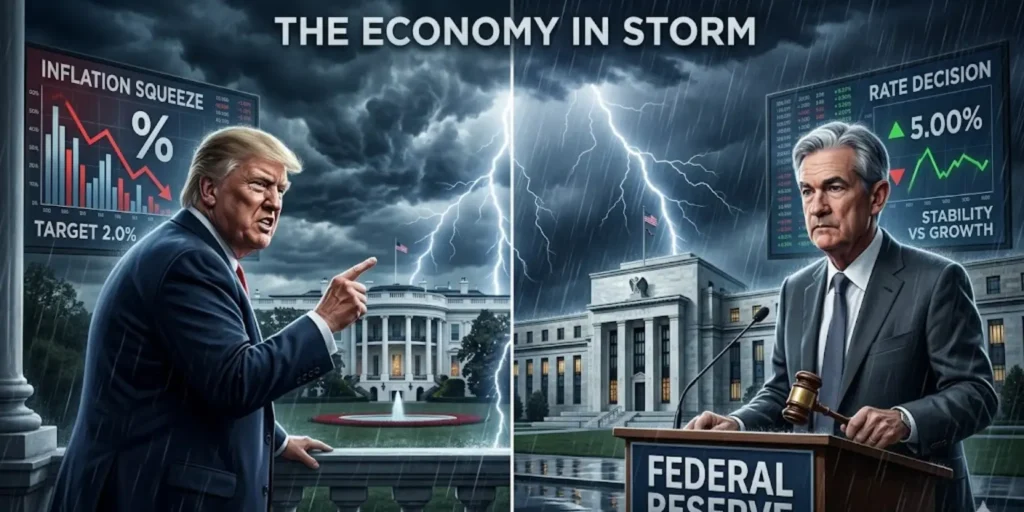
Donald Trump’s remarks about firing Fed Chair Jerome Powell intensify concerns over Federal Reserve independence and market stability.
US President Donald Trump has escalated his long-running conflict with Federal Reserve Chair Jerome Powell, saying he would consider firing him if Powell does not step aside when his term ends in May. The comments add fresh political uncertainty around the future leadership of the Federal Reserve at a time when markets are already sensitive to interest rate expectations.
The dispute centers on monetary policy disagreements, particularly Powell’s reluctance to cut interest rates as aggressively as Trump has demanded. The tension has been building for months, but the latest remarks signal a more confrontation over the central bank’s independence.
The Core of the Conflict: Interest Rates
At the heart of the disagreement is the Federal Reserve’s stance on interest rates. Powell and other Fed officials have maintained a cautious approach, prioritizing inflation control and economic stability.
Trump, however, has repeatedly argued that rates should be lower to stimulate growth and reduce borrowing costs. He has publicly criticized Powell multiple times, calling him a “knucklehead” and accusing him of poor decision-making.
The Federal Reserve operates independently from the White House, and this independence is considered a cornerstone of modern US monetary policy. Any attempt by a president to remove the Fed chair would be highly unusual and politically contentious.
The Succession Uncertainty Around May
Powell’s current term as chair is set to end on May 15. According to reports, he plans to remain in his role temporarily until a successor is confirmed by the Senate. Trump has indicated support for former Fed governor Kevin Warsh as a potential replacement. However, Warsh’s confirmation process faces complications, including resistance from influential senators.
One key figure is Senator Thom Tillis, who has suggested he may block Warren’s nomination unless a separate investigation into Powell is dropped. That investigation reportedly involves questions around renovations at the Federal Reserve building and allegations of excessive spending. This creates a layered political standoff involving the White House, Congress, and the central bank all at once.
Trump’s Comments and the “Firing” Threat
In an interview with Fox Business, Trump said: “Then I’ll have to fire him,” referring to Powell’s potential decision to remain in office beyond his term. He also suggested he had previously restrained himself from firing Powell, despite frustration with his policy approach. At the same time, Trump emphasized that he did not want to be “controversial,” even as his comments directly raised the possibility of unprecedented action against a sitting Fed chair.
Trump has also continued to criticize Powell’s handling of Federal Reserve operations, including the renovation of its headquarters, which he claims was unnecessarily expensive. He has suggested the project could have been completed for a fraction of its reported cost. However, Trump also indicated he was not willing to intervene in the ongoing investigation into Powell, stating that accountability should be determined through proper review.
Why This Matters for the Federal Reserve
The Federal Reserve is designed to operate independently from political pressure in order to maintain credibility in managing inflation and employment. The chair of the Fed plays a central role in setting interest rate policy and guiding financial markets.
Any perceived political interference in that process can have significant consequences. Markets often react strongly to signals that Fed independence may be weakened, as it raises concerns about inflation control and long-term policy stability.
If a US president were to attempt to remove a sitting Fed chair before the end of their effective influence, it would represent a major break from precedent in modern American economic governance.
Market Sensitivity to Fed Leadership
Financial markets closely track every signal from the Federal Reserve because interest rates influence borrowing costs, stock valuations, and currency strength.
When earlier speculation emerged in 2025 that Trump might attempt to fire Powell, markets reacted negatively, with both equities and the US dollar slipping. Investors tend to view central bank independence as a stabilizing force, and uncertainty around leadership can quickly translate into volatility.
Even without immediate policy changes, leadership uncertainty alone can affect expectations around inflation, rate cuts, and economic growth.
The Role of Congress in the Standoff
The situation is further complicated by Senate involvement in the confirmation process for Powell’s potential successor. Senator Thom Tillis has reportedly warned that he may block Kevin Warsh’s nomination unless the investigation into Powell is dropped. This introduces a legislative layer into what is already a high-stakes executive and regulatory dispute.
If Warsh is not confirmed in time, Powell could remain in a temporary capacity beyond his formal term, extending the period of uncertainty. This kind of political gridlock is not unusual in US appointments, but it is highly significant when it involves the central bank’s leadership.
Powell’s Position and Institutional Norms
Jerome Powell has previously stated that he intends to remain in office until a successor is properly confirmed, consistent with standard Federal Reserve practice. Historically, Fed chairs often stay in position during transition periods to ensure continuity in monetary policy. This reduces the risk of abrupt policy shifts or leadership vacuums.
Powell was originally appointed by Trump in 2017 and later reappointed by President Joe Biden in 2021, reflecting bipartisan support at the time. That cross-administration support highlights how unusual it is for a Fed chair to become a central political conflict.
The Political Stakes Behind Monetary Policy
While the dispute is framed publicly around interest rates and spending decisions, it also reflects broader political stakes. Lower interest rates typically support borrowing, investment, and stock market growth, which can be politically favorable in the short term. However, the Federal Reserve must balance this against inflation risks and long-term economic stability.
Powell’s cautious stance suggests the Fed is prioritizing inflation control, even if it slows economic expansion. Trump’s position reflects pressure for faster monetary easing to support growth. This tension between short-term political incentives and long-term economic policy is at the core of the conflict.
What Happens Next
The immediate future depends on several moving parts: Powell’s decision to stay on temporarily, Senate confirmation of a successor, and whether Trump escalates his rhetoric into formal action.
Even if no firing occurs, the public conflict itself could influence market expectations around future rate decisions. Investors will be watching upcoming Fed meetings closely for any signs of policy adjustment or internal division.
If uncertainty continues into May, markets may begin pricing in a more volatile policy environment, particularly if the leadership transition becomes protracted.
Final Thoughts
The confrontation between Donald Trump and Jerome Powell underscores the delicate balance between politics and monetary policy in the United States.
While presidential frustration with interest rates is not new, the suggestion of removing a sitting Fed chair pushes into historically untested territory. The outcome of this standoff will not only determine leadership at the Federal Reserve but could also shape how markets perceive US economic stability going forward.
At its core, this is an independence debate: whether the Federal Reserve can continue to operate free from political pressure, or whether economic policy will become more directly influenced by the White House in the months ahead.
About the Author