
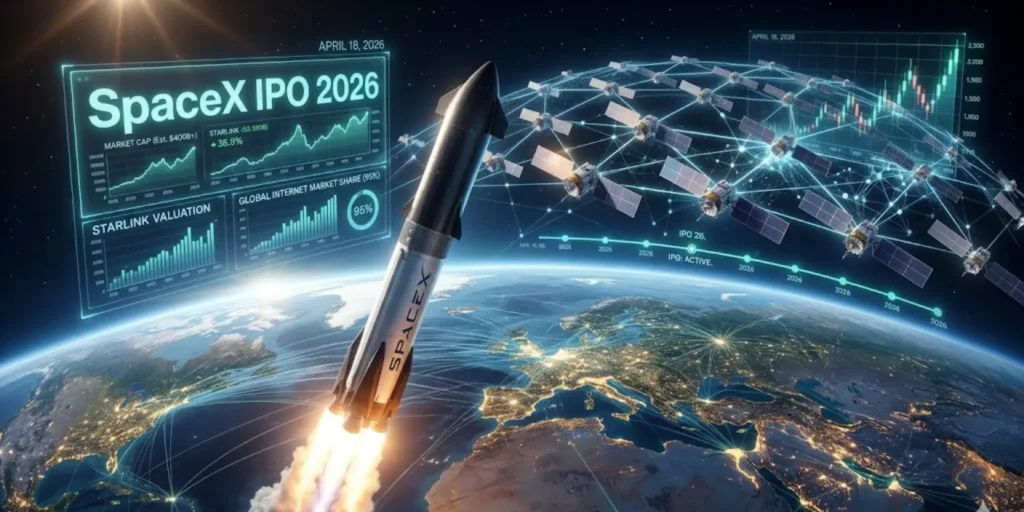
SpaceX’s IPO could redefine markets by merging space infrastructure, global internet connectivity, and AI into a single trillion-dollar platform.
SpaceX’s move toward public markets in 2026 is not just another tech IPO—it is the largest potential listing in financial history. With a targeted valuation of $1.75 trillion and a planned $75 billion raise, the company is attempting to enter public markets at a scale that reshapes how investors think about aerospace, telecom, and even AI infrastructure. What makes this moment unusual is that SpaceX is no longer a “future promise” company. It is already generating multi-billion-dollar cash flow from Starlink while dominating global launch markets.
The central tension for investors is simple: SpaceX is arguably one of the most strategically important companies in the world, but it is also entering public markets at a valuation that assumes near-perfect execution across multiple businesses that are still scaling.
SEC Filing and IPO Timeline: Where the Process Stands
SpaceX’s confidential SEC filing on April 1, 2026, marks the official beginning of its IPO process. This filing allows regulators to review financials, risk disclosures, and structural details before the public sees anything. The public S-1 is expected in late April or May, marking the first real opportunity for investors to evaluate profitability, margins, and segment breakdowns.
The company is currently targeting a June 2026 Nasdaq listing, with a roadshow scheduled for early June. During this phase, institutional investors will evaluate the pricing range, which is already being discussed between $1.75 trillion and $2 trillion, depending on demand. This stage is critical because even minor adjustments in growth assumptions or margins can shift valuation by hundreds of billions.
Starlink: The Core of the Investment Thesis
Starlink is the financial engine that transforms SpaceX from a launch company into a global infrastructure platform. With over 10 million subscribers as of early 2026, Starlink has scaled faster than almost any telecom or subscription service in history.
Revenue is expected to exceed $10 billion in 2025 and potentially reach $20 billion or more in 2026. What matters more than revenue is profitability—Starlink is already generating strong operating margins and meaningful free cash flow, making it one of the few satellite internet businesses that actually works at scale.
The long-term opportunity is even larger. With billions of people still underserved by traditional broadband infrastructure, Starlink is effectively building a global telecom network without relying on ground infrastructure. This creates a structural moat that is extremely difficult for competitors like Project Kuiper or regional telecom providers to replicate quickly.
Starship and Launch Business: High Risk, High Strategic Value
While Starlink drives cash flow, SpaceX’s launch business remains strategically critical. The Starship program is the next major phase, designed to dramatically reduce the cost of orbital launches while enabling deep-space missions, lunar landings, and large-scale satellite deployment.
The upcoming V3 Starship test flight is a key near-term catalyst. A successful launch would strengthen investor confidence ahead of the IPO roadshow, while delays or failures could increase perceived risk around execution capability.
Beyond commercial launches, SpaceX holds billions in NASA and U.S. defense contracts. These government relationships provide predictable revenue streams and reinforce the company’s strategic importance in national security infrastructure.
xAI Merger: SpaceX Becomes a Space-AI Platform
A major structural shift in the IPO narrative is the integration of xAI into SpaceX in early 2026. This merger pushes SpaceX beyond aerospace and telecom into artificial intelligence infrastructure, particularly by integrating Grok models into satellite operations and network optimization.
The combined entity is being framed as a “space-AI infrastructure platform,” where satellites, data centers, and AI models operate as a unified system. This positioning expands SpaceX’s total addressable market beyond traditional aerospace into cloud computing, AI inference, and distributed computing networks.
However, this also introduces complexity. Investors will need to understand how xAI’s financials, intellectual property, and liabilities are reflected in SpaceX’s consolidated reporting. This is likely to be one of the most closely scrutinized sections of the S-1.
Valuation: Why $1.75 Trillion Is Controversial
At a targeted valuation of $1.75 trillion, SpaceX would trade at roughly 80–90x projected revenue. This places it far above traditional aerospace companies and even most high-growth tech firms. There is essentially no direct public-market comparison at this scale.
The bullish argument is that SpaceX is not a traditional aerospace company. Instead, it is a vertically integrated infrastructure platform combining satellite internet, launch services, defense systems, and AI computing. In this framing, the valuation reflects future dominance in multiple trillion-dollar industries.
The bearish view is more straightforward. Even with strong Starlink growth, the valuation assumes flawless execution across Starship, satellite scaling, defense contracts, and AI integration. Any slowdown in subscriber growth or launch economics could result in significant multiple compression after listing.
Retail Allocation: A Rare Structural Shift
One of the most unusual aspects of this IPO is the reported 30% allocation to retail investors. Standard IPOs typically allocate only 5–10% to retail participants, so this represents a major departure from Wall Street norms.
This move is expected to create massive oversubscription. Demand is likely to exceed supply by 10x or more, meaning most retail investors will receive only partial allocations even if they are approved.
The strategy appears aligned with Elon Musk’s broader approach of reducing institutional gatekeeping and building a strong long-term retail shareholder base that is less sensitive to short-term volatility.
Risk Factors Investors Cannot Ignore
Despite strong fundamentals, SpaceX carries unique risks that are structurally different from typical tech IPOs. The most significant is governance concentration. Musk retains approximately 42% economic ownership and significant voting control, creating a single-decision-maker structure across multiple major companies simultaneously.
Another major risk is regulatory exposure. SpaceX operates under strict defense and aerospace regulations, including classified contracts that will be partially redacted in public filings. This limits transparency and creates information asymmetry for public investors.
There is also execution risk in Starship development. While Starlink is already profitable, Starship represents the long-term scalability engine for cost reduction in space logistics. Delays or failures in this program could impact future growth assumptions.
Finally, competition is intensifying. Amazon’s Project Kuiper and Blue Origin represent long-term challenges in satellite internet and launch services, even if they currently lag behind SpaceX in execution.
How to Invest in SpaceX Stock
For most investors, participation will begin at the IPO itself rather than in private markets. The confidential filing phase does not allow public trading access, and pre-IPO shares are limited to accredited investors on secondary platforms.
Once the public S-1 is released, major brokerages such as Fidelity, Schwab, and Robinhood are expected to offer IPO access. However, allocation will be highly competitive due to extreme demand.
After listing, investors should pay close attention to the lock-up expiration period, typically 90–180 days post-IPO. This is often when early investors and insiders begin selling shares, which can create short-term price volatility.
Competitive Landscape: SpaceX vs the Space Economy
SpaceX currently dominates global launch services with more than 60% market share, far ahead of competitors like United Launch Alliance and Rocket Lab. However, competition is evolving quickly in both launch and satellite internet.
Amazon’s Project Kuiper is the most direct competitor to Starlink, though it remains years behind in deployment scale. Blue Origin is developing heavy-lift capabilities with New Glenn, while Rocket Lab is targeting smaller satellite launch markets.
Despite these challenges, SpaceX’s integrated model—combining rockets, satellites, and software—gives it a structural advantage that is difficult to replicate.
Final Outlook: What This IPO Really Represents
The SpaceX IPO is not just a liquidity event. It is the transition of a private industrial monopoly into a public market asset spanning space infrastructure, global internet connectivity, defense systems, and AI computing.
At $1.75 trillion, expectations are extremely high, and the valuation leaves limited room for execution mistakes. However, the company also operates in markets with enormous long-term demand tailwinds, particularly satellite internet and space-based infrastructure.
Ultimately, SpaceX represents a rare type of IPO where the debate is not whether the company is important, but whether public markets are willing to price in its full multi-industry future at once.
About the Author