
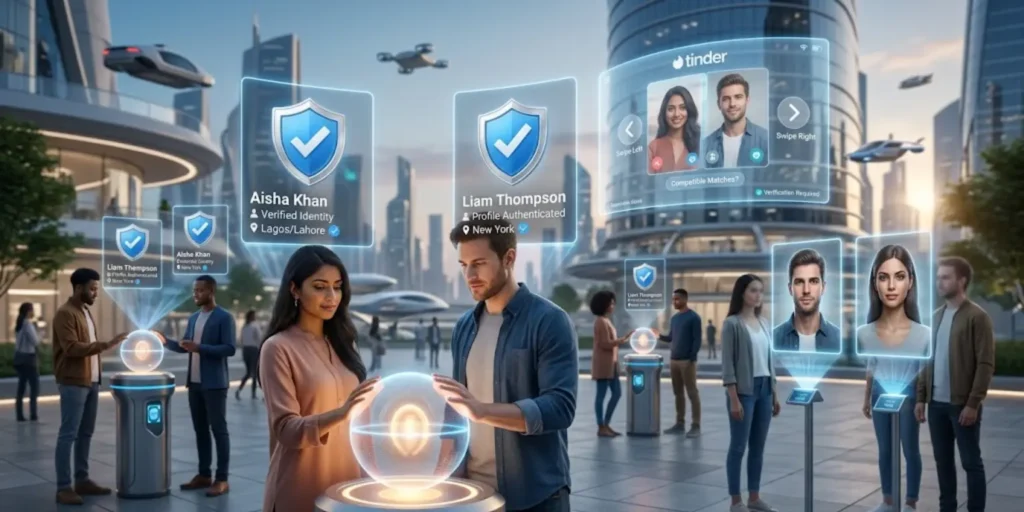
Sam Altman pushes World into mainstream use with new integrations like Tinder.
Sam Altman’s ambitious identity verification project, World (formerly Worldcoin), is entering a new phase — one focused on scaling its “proof of human” technology across everyday digital experiences. The latest move signals a major expansion beyond crypto roots, starting with a surprising but strategic partner: Tinder.
At a launch event in San Francisco, Altman framed the initiative as a response to a rapidly approaching reality: a world where AI-generated content may outnumber human-created interactions. The challenge, he argued, is no longer just building intelligent systems — it’s knowing whether you’re interacting with a human at all.
The Core Idea: Proof of Human in an AI World
The world’s central concept is simple but powerful: verify that a real human is behind an online account without exposing their identity. This is achieved through advanced cryptography, specifically zero-knowledge proofs, which allow systems to confirm authenticity without revealing personal data.
Instead of usernames and passwords alone, users can have a “World ID” — a digital credential proving they are a unique human being. This could fundamentally reshape how trust works online, especially as bots and AI agents become more sophisticated.
How the Orb Works
At the heart of the World’s system is a futuristic device known as the Orb. This spherical scanner captures a user’s iris and converts it into a unique cryptographic identifier.
The process:
- The Orb scans the user’s eyes
- The scan is converted into a secure, anonymous ID
- The user receives a verified World ID
This ID can then be used across platforms to prove humanity without revealing personal identity.
While effective, this process has also been one of the biggest barriers to adoption. Requiring people to physically visit a location for an eye scan is not exactly frictionless — and has raised both practical and privacy concerns.
Tinder Integration: A Strategic First Move
The world’s integration with Tinder is a major milestone. The dating app has long struggled with bots, fake profiles, and catfishing — making it an ideal testing ground for human verification.
The rollout builds on a pilot program in Japan and will now expand globally, including the United States. Verified users will display a World ID badge on their profiles, signaling that they are real individuals.
This could significantly improve trust in online dating, where authenticity is often the biggest concern.
Beyond Dating: Expanding Into Everyday Life
The world is not stopping with dating apps. The company outlined a broad vision for integrating its verification system across multiple sectors.
Ticketing and Live Events
Through a new feature called Concert Kit, World aims to combat ticket scalping — a problem driven largely by bots. By partnering with platforms like Ticketmaster and Eventbrite, the system can reserve tickets specifically for verified humans.
Artists like 30 Seconds to Mars and Bruno Mars are already planning to use this feature for upcoming tours.
Business and Communication Tools
The world is also targeting enterprise use cases. Integrations with platforms like Zoom aim to prevent deepfake impersonation during meetings, while partnerships with DocuSign could ensure that contracts are signed by verified humans.
These applications highlight a growing concern: as AI-generated voices and faces become indistinguishable from real ones, verifying identity becomes critical in professional environments.
Preparing for the “Agentic Web”
One of the more futuristic aspects of World’s roadmap is its preparation for what Altman and others call the “agentic web” — a digital environment where AI agents act on behalf of humans.
The world is developing a feature called “agent delegation,” allowing users to assign their World ID to an AI agent. This means:
- The agent can perform tasks online
- Platforms can verify that a real human is behind the agent
- Accountability is maintained even in automated interactions
A partnership with Okta is helping build this system, ensuring that agents are securely tied to verified individuals.
Solving the Scaling Problem
Despite its ambitious vision, World has struggled to scale — largely due to the friction involved in its verification process.
To address this, the company is introducing multiple verification tiers:
High Security: Orb Verification
The gold standard involves iris scanning for maximum accuracy.
Mid-Level: Government ID Verification
Uses NFC-enabled ID cards to confirm identity without requiring an Orb.
Low Friction: Selfie Verification
A quick, privacy-focused option using facial recognition processed locally on the user’s device.
Each tier offers a trade-off between security and convenience, allowing developers to choose the level of verification for their use case.
Privacy and Controversy
The world’s approach has not been without criticism. The idea of scanning irises — even with privacy protections — raises concerns about biometric data collection.
The company insists that its system is designed to protect user privacy:
- Data is anonymized
- Images are not stored centrally
- Verification relies on cryptographic proofs
Still, skepticism remains, particularly in regions with strict data protection regulations.
Why This Matters Now
The timing of World’s expansion is critical. AI-generated content is becoming increasingly realistic, blurring the line between human and machine interaction.
This creates several challenges:
- Fake accounts and bots are flooding platforms
- Deepfake videos and voices are undermining trust
- Difficulty verifying authenticity in digital transactions
The world’s “proof of human” system is one attempt to solve these problems at scale.
The Bigger Picture: Identity in the AI Era
The world’s vision goes beyond individual products. It represents a broader shift in how identity might work in a world dominated by AI.
Traditional identity systems rely on personal information — names, emails, documents. The world proposes a different model: proving uniqueness without revealing identity.
If successful, this could:
- Reduce fraud and bot activity
- Enhance privacy
- Create new standards for digital trust
However, adoption will depend on whether users and platforms are willing to embrace this new paradigm.
Final Thoughts: Sam Altman Expands World Into Mainstream Platforms
Sam Altman’s World project is making a bold bet: that the future of the internet will require a universal way to prove humanity. By expanding into platforms like Tinder and beyond, the company is moving from concept to real-world application.
The challenge now is execution. Scaling the technology, addressing privacy concerns, and convincing users to adopt a new form of identity will not be easy.
But if World succeeds, it could redefine how trust works online — turning “Are you human?” from a simple CAPTCHA question into a foundational layer of the digital economy.
About the Author