
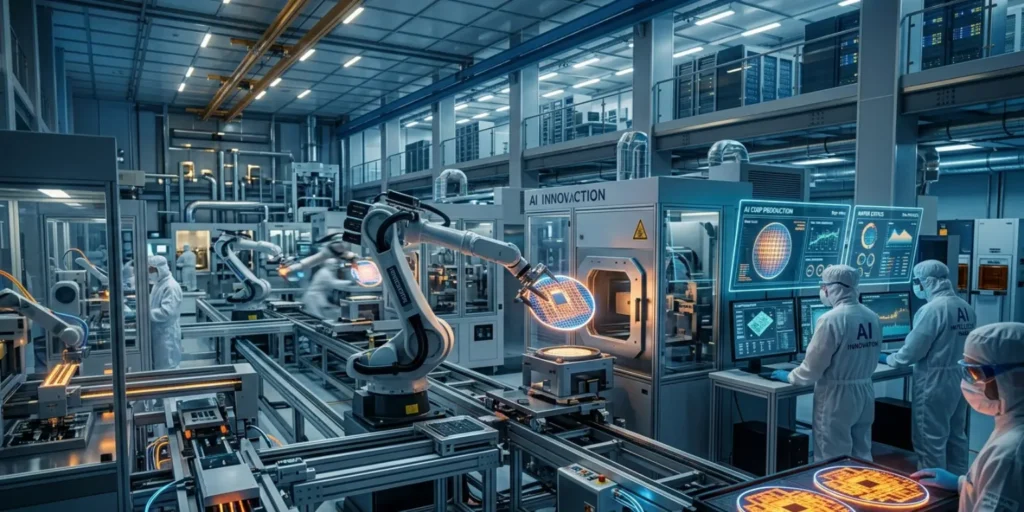
TSMC’s advanced chip production drives record growth fueled by AI demand
Taiwan Semiconductor Manufacturing Company, often called TSMC, has kicked off 2026 with a very strong performance. The company reported total revenue of NT$1,134.10 billion for the first quarter. That is about $35.71 billion based on current exchange rates. This result sits at the very top of the company’s earlier forecast, which ranged between $34.6 billion and $35.8 billion.
This growth is impressive when compared to the same period last year. Revenue increased by 35.1 percent in Taiwan dollar terms. In simple terms, TSMC added a huge amount of new business in just one year, even while many other parts of the semiconductor industry struggled.
March 2026 stood out in particular. The company generated NT$415.19 billion in just that one month. That makes it the strongest March in TSMC’s history. It also shows how quickly demand is rising, especially in areas linked to artificial intelligence.
A Closer Look at the Numbers
The headline figure of NT$1,134.10 billion is important, but what matters more is the growth behind it. In the first quarter of 2025, TSMC reported NT$839.25 billion in revenue. That means the company added nearly NT$295 billion in just one year.
This kind of increase is rare for a company of TSMC’s size. It is already one of the largest semiconductor manufacturers in the world. Adding that much revenue in a single year shows how strong demand has become, especially for advanced chips.
Another key point is how TSMC performed compared to expectations. Analysts had predicted slightly lower numbers. The company managed to exceed those estimates, even with some challenges such as currency changes and slower seasonal demand for smartphones.
Why March 2026 Matters So Much
March was not just another strong month. It gives clues about what might happen next. Revenue rose 30.7 percent compared to February. While February is a shorter month, that is still a sharp jump for a company of this scale.
Even more important is the year-on-year growth for March, which came in at 45.2 percent. That suggests demand is not only strong but also accelerating.
This kind of increase often signals that customers are placing more orders ahead of future product launches. It may also show that production of newer chip technologies is picking up speed.
What Makes This Quarter Different
TSMC has delivered solid results for several quarters in a row, so strong numbers alone are not surprising anymore. What makes this quarter different is the mix of factors behind the growth.
First, the company had already warned about two possible challenges. One was weaker demand from smartphone makers, which usually slows down in the first quarter. The other was a stronger Taiwan dollar, which can reduce revenue when converted into US dollars.
Both of these issues did happen. Despite that, TSMC still reached the top end of its forecast. This means demand in other areas, especially artificial intelligence, was strong enough to offset those pressures.
Second, this is one of the first reports that reflects meaningful production of TSMC’s 2-nanometer technology, often called N2. This is one of the most advanced chip manufacturing processes in the world. Early signs suggest that customers are already adopting it quickly.
The Growing Role of AI Demand
Artificial intelligence is now the biggest driver of TSMC’s growth. The company produces chips used in data centers, which power AI models and cloud services.
This category, often referred to as high-performance computing, has become the largest part of TSMC’s business. It includes chips used by major tech companies for training and running AI systems.
A large portion of this demand is believed to come from companies like Nvidia. Some estimates suggest that Nvidia alone may account for over one-fifth of TSMC’s total revenue.
This creates both opportunity and risk. On one hand, strong AI demand can drive rapid growth. On the other hand, relying heavily on a small number of customers can be risky if their spending slows down.
Big Spending Plans Signal Confidence
One of the clearest signs of TSMC’s confidence is its capital spending plan. The company expects to spend between $52 billion and $56 billion in 2026. This is a record level and about 30 percent higher than what it spent in 2025.
This money is being used to expand production capacity and develop new technologies. Key areas include the rollout of N2 chips, work on even more advanced processes, and expansion of manufacturing facilities in places like Arizona.
Companies do not invest this much unless they are confident about future demand. In this case, it suggests that TSMC expects strong orders not just in 2026, but also in the years ahead.
Profit Margins Remain Strong
Another important part of the story is profitability. TSMC expects gross margins between 63 percent and 65 percent for the first quarter. Operating margins are expected to be between 54 percent and 56 percent.
These are very high levels for a manufacturing business. They show that TSMC is able to charge premium prices for its advanced chips. However, there is still some uncertainty. New technologies like N2 can be expensive to produce at first. If production issues arise, it could put pressure on margins. Investors will be watching closely for updates on this.
Stock Performance in 2026
TSMC’s stock has performed well so far in 2026. Shares listed in Taipei have risen about 29 percent since the start of the year. This is better than the broader market in Taiwan.
The company’s US-listed shares have also shown strong performance. Investors see TSMC as a key player in the AI boom, which has driven interest in semiconductor stocks.
Even so, the stock is not considered overly expensive compared to its growth rate. This leaves room for further gains if the company continues to deliver strong results.
What Customers Are Planning
TSMC’s future growth depends heavily on its customers. Many major technology companies are preparing new products that will use their most advanced chips.
Apple is expected to use N2 technology in future iPhones and Mac chips. AMD is also planning new AI accelerators based on this process. Other companies, including large cloud providers, are developing custom chips for their own data centers.
These plans translate into long-term orders for TSMC. Once a company commits to a certain chip design, it usually continues production for several years.
The Importance of the Next Earnings Call
TSMC will provide more details during its full earnings call on April 16. This event is important because it will include forward-looking guidance.
Investors will focus on a few key areas. One is revenue guidance for the second quarter. Another is whether the company maintains its full-year growth forecast of close to 30 percent in US dollar terms.
Capital spending plans will also be closely watched. Any change in this number could affect not only TSMC but also other companies in the semiconductor supply chain.
Risks to Keep in Mind
While the outlook is strong, there are still risks. One major concern is how dependent TSMC has become on AI-related demand. If spending by large tech companies slows down, it could impact growth.
There are also geopolitical risks. Trade tensions and tariffs could affect the semiconductor industry. While recent results suggest demand remains strong, these factors could still create uncertainty.
Another risk is the complexity of new technologies. Moving to smaller chip sizes is becoming more difficult and expensive. Any delays or technical issues could affect production and profitability.
The Bigger Picture
TSMC’s latest results confirm that the semiconductor industry is being reshaped by artificial intelligence. While other segments have seen slow growth or declines, AI-related demand continues to expand rapidly.
The company’s ability to scale production of advanced chips puts it in a unique position. Few competitors can match its technology or manufacturing capacity.
At the same time, this success brings new challenges. Managing rapid growth, maintaining high margins, and reducing reliance on a small number of customers will all be important in the years ahead.
Final Thoughts
TSMC has started 2026 on a strong note. Record revenue in March and solid quarterly results show that demand for advanced chips remains high. The company has managed to grow even in a mixed market environment. Strong AI demand has more than made up for weakness in other areas.
Looking ahead, the next earnings call will provide more clarity. Investors want to know whether this growth can continue at the same pace. For now, one thing is clear. There is no sign of a slowdown in demand for advanced semiconductors. TSMC remains at the center of this trend, and its performance will continue to shape the future of the industry.
About the Author