
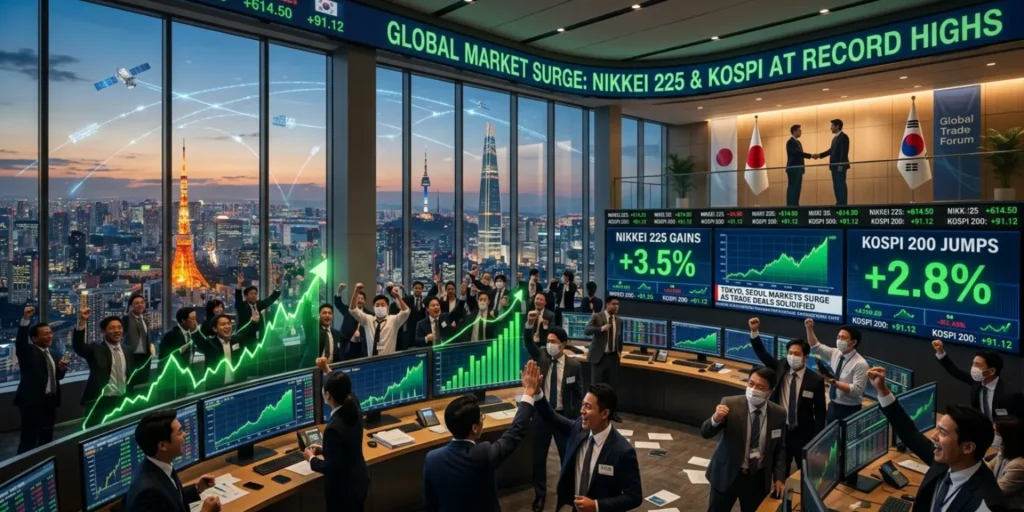
Nikkei 225 and KOSPI Index surge as ceasefire news boosts global market sentiment.
Asian markets delivered a powerful rebound on Wednesday after a tentative ceasefire agreement between the United States and Iran eased geopolitical tensions and restored investor confidence. The announcement triggered a broad-based rally across equities, with major indexes in Japan and South Korea leading the charge amid renewed optimism and strong momentum in technology stocks.
Ceasefire News Ignites Global Risk Appetite
The market reaction was swift after Donald Trump confirmed a two-week suspension of planned military action against Iran. The decision followed diplomatic efforts, including mediation attempts by Pakistan, and came alongside signals from Tehran that it was open to de-escalation and potentially reopening the critical Strait of Hormuz.
This development had an immediate effect on global sentiment. Investors, who had been bracing for escalation in the Middle East, shifted rapidly back into risk assets. The ceasefire reduced fears of supply disruptions in global oil markets, a key concern that had previously driven inflation expectations higher and pressured equities worldwide.
Japan and South Korea Lead the Rally
The strongest gains were seen in Asia’s major export-driven economies. Japan’s benchmark index, the Nikkei 225, surged more than 5 percent, reflecting strong buying interest across industrial and technology sectors. Japanese equities had been under pressure during the recent geopolitical tensions, and the ceasefire provided a much-needed catalyst for recovery.
Similarly, South Korea’s KOSPI index jumped over 5 percent, driven largely by gains in semiconductor and electronics companies. The Korean market is highly sensitive to global trade conditions and technology demand, making it particularly responsive to improvements in macroeconomic outlook and investor sentiment.
Technology Stocks Drive Momentum
A major driver behind the rally was renewed strength in technology shares, especially chipmakers. Samsung Electronics played a central role, as its strong first-quarter forecast boosted confidence in the global semiconductor cycle. The company’s outlook suggested that demand for memory chips and advanced processors remains robust despite recent macro uncertainties.
This positive signal from Samsung had a ripple effect across the region. Investors interpreted it as evidence that the tech sector, particularly semiconductors, continues to benefit from structural growth trends such as artificial intelligence, cloud computing, and next-generation devices.
As a result, chip stocks across Asia saw significant inflows, amplifying the overall market rally. The combination of easing geopolitical risks and strong corporate guidance created a powerful tailwind for equities.
US Futures Signal Broader Market Rebound
The optimism was not limited to Asia. Futures tied to the S&P 500 surged more than 2 percent, indicating that U.S. markets were also poised for a strong opening. This underscores how interconnected global markets have become, with developments in geopolitics and macroeconomics quickly transmitting across regions.
The ceasefire announcement effectively removed a major overhang that had been weighing on investor sentiment. With the immediate threat of military escalation reduced, markets began pricing in a more stable outlook for global growth.
Oil and Inflation Expectations Begin to Ease
One of the most important implications of the ceasefire is its potential impact on energy markets. The Strait of Hormuz, a critical chokepoint for global oil shipments, had been at the center of recent tensions. Any disruption there could have sent oil prices soaring, fueling inflation and forcing central banks to maintain tight monetary policies.
With Iran signaling a willingness to reopen the strait, expectations for oil supply stability improved significantly. This, in turn, helped ease inflation concerns, which have been a major driver of market volatility in recent months.
Lower inflation expectations could eventually give central banks more flexibility, particularly the U.S. Federal Reserve, to adjust interest rates. For equity markets, this is a highly supportive development, as lower rates typically boost valuations and encourage investment in growth assets.
The Role of Diplomacy in Market Stability
The ceasefire also highlights the critical role of diplomacy in shaping financial markets. Pakistan’s involvement in brokering talks between the U.S. and Iran demonstrates how regional actors can influence global outcomes. While the agreement is currently temporary, it opens the door for more comprehensive negotiations that could lead to a lasting resolution.
Markets are likely to remain sensitive to any updates on the situation. A successful transition from a temporary ceasefire to a permanent agreement would further strengthen investor confidence and could sustain the current rally. Conversely, any breakdown in talks could quickly reverse gains and reintroduce volatility.
Investor Sentiment Shifts Rapidly
The sharp rally in Asian stocks illustrates how quickly sentiment can change in response to geopolitical developments. Just days earlier, markets were dominated by risk aversion, with investors seeking safe-haven assets amid fears of conflict escalation.
The ceasefire flipped that narrative almost instantly. Capital flowed back into equities, particularly in sectors that had been most affected by uncertainty. This kind of rapid shift underscores the importance of staying attuned to macro developments when evaluating market trends.
What Comes Next for Asian Markets
Looking ahead, the sustainability of the rally will depend on several factors. The most immediate is the outcome of the two-week ceasefire period. If negotiations progress and tensions continue to ease, markets could build on their gains.
Corporate earnings will also play a crucial role. Strong guidance from companies like Samsung Electronics suggests that fundamentals remain solid, particularly in the technology sector. Continued positive earnings surprises could reinforce the bullish momentum.
At the same time, investors will be watching global economic indicators, including inflation data and central bank policies. Any signs of easing monetary conditions would provide additional support for equities.
Conclusion
The surge in Asian stocks following the U.S.-Iran ceasefire is a clear example of how geopolitical developments can drive market movements. With major indexes like the Nikkei 225 and KOSPI posting gains of over 5 percent, the rally reflects renewed optimism and a shift back toward risk-taking.
Strength in technology shares, led by Samsung Electronics, has further amplified the momentum, while rising S&P 500 futures संकेत that the positive sentiment is spreading globally. For now, the ceasefire has provided markets with a much-needed catalyst. Whether this marks the beginning of a sustained uptrend will depend on how geopolitical and economic conditions evolve in the coming weeks.
About the Author