
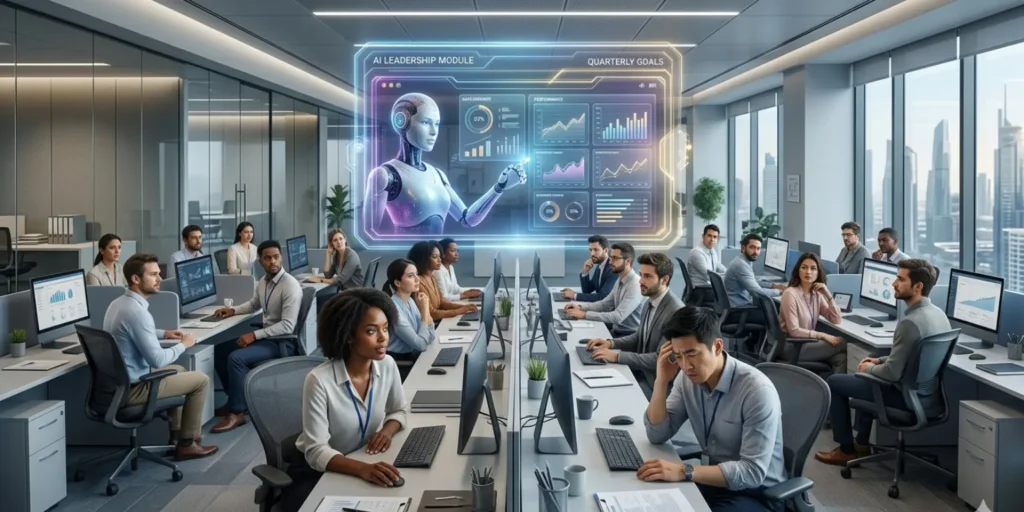
Office workers interacting with a digital AI manager interface, showing mixed reactions to AI leadership and workplace automation trends.
A new survey suggests that some workers in the United States are becoming more open to the idea of reporting to artificial intelligence instead of a human manager. While the idea may have sounded unrealistic just a few years ago, it is slowly entering real workplace discussions.
At the same time, most people are still unsure or uncomfortable with the shift. The findings show a mix of curiosity, caution, and concern about what this could mean for jobs and careers in the future.
What the Survey Found
According to a recent poll conducted by Quinnipiac University, about 15 percent of Americans said they would be willing to work under an AI-powered boss. The survey included 1,397 adults and was carried out between March 19 and March 23, 2026. It explored how people feel about artificial intelligence in the workplace, including trust levels, job security, and automation.
Even though 15 percent is still a minority, it is significant. It shows that a noticeable group of people is open to a major shift in how workplaces are structured. However, the majority of respondents said they would not want an AI as their direct supervisor. This indicates that while interest is growing, acceptance is still limited.
Why Some Workers Are Open to AI Managers
There are a few reasons why some people are willing to consider an AI boss. First, AI systems are often seen as more objective. Unlike human managers, they are less likely to show favoritism or bias. This could lead to fairer decisions when it comes to scheduling, task assignment, or performance reviews.
Second, AI tools can work faster and handle large amounts of data. For employees, this could mean quicker approvals, faster responses, and more efficient workflows. In some cases, workers may also prefer less direct human oversight. An AI manager might feel less intimidating or emotionally demanding than a traditional boss.
How Companies Are Already Using AI in Management
The idea of an AI boss is not just theoretical. Many companies are already using AI to handle tasks that were once done by managers. For example, Workday has introduced AI agents that can automatically process and approve expense reports. This removes the need for human managers to review routine submissions.
At Amazon, AI systems are being used to streamline operations and reduce layers of management. The company has already reduced thousands of middle management roles as part of this shift. Meanwhile, engineers at Uber developed an AI model based on CEO Dara Khosrowshahi. This tool can review ideas and provide feedback before employees present them to the actual CEO. These examples show that AI is already taking on responsibilities that were traditionally handled by human supervisors.
The Rise of “Flattened” Organizations
This shift is part of a broader trend sometimes called “The Great Flattening.” In this model, companies reduce layers of management and rely more on automation and AI systems. Instead of having multiple levels of supervisors, employees may interact directly with AI tools that guide their work.
Some experts believe this could lead to highly efficient companies with fewer employees. In extreme cases, it could even result in businesses run almost entirely by automated systems. While this might improve productivity, it also raises questions about job opportunities and career growth.
Concerns About Job Losses
The survey highlights a major concern among workers. Around 70 percent of respondents believe that advances in AI will reduce the number of available jobs. This fear is not limited to future generations. Many people are worried about their own roles.
Among those currently employed, about 30 percent said they are concerned that AI could make their job obsolete. This shows that automation is not just a distant threat. It is something workers are already thinking about in their daily lives.
These concerns are understandable. As AI systems take over more tasks, companies may need fewer employees, especially in administrative and management roles.
Can AI Really Replace a Human Boss?
Despite growing interest, there are still strong arguments against replacing human managers with AI. One major limitation is the lack of emotional intelligence. AI systems cannot truly understand human feelings, motivations, or personal challenges. This makes it difficult for them to handle sensitive situations, such as conflicts, feedback, or team morale.
Human managers also bring experience, intuition, and creativity to their roles. They can adapt to unexpected situations and make judgment calls that go beyond data. While AI can support decision-making, it may struggle to fully replace the human side of leadership.
The Balance Between AI and Human Management
Rather than completely replacing managers, many experts believe the future will involve a mix of both. AI can handle repetitive and data-driven tasks, such as scheduling, reporting, and analysis. This allows human managers to focus on more complex responsibilities, including leadership, communication, and strategy.
In this model, AI acts as a tool rather than a replacement. It supports managers and improves efficiency without removing the human element from the workplace. This balanced approach may be more acceptable to employees who are hesitant about fully automated management.
What This Means for Workers
For employees, the rise of AI in management means adapting to new ways of working. Skills such as problem-solving, communication, and creativity will become even more important. These are areas where humans still have a clear advantage over machines.
At the same time, workers may need to become more comfortable using AI tools in their daily tasks. Understanding how to work alongside these systems could become a key requirement in many jobs. Those who can adapt quickly may benefit from increased efficiency and new opportunities.
What Businesses Should Consider
For companies, introducing AI into management roles comes with both benefits and risks. On the positive side, AI can reduce costs, improve efficiency, and streamline operations. It can also help businesses scale more easily by handling routine tasks automatically.
However, there are also challenges. Employees may resist changes if they feel their jobs are at risk or if they do not trust AI systems. Businesses need to carefully manage this transition. Clear communication, transparency, and training will be essential to ensure that workers feel supported rather than replaced.
A Shift That Is Still in Progress
The idea of working for an AI boss is still new, and opinions are likely to evolve. As technology improves, AI systems may become better at understanding human behavior and communication. This could make them more acceptable in leadership roles.
At the same time, concerns about job loss and automation are unlikely to disappear. The balance between innovation and job security will remain a key issue.
The Bottom Line of Americans Warming Up to AI Bosses, But Concerns Remain
The survey from Quinnipiac University shows that attitudes toward AI in the workplace are changing, but slowly. A small but growing group of people is open to the idea of an AI boss. However, most workers still prefer human leadership, especially when it comes to decision-making and emotional understanding.
Companies like Workday, Amazon, and Uber are already experimenting with AI in management roles. This suggests that the shift is already underway. For now, the future of work is likely to be a mix of human and AI management. The key challenge will be finding the right balance between efficiency and the human touch. As workplaces continue to evolve, one thing is clear. AI is not just changing how we work. It is also changing who, or what, we work for.
About the Author