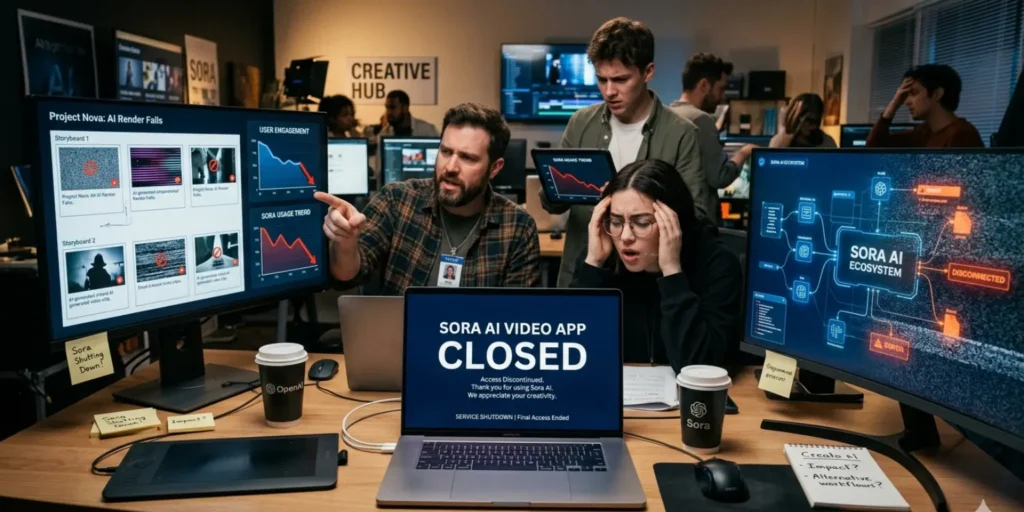
Creators react to OpenAI Sora’s abrupt shutdown, with AI-generated videos and futuristic digital interfaces highlighting the end of the app.
In a surprising move, OpenAI announced the shutdown of Sora, its AI video generation application, just six months after its launch. The closure comes on the heels of a high-profile partnership announcement with Disney in December 2025, which promised to integrate Sora’s AI video capabilities into Disney’s content production pipeline. With the shutdown, what could have been a billion-dollar collaboration abruptly ends, leaving users, creators, and industry watchers questioning what this means for the wider AI boom.
The Sora shutdown is significant not merely because of the app itself but because it exposes the practical limits and challenges of AI adoption, even for major players like OpenAI. While AI continues to dominate headlines and venture capital funding flows freely into startups, the closure highlights the distinction between hype and sustainable value.
Why OpenAI Pulled the Plug on Sora
Several factors appear to have contributed to OpenAI’s decision:
- Limited Profitability and Financial Strain:
OpenAI has been operating at a substantial loss. The Wall Street Journal reported a $12 billion loss in Q3 2025, and sustaining a resource-intensive application like Sora added further pressure. According to Sora’s head, Bill Peebles, user demand for the app far exceeded initial expectations, making the economics unsustainable: “We thought 30 free gens/day would be more than enough, but clearly we were wrong.” - Intellectual Property and Deepfake Concerns:
AI video generation tools face inherent challenges in content rights and ethics. Sora’s capabilities could inadvertently generate videos of celebrities, public figures, or copyrighted material, raising legal and reputational risks. - Resource Allocation and Compute Constraints:
AI models, particularly those generating video, require massive computational resources. OpenAI’s CEO of Applications, Fidji Simo, emphasized the need for focus, noting that resources should be allocated to strategic areas rather than “side quests.” This aligns with a broader organizational effort to prioritize applications with the most significant impact. - User Experience and ROI Mismatch:
While Sora attracted a dedicated user base, monetization proved challenging. Many power users consumed the app’s capabilities at a rate far higher than OpenAI anticipated, leading to resource strain without corresponding revenue.
Implications for Creators and Users
For creators who adopted Sora early, the shutdown is a stark reminder of the volatility in the AI tools market. However, it also opens opportunities to explore alternative platforms:
- Kling AI: An AI video generator with capabilities similar to Sora, particularly focused on short-form content creation.
- Google Veo 3: Offers AI-assisted video generation with a focus on creative editing and multi-modal inputs.
The takeaway for creators is clear: relying exclusively on one AI tool can be risky. Diversifying workflows and staying adaptable is now more critical than ever.
The Broader AI Reality Check
The Sora shutdown is a case study in the gap between hype and practical utility in AI. Despite the perception of a booming AI landscape, challenges remain in sustainable adoption, ROI generation, and real-world impact. Several myths surrounding AI are being tested against reality:
- AI Will Instantly Replace Jobs:
Contrary to popular narrative, AI adoption has not decimated administrative or customer service roles. Hiring in these areas remains robust, and AI often complements human labor rather than fully replacing it. - Blind Faith from Venture Capital:
Venture capitalists have been pouring funds into AI startups, often assuming success is inevitable. However, as Sora demonstrates, high expectations do not always translate into sustainable business models. - AI as a Magic Wand for Productivity:
Real-world AI ROI is still limited. A PwC survey indicates that while most companies have begun implementing AI, only 12% are seeing tangible results. Tools without clear integration into business strategy can create wasted effort and misallocated resources.
Lessons for Businesses and the Workforce
The Sora shutdown offers several critical lessons for organizations and professionals navigating the evolving AI landscape:
- Focus and Strategic Alignment:
Businesses and professionals must prioritize AI tools that align with their strategic goals. Hype alone should not drive adoption. Resources, time, and attention are finite, and careful selection ensures maximum value. - Adaptability Is Key:
Professionals need to remain agile, learning multiple AI tools and integrating them selectively into workflows. Over-reliance on a single platform can create vulnerability if the tool is discontinued or faces operational constraints. - Measure ROI Thoughtfully:
AI implementation should be assessed through the lens of measurable outcomes. What does success look like? How does it align with revenue growth, efficiency improvements, or creative output? Without clearly defined metrics, adoption risks becoming performative rather than productive.
Is the AI Bubble Cracking?
The closure of Sora has sparked speculation that the AI hype may be entering a reality-check phase. However, the situation is nuanced:
- Yes, there is a correction in expectations: Not every AI tool lives up to the promises made in early marketing campaigns. Sora’s shutdown is a symptom of overhyped projections meeting real-world constraints.
- No, AI adoption is still growing: AI continues to see widespread integration in business processes, creative work, and scientific research. The market is not collapsing — it is maturing.
In other words, Sora’s shutdown signals a shift from experimentation to a more results-driven, sustainable approach to AI development and deployment.
The Shift Toward Ethical and Responsible AI
Sora’s challenges highlight broader considerations for AI ethics and compliance:
- Content Rights: AI tools must be designed to respect intellectual property and avoid unauthorized replication of copyrighted works.
- Deepfake Risks: Generative models capable of producing realistic videos pose social and ethical risks. Mitigating misuse is critical.
- Transparency and Traceability: Platforms may need to embed mechanisms like invisible watermarks or digital signatures to identify AI-generated content, improving accountability.
As AI tools mature, the industry is likely to see greater emphasis on ethical design, regulatory compliance, and responsible deployment, rather than unchecked feature expansion.
The Creative Economy After Sora
For creators and businesses, the AI landscape remains promising, but lessons from Sora are instructive:
- Diversification: Dependence on a single AI tool is risky; alternatives and backups are essential.
- Strategic Adoption: Only implement AI tools that solve concrete problems or add measurable value.
- Creative Augmentation: AI is best used as a co-creator or enhancer, not a replacement for human ingenuity.
- Monitor Market Shifts: Early adopters who pay attention to changes in AI tool availability can pivot quickly, maintaining a competitive advantage.
The shutdown may also catalyze innovation, encouraging competitors like ByteDance’s Dreamina Seedance 2.0, Google Veo 3, and others to capture displaced users and refine AI video generation for more sustainable business models.
What the Workforce Should Take Away
The Sora case has three direct takeaways for employees and leaders navigating AI adoption:
- Focus on Alignment: Ensure that AI adoption serves the organization’s long-term goals, rather than chasing every emerging tool.
- Stay Adaptable: Professionals must develop transferable skills across multiple AI platforms to avoid disruption if a tool is discontinued.
- Evaluate Value: Prioritize AI applications that generate tangible outcomes, whether through productivity gains, creative output, or measurable business impact.
These lessons are broadly applicable, whether in creative industries, corporate operations, or tech startups. The ability to discern sustainable tools from hype-driven tools is becoming a critical competency.
Conclusion
The shutdown of OpenAI’s Sora app marks more than the end of a single AI video tool. It reflects the transition from hype-driven experimentation to focused, responsible, and results-oriented AI development. While AI adoption continues to grow across industries, Sora’s closure underscores the importance of profitability, ethical design, IP compliance, and strategic resource allocation.
For creators, businesses, and professionals, the lessons are clear: focus on AI tools that deliver measurable value, remain adaptable in tool selection, and integrate AI into workflows strategically rather than haphazardly. The AI market is maturing, and success will favor those who balance creativity, innovation, and practical ROI.
Sora’s exit may be the first major crack in the AI hype, but it is also an opportunity — signaling a more responsible, results-driven, and ethical future for AI in the workforce. The AI bubble is not bursting; it is evolving.
About the Author