
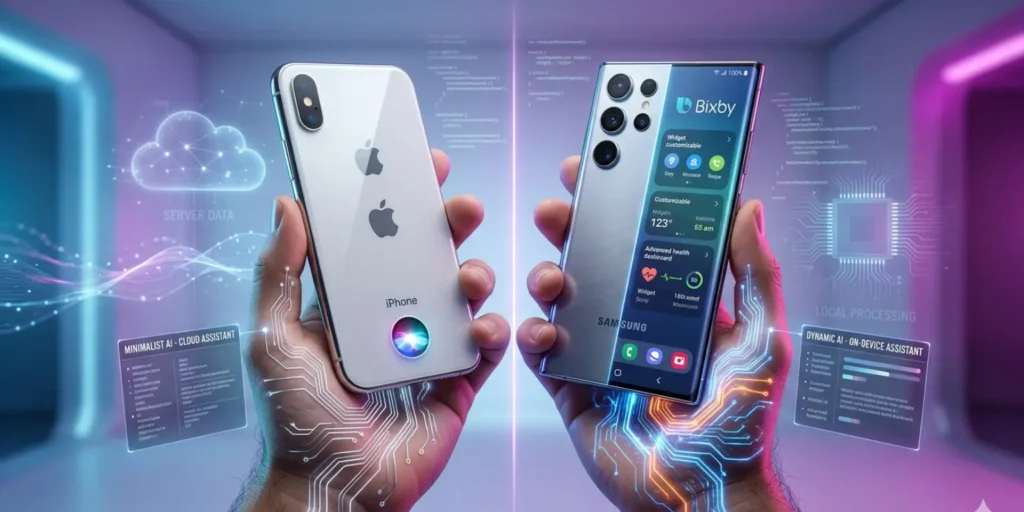
Apple and Samsung compete for AI dominance, reshaping how smartphones think, learn, and assist users.
The smartphone industry has entered a fascinating new phase, and at the center of this shift lies the evolving rivalry between Samsung Electronics and Apple Inc. For over a decade, innovation was easy to measure—bigger displays, sharper cameras, thinner designs, and faster processors. Each product launch from these two giants brought visible, tangible upgrades that consumers could instantly recognize, often setting new industry benchmarks.
However, in recent years, that momentum has slowed. Devices from different brands—including flagship models from Samsung and Apple—now look remarkably similar, with only subtle design differences separating them. Hardware improvements, while still meaningful, feel incremental rather than revolutionary. This shift has quietly transformed the nature of competition between the two companies, pushing the focus away from physical design and toward something far more complex: the intelligence powering the devices.
The Shift from Hardware to Intelligence
To understand the current landscape, it’s important to recognize how the role of smartphones has changed. Phones are no longer just communication devices—they are personal assistants, creative tools, productivity hubs, and increasingly, decision-making companions.
Artificial intelligence is the driving force behind this evolution. From predictive text and voice assistants to advanced photography and real-time translation, AI has already been embedded into smartphones for years. However, what’s changing now is the scale and sophistication of that intelligence.
Instead of simply reacting to commands, modern AI systems aim to anticipate user needs. They analyze behavior, learn preferences, and proactively offer suggestions. This shift—from reactive tools to proactive assistants—is where Apple and Samsung are placing their biggest bets.
Apple’s Philosophy: Quiet, Private, and Integrated
Apple Inc. has taken a characteristically subtle approach to AI. Rather than showcasing flashy demonstrations, the company emphasizes seamless integration and user privacy. Its AI framework, often referred to as “Apple Intelligence,” is designed to operate quietly in the background, enhancing everyday tasks without drawing too much attention to itself.
Apple’s strategy revolves around on-device processing. This means that much of the AI computation happens directly on the iPhone rather than in the cloud. The advantage is clear: user data remains private, reducing the risk of exposure or misuse. In an era where data privacy concerns are growing, this approach resonates strongly with consumers.
However, this philosophy comes with trade-offs. On-device AI is inherently limited by the hardware capabilities of the device. While Apple’s chips are among the most powerful in the industry, they still cannot match the computational scale of cloud-based systems. As a result, Apple’s AI features may feel more refined but less ambitious compared to competitors.
Still, Apple’s strength lies in its ecosystem. By tightly integrating AI across devices—iPhones, iPads, Macs, and wearables—the company creates a unified experience that feels intuitive and consistent. The goal is not to overwhelm users with features, but to make technology feel invisible.
Samsung’s Strategy: Bold, Feature-Rich, and Proactive
In contrast, Samsung Electronics takes a more aggressive approach to AI. The company is not afraid to showcase its capabilities through live demonstrations and feature-packed presentations. Its vision of AI is more visible, more interactive, and in many ways, more experimental.
Samsung’s Galaxy AI ecosystem leverages both on-device processing and cloud-based intelligence, often through partnerships with platforms like Google’s Gemini. This hybrid approach allows Samsung to deliver more advanced features, such as real-time language translation during calls, AI-assisted image editing, and proactive task suggestions.
The result is a smartphone experience that feels dynamic and futuristic. Samsung devices don’t just respond to user input—they actively participate in workflows. For example, an AI system might suggest scheduling a meeting based on a conversation or recommend edits to a photo before the user even asks.
However, this ambition raises important questions. As AI becomes more proactive, it also becomes more intrusive. Users may appreciate the convenience, but they may also feel uneasy about how much their devices know—and how much control they are giving up.
Two Philosophies, One Goal
The contrast between Apple and Samsung reflects two fundamentally different philosophies. Apple focuses on restraint. Its AI is designed to assist without overwhelming, to enhance without intruding. It prioritizes trust, privacy, and consistency.
Samsung, on the other hand, embraces possibility. Its AI aims to push boundaries, to explore what’s technically feasible, and to deliver experiences that feel ahead of their time. Despite these differences, both companies share the same ultimate goal: to create a smartphone that understands its user on a deeper level. This is the essence of the modern AI race.
The Hidden Cost of Intelligence
While consumers see the benefits of AI in the form of smarter features, the underlying reality is far more complex—and expensive. Building AI-powered smartphones requires significant investment in hardware, software, and infrastructure. Advanced AI models demand powerful chips, high-bandwidth memory, and efficient energy management. At the same time, cloud-based AI requires massive data centers, which consume enormous amounts of electricity and resources.
These costs are beginning to influence the entire industry. Manufacturers must balance performance with affordability, innovation with sustainability. In some cases, the rising cost of AI could lead to higher smartphone prices, even if the physical design remains unchanged. This is where the competition extends beyond Apple and Samsung. Semiconductor companies, cloud providers, and AI research labs all play a role in shaping the future of mobile intelligence.
The User Experience: Convenience vs Control
For users, the AI revolution brings both excitement and uncertainty. On one hand, smarter devices can save time, reduce effort, and enhance productivity. On the other hand, they introduce new questions about control, privacy, and trust. How much should a phone know about its user? How much autonomy should it have? And where should the line be drawn between helpful and intrusive?
Apple’s approach appeals to users who value privacy and predictability. Samsung’s approach आकर्षates those who seek innovation and convenience. Neither strategy is inherently better—it ultimately depends on individual preferences. What’s clear, however, is that user expectations are changing. People are no longer satisfied with devices that simply perform tasks. They want devices that understand context, adapt to behavior, and provide meaningful assistance.
The Role of Ecosystems and Lock-In
Another critical aspect of this competition is ecosystem integration. Both Apple and Samsung are building interconnected networks of devices and services that reinforce user loyalty. Apple’s ecosystem is famously cohesive. Features like seamless file sharing, synchronized notifications, and cross-device continuity create a unified experience that is difficult to leave.
Samsung, while historically more fragmented, is rapidly expanding its ecosystem through smart home devices, wearables, and partnerships with other platforms. Its AI strategy plays a key role in tying these elements together. As AI becomes more central to the user experience, ecosystem lock-in may become even stronger. Switching between platforms could mean losing personalized data, preferences, and AI-driven insights.
Will AI Drive Upgrades?
One of the biggest questions facing the industry is whether AI will be enough to drive smartphone upgrades. In the past, consumers upgraded for better cameras, faster performance, or new designs. Today, those improvements are less compelling.
AI has the potential to change that—but only if users perceive real value. Features like real-time translation, intelligent assistants, and generative editing are impressive, but they must translate into everyday usefulness. If AI becomes essential to daily life, it could trigger a new upgrade cycle. If not, it may remain a secondary feature.
The Future of the Smartphone War
As the competition between Apple Inc. and Samsung Electronics continues, one thing is certain: the smartphone war is no longer about hardware alone. It is about intelligence—how it is built, how it is delivered, and how it is experienced.
The next generation of smartphones will not just be faster or more powerful. They will be more aware, more adaptive, and more personal. They will learn from users, anticipate needs, and in some cases, make decisions on their behalf.
This shift represents both an opportunity and a challenge. It has the potential to redefine how we interact with technology—but it also requires careful consideration of ethics, privacy, and control.
Conclusion: A Subtle but Significant Transformation
The battle for AI dominance inside your pocket may not be as visible as the hardware wars of the past, but it is far more significant. It is a battle that will shape the future of technology, influence user behavior, and redefine the relationship between humans and machines. Apple and Samsung are leading this transformation in their own distinct ways—one through subtle integration, the other through bold innovation. Their approaches may differ, but their ambitions are aligned.
In the end, the winner of this quiet war will not be the company with the most features or the fastest chips. It will be the one that can strike the perfect balance—between intelligence and simplicity, between convenience and control, between innovation and trust. And as this new era unfolds, one thing becomes increasingly clear: the most important part of your smartphone is no longer what you can see. It’s what’s happening inside.
About the Author