
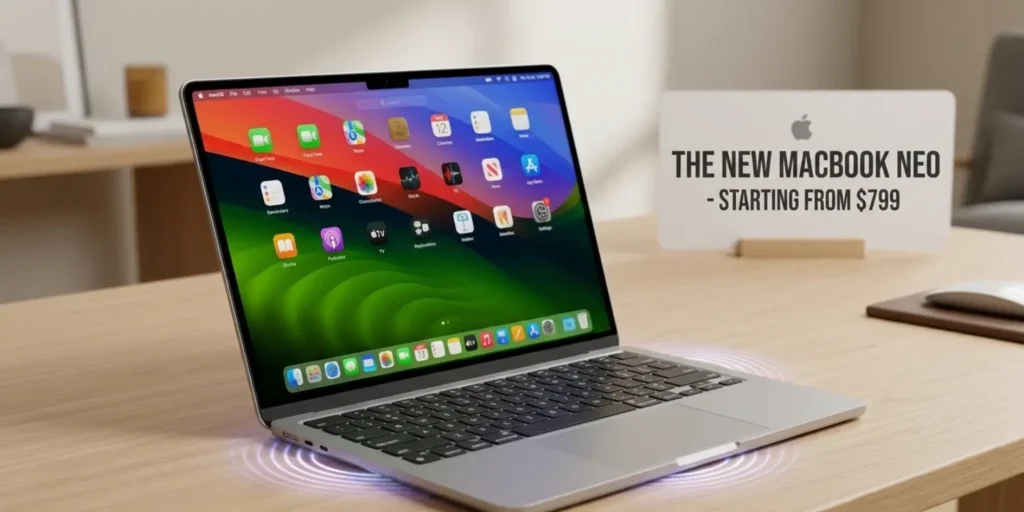
Apple introduces the MacBook Neo, a $599 laptop powered by the A18 Pro chip, delivering performance comparable to earlier M1 Mac models.
Apple has introduced the new MacBook Neo, a laptop designed to make the Mac ecosystem more accessible to a wider range of users. With a starting price of $599, the MacBook Neo becomes one of the most affordable Macs ever released by the company. The device aims to provide a balance between performance and affordability while maintaining the core experience that Apple users expect.
What makes the MacBook Neo especially interesting is the processor powering the device. Instead of using a traditional Mac-class chip, Apple has equipped the laptop with the A18 Pro processor, the same chip used in the iPhone 16 Pro. This design choice marks a significant shift in its strategy, as it blends smartphone-grade silicon with a full laptop operating environment.
Early benchmark results show that this approach may work better than many expected. Performance numbers suggest that the MacBook Neo can compete with earlier Macs powered by the M1 processor, which was once considered a revolutionary upgrade for Apple computers.
Why Apple Chose the A18 Pro Chip
Apple has spent years developing its own processors through the Apple Silicon program. The company first transitioned Macs away from Intel chips in 2020 with the introduction of the M1 processor. Since then, Apple has expanded its lineup with chips such as the M2 and M3 series, each offering improvements in efficiency and performance.
However, the MacBook Neo takes a slightly different path. By using the A18 Pro chip instead of an M-series processor, it is leveraging the same advanced technology that powers its flagship smartphones. The A18 Pro already offers strong performance and exceptional power efficiency, making it a suitable candidate for lightweight computing tasks.
Another key advantage is cost. Smartphone processors are produced in extremely large quantities, which reduces manufacturing expenses. By adapting this chip for a Mac laptop it can lower production costs while still delivering a capable machine.
This strategy also highlights the flexibility of Apple’s unified silicon architecture. Because it designs both the hardware and software ecosystems, the company can optimize macOS to run efficiently on different processors without compromising the user experience.
Benchmark Results Reveal Strong Performance
Early benchmark tests discovered by MacRumors have provided insight into the real-world capabilities of the MacBook Neo. Using the widely recognized testing platform Geekbench, the laptop recorded impressive performance numbers for an entry-level device.
The MacBook Neo achieved a single-core score of 3,461 and a multi-core score of 8,668. These numbers are nearly identical to the performance recorded by the iPhone 16 Pro, which is expected because both devices use the same A18 Pro processor.
When compared to the original M1-based MacBook models, the results become even more interesting. The M1 MacBook Pro recorded approximately 2,235 in single-core performance and 7,901 in multi-core testing. This means that the A18 Pro actually delivers a noticeable improvement in single-core tasks while maintaining similar overall multi-core capabilities.
Single-core performance is particularly important for everyday tasks such as launching applications, browsing the web, editing documents, and managing operating system functions. As a result, many users may experience a very responsive system despite the MacBook Neo’s lower price point.
Graphics Performance Remains Competitive
Graphics performance is another important aspect of modern laptops, especially for creative tasks and media consumption. Although the MacBook Neo does not include the full GPU architecture found in M-series chips, its graphics performance remains surprisingly competitive.
In Metal GPU testing, the MacBook Neo scored 31,286, which is only slightly below the 31,912 achieved by the M1 MacBook Air. The difference is so small that most users are unlikely to notice it during everyday tasks.
This level of performance means the MacBook Neo should handle activities such as video streaming, photo editing, casual gaming, and light creative work without difficulty. While it may not be designed for professional video production or advanced 3D rendering, it provides enough graphical capability for the majority of typical laptop users.
Designed to Reach the $599 Price Point
Apple carefully engineered the MacBook Neo to reach its affordable price target. To achieve this goal, the company removed some premium features commonly found in higher-end Macs.
For example, the MacBook Neo focuses on essential functionality rather than advanced hardware configurations. It is positioned as a practical laptop for students, home users, and professionals who need reliable performance for everyday computing.
The base model includes 256GB of storage, along with built-in Touch ID for secure login and authentication. Users who require additional storage can upgrade to 512GB for an extra $100, keeping the overall cost significantly lower than most other Mac models.
By simplifying the design and using an efficient processor, Apple has managed to create a device that delivers solid performance while remaining budget-friendly.
A Replacement for Discounted M1 MacBook Models
The MacBook Neo effectively replaces the discounted M1 MacBook Air units that were widely available through retailers such as Walmart. Those models had become popular because they offered Apple Silicon performance at a reduced price.
However, as Apple continues to update its product lineup, maintaining older hardware becomes less practical. The MacBook Neo allows Apple to introduce a modern alternative that maintains similar performance while benefiting from newer technology.
The use of the A18 Pro chip also ensures improved energy efficiency, which could translate into better battery life and thermal management. Although full battery benchmarks have not yet been released, Apple’s mobile processors are known for their exceptional efficiency.
A New Approach to Apple Silicon
The MacBook Neo demonstrates how Apple’s silicon ecosystem continues to evolve. Instead of separating smartphone and laptop processors completely, Apple is exploring ways to combine them in different devices.
This approach may open the door to more flexible product designs in the future. Apple could potentially use variations of its mobile processors in tablets, lightweight laptops, or other portable computing devices.
At the same time, the company still maintains its powerful M-series processors for high-performance systems such as the MacBook Pro and Mac Studio. These devices remain targeted at professionals who require advanced computing power for demanding workloads.
By offering different tiers of processors, Apple can serve a broader range of users while maintaining consistent software compatibility across the entire ecosystem.
Availability and Market Impact
The MacBook Neo is currently available for pre-order and is scheduled to begin shipping on March 11. With its starting price of $599, the laptop enters a highly competitive segment of the market dominated by affordable Windows laptops and Chromebooks.
However, Apple’s brand reputation, software ecosystem, and hardware integration could give the MacBook Neo a significant advantage. For many consumers, the opportunity to purchase a Mac at this price point may be particularly appealing.
Students, casual users, and first-time Mac buyers are likely to be among the primary audiences for the device. The MacBook Neo also offers an attractive option for users who already own an iPhone and want a laptop that integrates smoothly with Apple’s ecosystem.
A Promising Entry-Level Mac
The early benchmark results suggest that the MacBook Neo delivers exactly what Apple intended: a capable, affordable Mac that performs on par with earlier Apple Silicon laptops. By using the A18 Pro processor, Apple has demonstrated that smartphone-grade chips can power full desktop environments effectively.
While the MacBook Neo may not replace high-performance MacBook Pro models, it fills an important role in Apple’s product lineup. It provides a modern entry point into the Mac ecosystem while maintaining respectable performance levels.
As more users gain access to the device after its official release, real-world testing will reveal how it performs in everyday scenarios. If the early benchmarks are any indication, the MacBook Neo could become one of Apple’s most popular budget laptops in years.
About the Author