
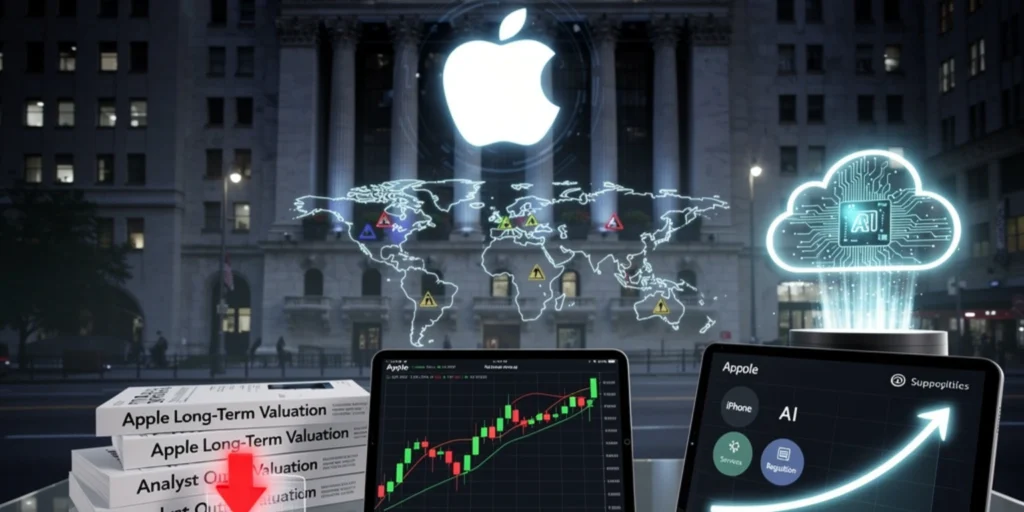
Apple faces potential headwinds including slowing iPhone sales, China exposure, and rising competition.
Apple Inc. (AAPL) is one of the most widely followed technology companies in the world. Its products, from iPhones to MacBooks, have created a loyal customer base, and the company’s financial performance has been strong for years. However, some analysts and investors argue that there are reasons to be cautious. Here, we explore a bear case theory for Apple and why the stock could face headwinds.
Slowing iPhone Growth
Apple’s iPhone is the core of its business, generating a large portion of revenue and profits. In recent years, however, the smartphone market has shown signs of saturation. Many consumers now hold onto their devices for longer, reducing the frequency of upgrades.
Reports suggest that Apple’s unit sales growth for the iPhone has slowed in key markets like the United States, Europe, and China. Without a major technological leap or revolutionary feature, there is a risk that iPhone sales could plateau or decline, putting pressure on Apple’s overall revenue.
Dependence on China
Apple relies heavily on China, both for manufacturing and as a large consumer market. This creates multiple risks. On the manufacturing side, Apple’s supply chain could be disrupted by geopolitical tensions, trade restrictions, or factory closures.
On the consumer side, China represents a significant share of Apple’s revenue. Any slowdown in the Chinese economy, increased competition from local smartphone brands, or regulatory restrictions could impact Apple’s sales. Investors concerned about these factors see exposure to China as a potential vulnerability.
Rising Competition
Competition in both hardware and services is intensifying. On the smartphone front, companies like Samsung, Xiaomi, and Oppo offer high-quality devices at lower prices. This challenges Apple’s ability to maintain growth in markets where consumers are price-sensitive.
Apple’s services business, which includes Apple Music, iCloud, and the App Store, is also facing pressure. Streaming platforms like Spotify and cloud services like Google Drive compete aggressively, sometimes with more flexible pricing. Increased competition could limit Apple’s pricing power and slow the growth of recurring revenue.
High Valuation
Apple’s stock is often considered expensive by traditional valuation measures. Its price-to-earnings (P/E) ratio is higher than the broader market and most of its peers. If earnings growth slows due to weaker iPhone sales or increased competition, investors may reconsider the stock’s valuation. A high starting point leaves limited room for disappointment.
Market corrections or broader technology sell-offs could impact Apple more than other, less expensive stocks. Investors expecting continued rapid growth may be disappointed if the company delivers more modest results.
Supply Chain and Component Risks
Apple depends on a complex global supply chain. Any disruption in the production of key components such as chips, batteries, or display panels can affect product launches and sales. Recent global chip shortages and rising costs have highlighted the fragility of technology supply chains.
Apple’s strategy of using proprietary chips, like the M-series processors in Macs, gives it some control over performance and differentiation. Still, global supply chain disruptions or cost increases could reduce margins and affect profitability.
Potential Regulatory Challenges
Apple faces ongoing regulatory scrutiny in multiple regions, particularly in the United States and Europe. Antitrust investigations focus on the App Store’s business model and commission fees. In addition, privacy regulations could limit Apple’s ability to monetize user data, which affects advertising and service revenue.
New regulations or legal actions could result in fines, higher costs, or changes to Apple’s business practices. Regulatory uncertainty is a key concern for investors who favor companies with predictable growth paths.
Market Dependence on Innovation
Apple has built its reputation on innovation, regularly introducing products that set industry standards. However, innovation is not guaranteed. If the company fails to deliver breakthrough products, consumer excitement may decline.
Investors have concerns that upcoming products, such as foldable devices or augmented reality gadgets, may not generate the same market impact as past hits like the iPhone or iPad. A lack of compelling new offerings could limit revenue growth and stock performance.
Economic Sensitivity
Apple products are largely premium-priced items. In an economic downturn, consumers may reduce spending on high-end electronics. Inflation, rising interest rates, or global economic slowdowns could reduce demand for iPhones, MacBooks, and other devices.
The bear case argues that Apple’s exposure to consumer spending cycles is a vulnerability that could weigh on earnings during uncertain economic periods.
Conclusion: Apple Inc. Bearish Risks Investors Must Know
Apple remains a dominant technology company with strong brand loyalty, innovative products, and a solid balance sheet. Yet the bear case suggests several potential risks. Slowing iPhone sales, dependence on China, rising competition, high valuation, supply chain fragility, regulatory pressure, and economic sensitivity could all pose challenges.
Investors should weigh these factors carefully. While Apple has historically delivered strong returns, the bear case reminds the market that no company is immune to disruption, competition, or broader economic pressures. Those considering a conservative approach may monitor these risks closely before taking a position in the stock.
About the Author