
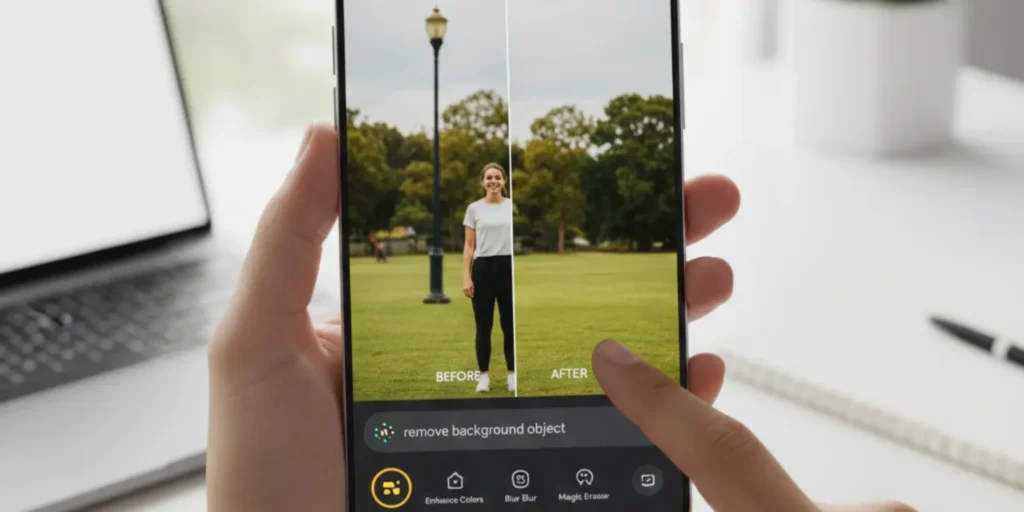
Google Photos now allows users in India, Australia, and Japan to edit photos using simple text commands, making advanced edits accessible without complex tools.
Google is expanding its smart photo editing tools to more users worldwide, making photo editing easier and more natural. The company has announced that its prompt-based editing feature in Google Photos is now available in India, Australia, and Japan.
This feature allows users to edit photos by simply typing what they want to change instead of using traditional editing controls. It is designed for people who want quick improvements without learning complex tools or spending time adjusting sliders.
Editing Photos Using Simple Text Commands
The new editing experience is built around natural language. When users tap the edit option on a photo, they will see a box labeled “Help me Edit.” From there, they can choose from suggested prompts or write their own instructions in everyday language.
For example, users can ask the app to remove unwanted objects from the background, reduce blur, or improve an old and faded photo. The tool understands both specific and general requests, making it useful for casual users and those who want more control over their images. Instead of manually adjusting brightness, contrast, or sharpness, users can simply describe the result they want and let the system handle the rest.
Advanced Edits Without Manual Work
The editing feature is capable of handling surprisingly detailed changes. Users can ask it to remove glasses from a person’s face, adjust a pose, or even open someone’s eyes if they blinked at the wrong moment. These types of edits usually require professional software or advanced skills, but Google Photos now offers them through simple commands. This approach lowers the barrier for photo editing and allows more people to improve their images quickly.
The edits are powered by Google’s Nano Banana image model, which processes changes directly within the app. This means users do not need an active internet connection while editing their photos, which is especially useful in areas with limited connectivity.
Works on a Wide Range of Android Devices
One of the most notable aspects of this update is that it is not limited to Google Pixel phones. The feature works on any Android device with at least 4GB of RAM running Android 8.0 or higher. This opens the tool to a large number of users across different brands and price ranges. Google appears to be focusing on accessibility and scale rather than restricting features to its own hardware.
By supporting older Android versions and modest hardware requirements, the company ensures that more people can benefit from the new editing experience.
Support for Multiple Local Languages
Along with expanding to new countries, Google is also adding support for more languages. In addition to English, the feature now supports Hindi, Tamil, Marathi, Telugu, Bengali, and Gujarati.
This language expansion is especially important in India, where users often prefer interacting with apps in their native language. Allowing people to edit photos using familiar words makes the feature more approachable and practical. By supporting local languages, Google is clearly aiming to reach users who may not be comfortable using English-based tools.
Clear Labels for AI-Edited Images
Google is also introducing C2PA Content Credentials support in Google Photos in these regions. This feature adds metadata to images that have been created or edited using advanced tools.
The credentials help indicate whether a photo has been modified using automated techniques. As edited and generated images become more common online, many platforms are struggling with how to clearly label such content. These credentials help users understand how an image was created or changed, adding transparency and trust. This move aligns with broader industry efforts to make digital content easier to verify.
Part of a Larger Push in Google Photos
This expansion is part of Google’s ongoing effort to make Google Photos smarter and more useful. Over the past year, the company has added several new features that rely on advanced automation and smarter search.
Last November, Google expanded its enhanced photo search to more than 100 countries and added support for over 17 languages. This allows users to find images using natural descriptions instead of file names or dates. Google has also introduced creative templates that can turn photos into artistic styles. These tools allow users to experiment with different looks without needing separate apps.
New Creative Tools Continue to Roll Out
More recently, Google launched a feature called “Meme me,” which lets users combine templates with their own images to create memes directly in the app. This reflects a growing focus on casual creativity and social sharing.
By adding tools that are fun, fast, and easy to use, Google Photos is evolving beyond simple storage and backup. It is becoming a full creative platform for everyday users. The company’s approach suggests that future updates will continue to focus on reducing complexity while increasing creative options.
Conclusion
The rollout of prompt-based editing in India, Australia, and Japan marks an important step in making photo editing more accessible. By allowing users to describe edits in plain language, Google Photos removes many of the barriers that have traditionally made photo editing difficult.
With broad device support, local language options, and clear labeling for edited content, Google is positioning Google Photos as a powerful yet easy-to-use tool. As these features continue to expand, more users will be able to fix, enhance, and enjoy their photos with minimal effort.
About the Author