
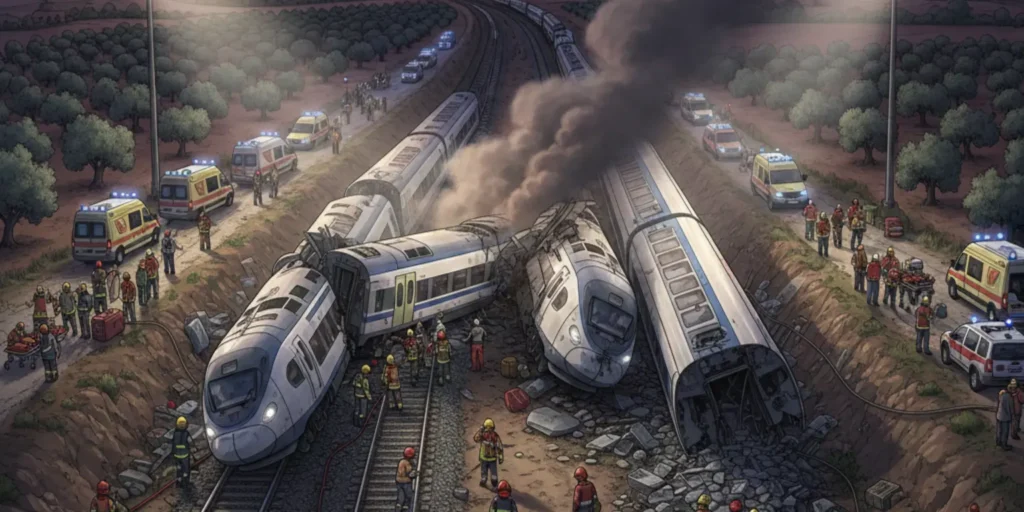
Rescue teams work at the scene after two high speed trains collided near Adamuz in southern Spain.
A tragic train collision accident struck southern Spain on Sunday evening when two high-speed trains collided near the town of Adamuz in the province of Cordoba. Police sources confirmed that at least 21 people were killed, with fears that the death toll could rise as rescue teams continue their work.
The crash involved a train traveling from Malaga to Madrid and another heading from Madrid to Huelva. One of the trains derailed and crossed onto an adjacent track, where it slammed into the oncoming train. The impact pushed the second train off the tracks and down an embankment, leaving scenes of devastation and chaos.
Location and Timing of the Train Collision Accident
The collision happened around 7:45 pm local time, roughly ten minutes after the Malaga to Madrid train departed from Cordoba. The accident occurred on a straight section of track near Adamuz, a small town with a population of about 5,000 people.
Spanish rail operator Adif confirmed that the Malaga-bound train derailed first before crashing into the Huelva-bound train. Both trains were traveling at high speed, with reports suggesting the second train was moving at around 200 kilometers per hour at the time of impact.
Casualties and Injuries
Regional officials said that 75 people were taken to hospitals following the crash. Of those, 15 remain in serious condition. Juanma Moreno, the head of the Andalucia regional government, warned that the number of deaths could increase as daylight allows rescuers to fully assess the wreckage.
He described the crash as extremely violent and said heavy machinery would be needed to remove twisted metal and reach trapped victims. Authorities believe many of the fatalities were in the first two carriages of the Huelva-bound train, which fell down the embankment after being hit. Spanish media reported that the 27-year-old driver of the Madrid to Huelva train was among those who lost their lives.
Passengers Describe Moments of Fear
There were nearly 400 passengers aboard the two trains combined. Most were Spanish residents traveling to or from Madrid after the weekend. January is not a peak travel period, so officials believe the number of tourists on board was limited.
Survivors described terrifying moments during and after the train crash. Maria San Jose, a passenger on the Malaga to Madrid train, said she was still shaking hours later. She recalled confusion, loud noises, and injured people around her. Another passenger on the second train told public broadcaster TVE that people were screaming as luggage fell from overhead racks. He said he was lucky to be in the last carriage, which suffered less damage than the front sections.
Rescue Efforts Continue Through the Night
Emergency crews rushed to the scene soon after the crash. Firefighters, medical teams, and police worked through the night to evacuate passengers and search for survivors. Paco Carmona, Cordoba’s fire chief, said that while passengers from the Malaga to Madrid train were evacuated within a few hours, the Huelva-bound train was far more damaged. Carriages were crushed, metal was twisted, and seats were torn from their fittings.
He confirmed that some people remained trapped inside the wreckage late into the night. Rescue teams were forced to carefully remove bodies to reach anyone who might still be alive. He described the operation as slow and extremely difficult due to the narrow spaces and unstable debris.
Authorities Seek Answers
Spanish Transport Minister Oscar Puente said the cause of the crash is still unknown. He noted that it was unusual for a derailment to occur on a straight section of track, especially one that had been renewed just months earlier in May. Investigators are now examining whether mechanical failure, track conditions, or human error played a role. Rail traffic between Madrid and Andalucia has been suspended as a precaution while inspections are carried out.
National Response and Support
Prime Minister Pedro Sanchez cleared his schedule on Monday to focus on the tragedy. The King and Queen of Spain were also briefed and expressed concern for the victims and their families. Foreign embassies in Spain contacted their staff to ensure their safety, reflecting fears that non-Spanish nationals may have been involved.
In Adamuz, residents quickly organized support for survivors. A reception center was set up where passengers received food, blankets, and medical attention. Nighttime temperatures dropped to around six degrees Celsius, adding to the discomfort and stress faced by those involved.
Witness Accounts Paint a Grim Picture
Adamuz Mayor Rafael Moreno was among the first officials to reach the crash site. He described the scene as horrific, saying he saw what appeared to be a badly injured body several meters away from the tracks. Journalist Salvador Jimenez, who was traveling on the Malaga to Madrid train, shared images showing one carriage tipped onto its side. He said passengers used emergency hammers to break windows and climb out. He also witnessed injured people being carried away on stretchers.
Rail Operators Respond
The Malaga to Madrid train was operated by Iryo, a private rail company majority owned by Italy’s state railway group. The company said it deeply regretted the incident and had activated emergency protocols to cooperate with authorities. Renfe, Spain’s state-funded rail operator, said its train derailed after being struck by the Iryo train. The president traveled to the crash site, and the company said it was working to support affected passengers and families.
A Nation in Mourning
As rescue and recovery efforts continue, Spain is grappling with one of its worst rail disasters in recent years. Investigators face pressure to quickly determine what went wrong, while families wait anxiously for news of loved ones. For now, the focus remains on saving lives, supporting survivors, and honoring those who were lost in a tragedy that has shaken the country.
About the Author