
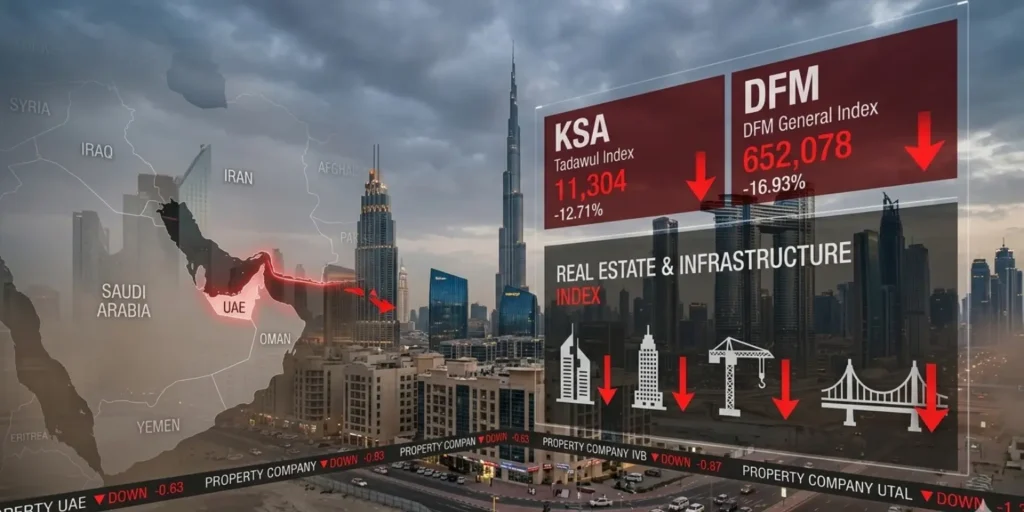
UAE equity markets face pressure as geopolitical tensions in Iran impact investor sentiment, hitting real estate and infrastructure sectors.
The ongoing conflict in Iran, now entering its third week, continues to affect investor confidence in the UAE. Analysts warn that an extended conflict could create wider economic uncertainty for Gulf markets, prompting cautious trading behavior and increased volatility.
According to Vijay Valecha, markets have fallen over the past 8–10 days as investors monitor tensions closely. A conflict lasting four weeks or more may not only pressure UAE markets but could also ripple across GCC countries, highlighting the interconnected nature of the region’s financial systems.
Ahmad Assiri noted that ongoing turmoil has forced investors to reassess regional risks. Volatility is rising as market participants weigh the stability of trade routes and the potential impact on sectors reliant on international commerce, especially aviation, banking, and tourism.
Sector Performance Shows Sharp Divergence
Real estate stocks have been the hardest hit, with property developers bearing the brunt of selling pressure. The Dubai Financial Market and Abu Dhabi Securities Exchange indices fell by almost 18% and 11%, respectively, since the start of the conflict.
Major real estate names such as Emaar Development and Emaar Properties declined 20.1% and 19.7%, reflecting the sector’s vulnerability to geopolitical uncertainty. Analysts attribute these declines to risk-driven reactions rather than fundamental economic issues.
Other sectors, like materials and consumer discretionary, have shown occasional short-term gains, but most sectors ended the week in negative territory. The steep losses in property and infrastructure stocks highlight the sensitivity of UAE markets to global and regional risk factors.
Risk-Driven Reaction versus Fundamentals
Experts emphasize that the recent market volatility is largely a response to perceived risk rather than a fundamental change in the UAE economy. “Geopolitical risk always pushes investors toward capital preservation,” said Nigel Green, noting that many investors are reducing exposure in the short term.
Despite the sell-offs, the UAE remains in a strong fiscal position. Valecha pointed out that ongoing geopolitical risks may keep foreign investment low and market volatility high, particularly in sectors linked to global trade and tourism, such as aviation, banking, and real estate.
This risk-driven environment suggests that investors are reacting to uncertainty and potential long-term disruptions, rather than structural weaknesses in the UAE economy. Short-term volatility is expected to persist as geopolitical developments unfold.
Valuations Offer Selective Opportunities
While volatility has affected stock prices, some analysts see opportunities for long-term investors. Recent declines have led to moderate dips in valuations, making certain sectors more attractive for strategic buying.
Ahmad Assiri noted that dips in the financial sector may be short-lived, supported by strong balance sheets and earnings. Similarly, Rania Gule highlighted that many UAE-listed companies still trade at reasonable price-to-earnings ratios of 12–15 times, competitive with other emerging markets.
Long-term investors may benefit from these levels, particularly in companies with stable cash flows and strong fundamentals. The continued expansion of infrastructure projects and steady economic growth in the UAE support the potential for gradual re-rating in these firms over time.
Outlook Amid Prolonged Conflict
If the conflict continues beyond four weeks, analysts expect markets to remain volatile rather than experience sustained sell-offs. Green suggested that ongoing instability could maintain high levels of caution among investors, affecting key sectors tied to trade and tourism.
Valecha added that a prolonged scenario extending beyond six months could have broader repercussions across the Gulf, impacting financial centres such as Dubai, Abu Dhabi, Riyadh, and Doha. The region’s interconnected markets and reliance on international capital flows mean that extended instability could weigh on investor confidence across multiple economies.
Despite the uncertainty, UAE economic fundamentals remain strong, which may help limit deeper losses. Analysts emphasize that volatility is likely to persist as investors closely monitor developments in the region, particularly regarding trade routes and security.
Conclusion
The UAE equity markets are under pressure as the Iran conflict continues. Real estate and infrastructure sectors have suffered the sharpest losses, reflecting investor caution in the face of geopolitical risk.
While short-term volatility is high, strong fiscal positions and attractive valuations in certain sectors provide opportunities for long-term investors. Continued monitoring of the conflict, regional trade stability, and foreign investment flows will be key in determining the near-term performance of UAE equities.
Prolonged uncertainty could affect not just UAE markets but the broader Gulf region, emphasizing the importance of geopolitical stability in maintaining investor confidence.
About The Author