
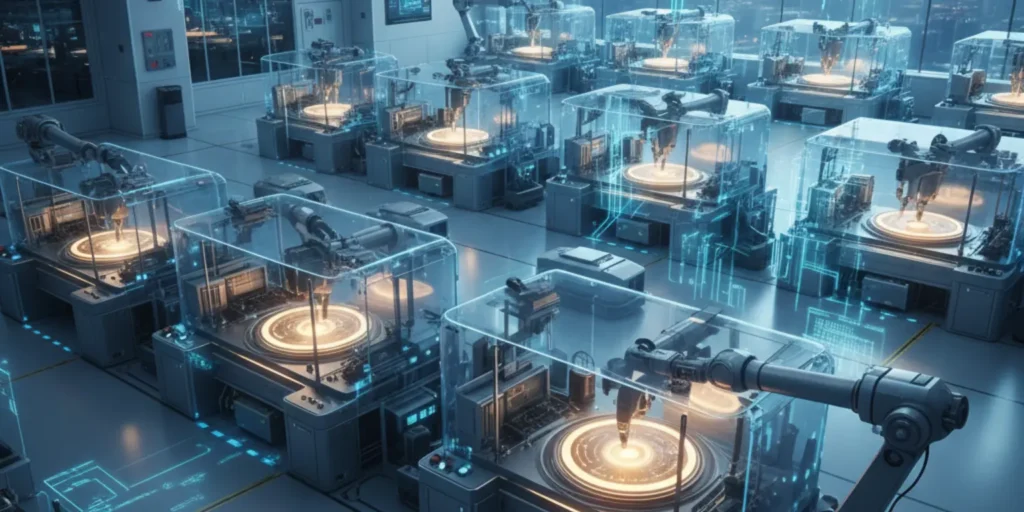
Taiwan Semiconductor Manufacturing Company plays a central role in global chip production as demand for AI and advanced computing drives long-term growth expectations.
On February 19, 2026, shares of Taiwan Semiconductor Manufacturing Company, better known as TSMC, were trading at $359.34, down 0.78 percent on the day. Even after that slight dip, the company remains one of the most valuable businesses in the world, with an estimated market capitalization of about $1.865 trillion. The big question for investors is simple: can TSMC more than double its value and reach a $3 trillion market cap by 2029?
A Dominant Force in Chip Manufacturing
TSMC is the world’s leading pure-play semiconductor foundry. It manufactures advanced chips for many of the biggest names in technology, including Nvidia and AMD. The company controls roughly 70 percent of the global foundry market, giving it enormous pricing power and strategic importance.
Unlike chip designers who focus on creating blueprints, TSMC specializes in actually producing the chips at scale. This distinction has become increasingly important as artificial intelligence, cloud computing, and advanced consumer devices require ever more powerful and efficient semiconductors.
Strong Revenue Growth of Taiwan Semiconductor Manufacturing Company
TSMC’s recent financial performance has been impressive. In 2025, the company generated $122 billion in revenue, representing a 36 percent increase from the previous year. That kind of growth is rare for a company of its size.
The fourth quarter of 2025 was particularly strong. Revenue came in at $33.73 billion, up 25.5 percent year over year and slightly ahead of analyst expectations. This momentum carried into early 2026, with January revenue rising 37 percent compared to the same month a year earlier.
Much of this growth is tied to surging demand for AI hardware. As companies invest heavily in data centers and AI servers, they require advanced chips built on cutting-edge manufacturing processes. TSMC is one of the few companies capable of producing chips at the most advanced nodes.
The Math Behind a $3 Trillion Valuation
To reach a $3 trillion market cap from $1.865 trillion, TSMC would need to grow its valuation by roughly 60 percent over the next three years. Management has forecast annual revenue growth of around 25 percent through 2029, supported by strong demand for advanced nodes such as 3nm and 2nm chips. If the company can sustain that growth and maintain healthy profit margins, earnings could rise significantly.
Currently, TSMC trades at a forward price-to-earnings ratio of about 26.4. If earnings expand in line with revenue and the valuation multiple remains stable, some estimates suggest the share price could climb to around $543. At that level, the company’s market capitalization would approach $3 trillion. Of course, this assumes that both growth and investor confidence hold steady.
Heavy Investment in Advanced Technology
TSMC is not standing still. The company plans to invest between $52 billion and $56 billion in capital expenditures in 2026, roughly 40 percent higher than in 2025. These investments will support expanded production capacity for 2nm and 3nm chips.
Building and equipping semiconductor fabrication plants is extremely expensive. However, these investments are essential to maintain leadership in advanced manufacturing. As AI servers and high-performance computing systems become more widespread, demand for cutting-edge chips is likely to remain strong. If TSMC successfully ramps up its new production lines without major delays, it could strengthen its competitive position even further.
Risks to Consider
Despite its strong position, TSMC faces real risks. Geopolitical tensions involving Taiwan remain a major concern for global investors. Any disruption to operations could have serious consequences not just for TSMC but for the entire global technology supply chain.
In addition, other countries are investing heavily in domestic semiconductor manufacturing. New fabrication plants in the United States, Japan, and Europe could gradually increase competition. While TSMC is also expanding internationally, foreign operations may come with higher costs and lower margins compared to its established facilities in Taiwan. There is also the usual cyclical risk in the semiconductor industry. Demand can fluctuate, and overcapacity can lead to pricing pressure.
Long-Term Outlook
Even with these risks, TSMC’s long-term outlook appears strong. The global shift toward AI-driven applications, autonomous systems, advanced smartphones, and high-performance computing continues to support robust chip demand. If the AI market grows faster than currently projected, TSMC’s revenues could exceed existing forecasts. As manufacturing constraints ease and capacity expands, the company may be able to capture even more of this demand.
Reaching a $3 trillion valuation by 2029 is ambitious but not unrealistic. It will depend on sustained revenue growth, disciplined capital spending, and stable geopolitical conditions. If TSMC continues to execute as it has over the past few years, investors who believe in the long-term AI trend may see substantial returns. In the end, TSMC’s future is closely tied to the growth of the global technology ecosystem. If AI and advanced computing remain central to economic expansion, the company could well justify a much higher valuation in the years ahead.
About The Author