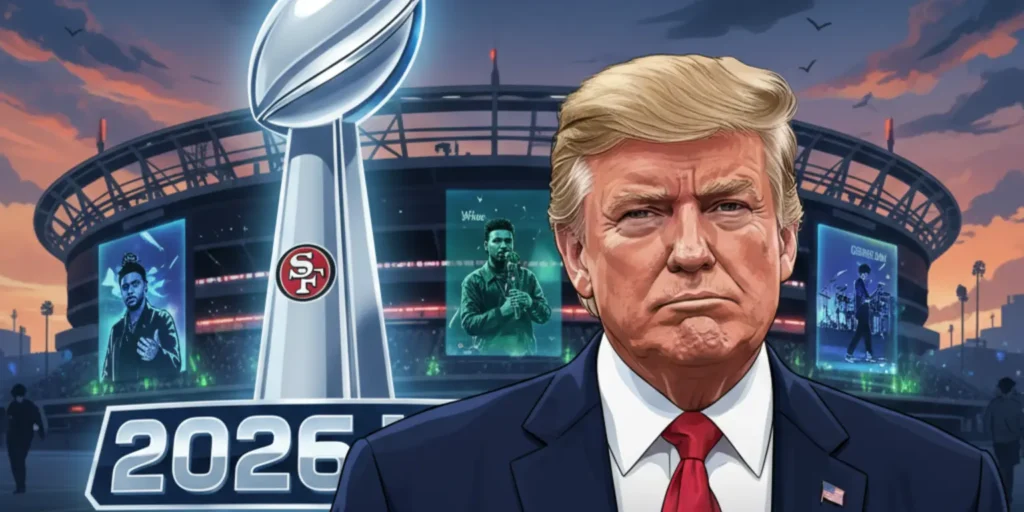
Trump declines attendance at the 2026 Super Bowl, citing dissatisfaction with the halftime lineup and travel distance.
President Donald Trump has confirmed that he will not attend the 2026 Super Bowl. Along with his decision, he openly criticised the National Football League for choosing Bad Bunny and Green Day as the halftime performers. Trump described the selection as a poor choice and said it played a role in his decision to stay away from the event.
The Super Bowl will take place in February 2026 at Levi’s Stadium in Santa Clara, California. It is one of the most-watched sporting events in the world and often draws attention far beyond football due to its halftime show and celebrity appearances.
Strong Reaction to Halftime Performers
In an interview with the New York Post, Trump spoke bluntly about the NFL’s choice of musicians. He called the pairing of Bad Bunny and Green Day “terrible” and made it clear that he does not support either artist.
“I’m anti them. I think it’s a terrible choice. All it does is sow hatred,” Trump said during the interview. His comments quickly spread across media outlets and social platforms, adding fuel to ongoing debates about politics and entertainment mixing at major sports events. The halftime show has long been a topic of controversy, with performers often praised by some fans and criticised by others. This time, Trump’s remarks brought a strong political angle to the discussion.
Distance and Travel Also Cited
Trump also mentioned practical reasons for skipping the Super Bowl. He suggested that the location played a role in his decision, stating that California is simply too far away.
“It’s just too far away. I would go. I’ve gotten great hands for the Super Bowl. They like me,” Trump said. He added that he might have considered attending if the event were closer.
His comments appeared slightly unclear at times, but his overall message was that distance, combined with dissatisfaction over the halftime lineup, made the trip less appealing.
Trump’s Super Bowl History
Trump made history last year by becoming the only sitting US president to attend the Super Bowl. He was present at the game in New Orleans, a move that drew significant media coverage at the time.
His appearance was seen as an effort to connect with sports fans and project a public image beyond politics. That context makes his decision to skip the 2026 game more notable, especially given how openly he criticised the NFL’s entertainment choices.
Why Bad Bunny and Green Day Sparked Criticism
Trump’s criticism did not come out of nowhere. Both Bad Bunny and Green Day have previously spoken out against his policies and political views. Bad Bunny recently released a song titled “NuevaYol,” in which he used a fake version of Trump’s voice to deliver a message supporting immigrants.
In the song, the imitation voice apologizes to immigrants and highlights the role they play in building the United States. The lyrics specifically mention communities such as Mexicans, Puerto Ricans, Dominicans, Colombians, Venezuelans, and Cubans. This message directly contradicts Trump’s past statements on immigration, making Bad Bunny’s work a clear point of tension.
Green Day’s Long History of Political Songs
Green Day has also been vocal in its criticism of Trump and the Republican Party. The band is known for political songs that challenge authority and government policies.
Tracks like “American Idiot” and “Jesus of Suburbia” have long been associated with anti-establishment themes. Over the years, Green Day has continued to use its platform to comment on social and political issues, including Trump’s presidency. Because of this history, Trump’s negative response to the band’s Super Bowl appearance was not surprising to many observers.
NFL Faces Mixed Reactions
The NFL has not responded directly to Trump’s comments, but the announcement of Bad Bunny and Green Day has already divided fans. Supporters of the performers praise the league for choosing artists with global influence and strong fan bases. Critics argue that the selection brings unnecessary political tension into a sporting event meant to unite viewers.
The Super Bowl halftime show has increasingly reflected cultural and social trends, often featuring artists who take clear public positions. This approach continues to spark debate about whether sports and politics should remain separate.
A Super Bowl Without Trump
Trump’s decision to skip the 2026 Super Bowl adds another layer of attention to an event that already draws massive interest. While his absence will not affect the game itself, his comments ensure that political discussion will remain part of the broader conversation.
As the event approaches, focus is likely to remain on the halftime show, the performers, and the reactions they provoke. Whether fans agree or disagree with Trump’s views, his remarks have once again placed the Super Bowl at the center of national discussion. The 2026 Super Bowl is still months away, but it is already shaping up to be one of the most talked-about editions in recent years, both on and off the field.
About The Author