
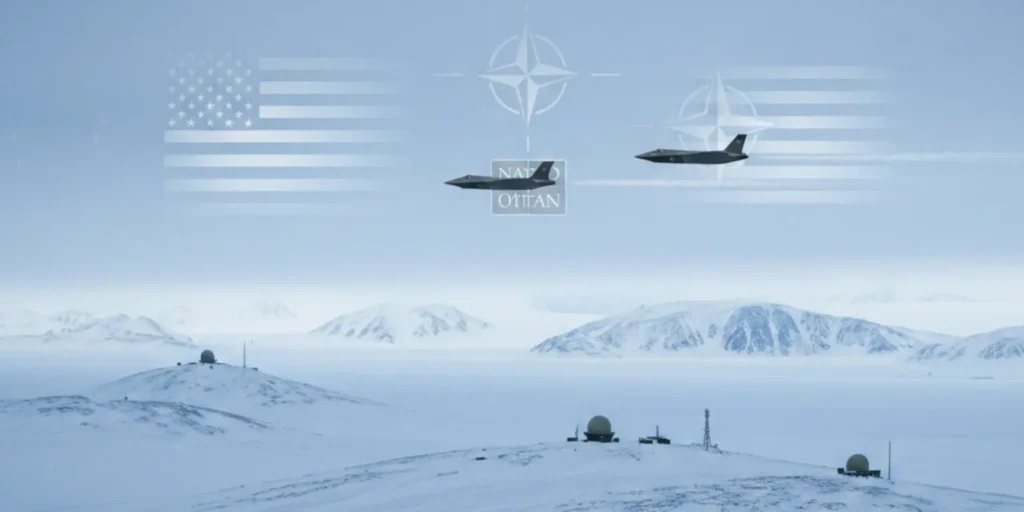
Greenland emerges as a strategic focus as the United States and NATO discuss expanded Arctic security cooperation.
President Donald Trump said this week that the United States has secured what he called total and permanent access to Greenland under a new framework discussed with NATO. His comments came during the World Economic Forum in Davos and followed days of tension with European allies over trade threats and security concerns in the Arctic.
Trump said the agreement would give Washington wide freedom to act in Greenland, though he avoided direct answers when asked whether it affected the island’s sovereignty. He stressed that the United States needs the ability to operate freely in the region to protect its interests.
NATO Pushes for Stronger Arctic Security
NATO Secretary General Mark Rutte said the talks reflect growing concern among allies about security risks in the Arctic, particularly from Russia and China. He said NATO members will need to increase their commitment to the region and work together to strengthen defenses.
According to sources familiar with the discussions, Trump and Rutte agreed on further talks between the United States, Denmark, and Greenland to update a 1951 agreement that already governs U.S. military access to the island. The framework being discussed may also limit Chinese and Russian investments in Greenland. Rutte said NATO military leaders would now work through the practical details and expressed hope that new security arrangements could be in place by early 2026.
Denmark and Greenland Push Back on Sovereignty
While Trump spoke confidently about expanded U.S. access, Denmark and Greenland made clear that sovereignty is not negotiable. Denmark insists that Greenland remains a semi-autonomous territory under Danish control, and no agreement has changed that status.
Greenland’s Prime Minister Jens-Frederik Nielsen said he welcomed dialogue but said he had not been informed of any detailed deal. Speaking in Nuuk, he said Greenland is open to cooperation and stronger partnerships but will not cross red lines related to sovereignty and international law.
Danish Prime Minister Mette Frederiksen echoed that message, saying no negotiations had taken place about Greenland’s sovereignty. She described the situation as serious but said progress had been made in shifting the focus toward shared Arctic security rather than political control.
Markets Calm After Trump Steps Back
Trump’s comments came alongside a softer tone toward Europe. He backed away from earlier tariff threats and ruled out taking Greenland by force. That shift helped ease market fears and led to a rebound in European stocks, while U.S. markets moved back toward record highs.
Still, European leaders said the episode has already damaged trust. EU foreign policy chief Kaja Kallas said relations with Washington had taken a major hit over the past week. She warned that disputes between allies only benefit rivals who are watching closely. An emergency summit of EU leaders was held to discuss the situation and reassess ties with the United States.
Calls for Permanent NATO Presence
Several European leaders used the moment to call for a stronger NATO footprint in the Arctic. Frederiksen said NATO should maintain a permanent presence in the region, including areas around Greenland.
Finnish President Alexander Stubb said he hoped allies could agree on a clear plan to boost Arctic security by a NATO summit scheduled for July in Ankara. British Prime Minister Keir Starmer also said the United Kingdom stands ready to contribute fully to Arctic defense efforts.
Military Access and Strategic Interests
Trump said the discussions could support U.S. goals such as missile defense and protecting access to critical resources while blocking Russian and Chinese ambitions in the Arctic. He referred to his vision of a future missile defense system, often called the Golden Dome.
Rutte said mineral extraction was not discussed in his meeting with Trump, emphasizing that talks are focused on security. Experts note that the existing 1951 agreement already gives the United States broad rights to build bases and move freely in Greenland, as long as Denmark and Greenland are informed. The U.S. currently operates a base at Pituffik in northern Greenland. During the Cold War, the United States maintained far more bases and activity on the island than it does today.
China Rejects Threat Claims
China responded by rejecting claims that it poses a threat in the Arctic. Its foreign ministry said such accusations are baseless and accused Western countries of using China as an excuse to advance their own agendas.
Beijing said its Arctic activities, including scientific research and shipping, follow international law. Chinese state media also criticized attempts by the United States and Europe to label China as a military or resource threat in the region.
Unease Among Europeans and Greenlanders
Although Trump’s retreat from tariffs eased immediate tensions, diplomats said confidence in transatlantic relations has been shaken. European governments remain cautious, worried that U.S. policy could shift again without warning.
In Greenland, residents expressed confusion and concern. Some said the rapid swings in rhetoric make it hard to trust long-term promises or build stability. As talks continue, the debate over Greenland highlights deeper questions about Arctic security, alliance unity, and how major powers compete in a region that is becoming more important each year.
About The Author