
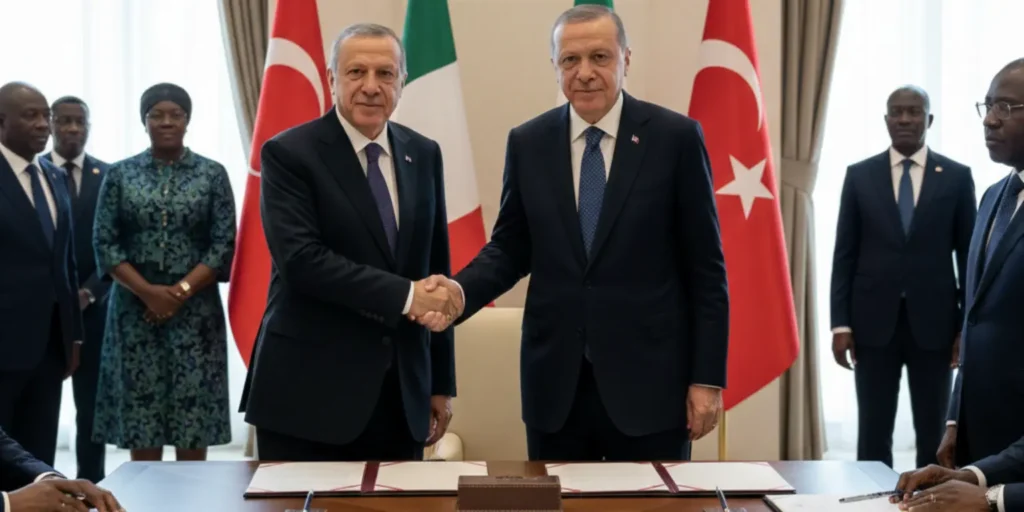
Turkish President Recep Tayyip Erdogan and Nigerian President Bola Ahmed Tinubu meet in Ankara to sign agreements boosting trade, investment, and defence cooperation.
Türkiye & Nigeria have agreed to expand cooperation in trade, investment, industry, and defence, marking a new phase in relations between the two countries. The agreements were signed during an official visit to Türkiye by Nigerian President Bola Ahmed Tinubu, with both sides signaling a strong commitment to a long-term partnership.
The discussions took place in Ankara and were led by President Recep Tayyip Erdogan of Türkiye and President Tinubu. The visit resulted in the signing of multiple agreements aimed at boosting economic ties and deepening collaboration across several strategic sectors.
New Framework to Boost Economic Relations
Turkish Trade Minister Omer Bolat said the two countries signed a joint declaration to establish a Joint Economic and Trade Committee, commonly known as JETCO. This committee is expected to play a central role in guiding trade and investment relations between Ankara and Abuja.
Alongside this declaration, both sides also signed a Memorandum of Understanding focused on Halal Quality Infrastructure. The agreement is designed to support cooperation in halal certification and standards, which is seen as an important area for trade expansion, especially in food, pharmaceuticals, and consumer goods.
Bolat said the talks covered a wide range of topics related to production, investment, and industrial cooperation. He added that the agreements would open new opportunities for companies in both countries and help strengthen private-sector engagement.
Targeting $5 Billion in Bilateral Trade
One of the key goals outlined during the meetings was a shared ambition to raise bilateral trade to $5 billion. According to Bolat, both governments are committed to diversifying trade, increasing investment flows, and encouraging partnerships between Turkish and Nigerian businesses.
Türkiye plans to continue its relationship with Nigeria based on trust and a long-term strategic vision. Bolat said Ankara views Nigeria as a key partner in Africa and believes the two economies can complement each other in areas such as manufacturing, energy, and infrastructure development.
Nine Agreements Signed at Presidential Level
In total, nine agreements were signed in the presence of Presidents Erdogan and Tinubu following both bilateral and wider delegation meetings. These agreements cover a broad range of sectors and reflect the growing scope of cooperation between the two countries.
The areas included military training, defence and security cooperation, diaspora policy, media and communications, higher education, halal accreditation, diplomatic training, and social and women’s affairs. The signing ceremony highlighted the importance both leaders place on strengthening institutional ties and formalizing cooperation across government agencies.
Nigeria Seeks Deeper Security and Trade Links
President Tinubu said Nigeria is keen to expand cooperation with Türkiye, especially in the areas of security and trade. He noted that both countries face shared challenges related to regional stability and economic development.
Tinubu emphasized that stronger partnerships with Türkiye could help Nigeria improve its security capabilities while also supporting economic growth through trade and investment. He expressed confidence that the agreements signed would bring practical benefits to both nations.
Trade Relations Continue to Grow
Trade between Türkiye & Nigeria has been steadily increasing in recent years. Bilateral trade reached $688.4 million in the first 11 months of 2025, reflecting growing economic engagement.
When energy trade is included, Nigeria became Türkiye’s largest trading partner in sub-Saharan Africa last year. This highlights Nigeria’s importance in Türkiye’s broader Africa strategy and underscores the potential for further growth. Both governments believe that improved coordination through the new trade mechanisms will help unlock even greater volumes of commerce.
Expanding Defence Cooperation
Defence ties between Türkiye & Nigeria have developed rapidly. The Nigerian Air Force has purchased Turkish-made drones as well as six ATAK T129 attack helicopters, strengthening its operational capabilities.
This cooperation is part of Nigeria’s broader effort to address security threats and improve its defence infrastructure. Türkiye’s defence industry has become an increasingly important partner for countries seeking cost-effective and reliable military technology. Officials from both sides said defence cooperation would continue to expand, supported by training programs and knowledge sharing.
Turkish Investment Presence in Nigeria
Turkish companies are active in several sectors across Nigeria, including construction, energy, textiles, and manufacturing. More than 50 Turkish-owned firms have invested around $400 million in the country so far.
The value of projects carried out by Turkish contractors in Nigeria is approaching $3 billion. These projects include infrastructure development and industrial facilities that contribute to job creation and economic growth. Both governments see strong potential for further investment, especially as Nigeria continues to develop its industrial base and expand its consumer market.
Longstanding Diplomatic Relations
Türkiye & Nigeria established diplomatic relations in 1960 and have gradually expanded cooperation over the decades. In recent years, the relationship has grown stronger, particularly in security and defence, as Nigeria intensifies efforts to counter militant groups and improve internal stability. The latest agreements reflect a shared intention to move beyond traditional diplomacy and build a comprehensive partnership that supports development, security, and mutual economic benefit.
Conclusion
The agreements signed in Ankara mark an important step in strengthening Türkiye & Nigeria’s relationship. With ambitious trade targets, expanding defence cooperation, and growing private-sector involvement, both countries are positioning themselves for deeper and more balanced engagement. As the new mechanisms take shape, the focus will be on turning political commitments into real economic and strategic outcomes that benefit businesses and citizens in both nations.
About The Author