
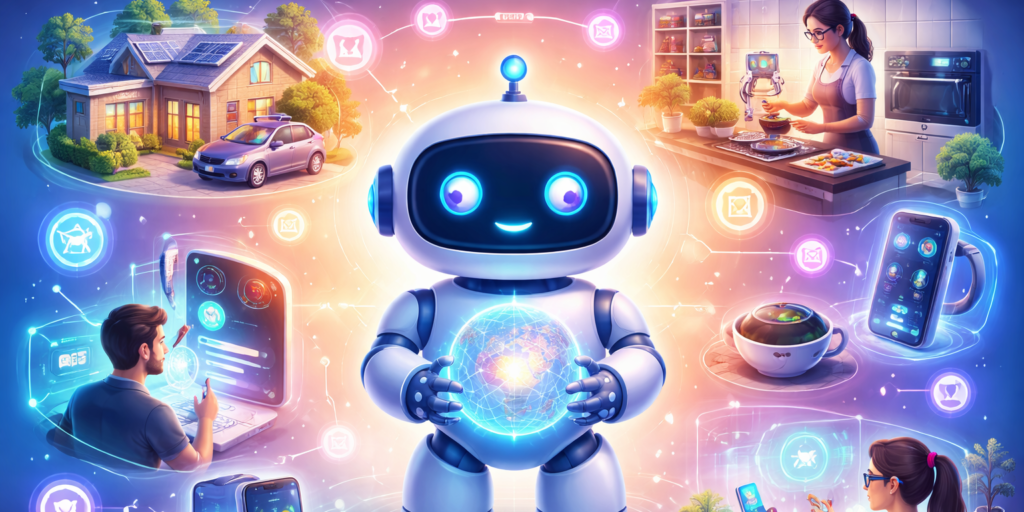
Artificial intelligence is no longer futuristic — it already powers daily routines in subtle, invisible ways.
Artificial intelligence often feels like something distant, advanced, or reserved for research labs and tech giants. Many people still imagine AI as futuristic robots, self-aware machines, or science-fiction scenarios that have not yet arrived. In reality, artificial intelligence has already become a quiet and constant presence in everyday life. It works in the background, making small decisions, improving convenience, and shaping experiences without demanding attention or explanation.
From the moment people wake up and check their phones, AI is already at work. It helps unlock devices through facial recognition, prioritizes notifications, suggests replies to messages, and predicts the next word while typing. Navigation apps choose faster routes based on traffic patterns, music platforms recommend songs based on listening habits, and online stores display products that feel surprisingly relevant. These interactions happen dozens of times each day, often without users realizing that artificial intelligence is behind them.
AI is not limited to personal devices. It helps manage electricity usage in homes, filters spam from email inboxes, improves photo quality with a single tap, and assists customer support systems in responding faster. In offices, AI supports scheduling, automates repetitive tasks, and helps teams analyze information more efficiently. In healthcare, it helps track health data, detect patterns, and support medical professionals in decision-making. Even entertainment, news, and social media feeds are shaped by algorithms designed to understand preferences and behavior.
Because AI operates quietly, many people never stop to question how it works or how much influence it has. This lack of awareness can create confusion, fear, or misplaced expectations. Some worry that AI will replace humans, while others trust it blindly without understanding its limitations. Both reactions stem from the same issue: a gap in understanding.
Understanding artificial intelligence now matters more than ever because it is no longer optional or avoidable. AI systems influence what people see, buy, read, and interact with daily. They shape opportunities, productivity, privacy, and even personal choices. Knowing how AI works at a basic level helps people use it more confidently, question it when necessary, and make informed decisions about technology in their lives.
This guide is designed to explain artificial intelligence in a clear and accessible way. It focuses on how AI fits into everyday routines, not just how it works in theory. By understanding where AI appears, what it can do, and where its limits lie, readers can move from passive users to informed participants in an AI-driven world.
What Artificial Intelligence Really Is (And What It Is Not)
Artificial intelligence is often misunderstood because the term itself sounds complex and futuristic. At its core, AI is not a single machine, robot, or conscious system. It is a collection of technologies designed to help computers perform tasks that normally require human intelligence, such as recognizing patterns, understanding language, making predictions, or learning from experience.
In simple terms, artificial intelligence allows machines to process information, learn from data, and improve their performance over time. Unlike traditional software, which follows fixed instructions written by programmers, AI systems can adapt. They analyze large amounts of information, find patterns, and adjust their responses based on what they learn. This ability to improve is what makes AI different from ordinary automation.
One of the most common concepts within AI is machine learning. Machine learning refers to systems that learn from data rather than being explicitly programmed for every outcome. For example, instead of telling a computer exactly how to identify spam emails, developers provide examples of spam and non-spam messages. The system studies these examples, learns the differences, and applies that knowledge to new emails. Over time, it becomes better at making accurate decisions.
A more advanced form of machine learning is deep learning. Deep learning uses layers of artificial neural networks inspired by how the human brain processes information. These systems are especially good at recognizing images, understanding speech, and interpreting complex patterns. Deep learning powers features such as voice assistants, image recognition in photos, and real-time language translation. While the technology is sophisticated, its purpose remains practical: improving accuracy and efficiency in specific tasks.
Another important concept often confused with AI is automation. Automation refers to systems that follow predefined rules to perform tasks automatically. While automation can be part of AI, not all automated systems are intelligent. A simple timer that turns lights on and off is automation, but it does not learn or adapt. AI goes further by adjusting behavior based on data and outcomes, rather than repeating the same action every time.
There are many myths surrounding artificial intelligence, and one of the most common is the fear of sentient machines. Popular culture often portrays AI as self-aware, emotional, or capable of independent thought. In reality, modern AI has no consciousness, emotions, or understanding. It does not think, feel, or have intentions. It processes inputs and produces outputs based on probabilities, patterns, and instructions created by humans.
Another misconception is that AI is always accurate or unbiased. AI systems reflect the data they are trained on. If the data is incomplete, outdated, or biased, the results will be as well. AI does not possess common sense or moral judgment. It cannot understand context the way humans do unless that context has been clearly defined and trained into the system.
Modern AI also does not operate independently from humans. Behind every AI system are designers, engineers, researchers, and decision-makers who shape how it functions. Humans decide what data is used, what goals the system should prioritize, and where it is deployed. AI is a tool, not an authority.
Understanding what artificial intelligence truly is helps remove unnecessary fear and unrealistic expectations. It is neither a magical solution nor an uncontrollable force. Instead, AI is a powerful technology designed to assist, enhance, and support human activities when used responsibly. By viewing AI as a practical tool rather than a mystery, people can better understand its role in everyday life and make informed choices about how they interact with it.
How AI Works in the Background of Daily Life
Artificial intelligence does not announce itself when it is working. In most cases, it operates quietly behind the screens and systems people use every day. Instead of acting like a human mind, AI functions through structured processes that analyze data, recognize patterns, and make predictions based on probabilities.
At the heart of most AI systems are algorithms. Algorithms are sets of instructions that tell a system how to process information and what to do with it. In AI, these instructions are designed to learn from data rather than follow a fixed path. When users interact with apps, websites, or devices, their actions generate data. AI systems use this data to understand patterns and improve performance over time.
Data training is the process through which AI learns. During training, large volumes of examples are fed into the system. For instance, a music app studies listening habits, skipped tracks, and saved songs. Over time, it identifies patterns, such as preferred genres or listening times. The system does not understand music emotionally; it simply recognizes which combinations of features lead to positive user responses.
Pattern recognition allows AI to make sense of complex information. When a navigation app suggests a faster route, it is analyzing traffic data, road conditions, and historical trends. It recognizes patterns in congestion and predicts outcomes based on past behavior. The system does not reason like a human driver; it calculates probabilities and selects the most likely efficient option.
Decision models are used to choose the best action from several possibilities. These models weigh different factors, such as speed, relevance, or user preference. For example, an email filter decides whether a message belongs in the inbox or spam folder. It does not read emails for meaning but compares patterns in sender behavior, content structure, and past outcomes.
AI learns by observing behavior, not by thinking or understanding. If users repeatedly correct an autocorrect suggestion or skip recommended videos, the system adjusts. This feedback loop allows AI to improve without human-like awareness. The result is a technology that feels responsive and intuitive, even though it operates entirely on data-driven logic.
AI in Smartphones and Personal Devices
Smartphones are one of the most common and personal ways people interact with artificial intelligence. Nearly every modern device relies on AI to enhance usability, performance, and personalization. These systems work continuously, shaping the user experience without demanding attention.
One of the most visible uses of AI is in camera enhancements. When users take photos, AI automatically adjusts lighting, sharpness, color balance, and focus. It recognizes faces, landscapes, text, and motion to improve image quality in real time. The system does not see the world as humans do; it analyzes visual patterns and applies adjustments based on millions of similar images it has learned from.
Voice assistants rely heavily on AI to understand spoken language and respond accurately. When someone speaks to a device, the AI converts sound waves into text, interprets intent, and generates a response. This process involves speech recognition, language models, and contextual analysis. Over time, these systems adapt to accents, speech patterns, and usage habits.
Face recognition uses AI to identify unique facial features and compare them with stored patterns. It measures distances between facial elements, not personal identity. This allows devices to unlock quickly while maintaining security. The system improves accuracy as it encounters more variations in lighting, angles, and expressions.
Predictive text and personalization are powered by AI that studies typing habits, commonly used phrases, and context. The keyboard suggests words based on probability, not understanding. It predicts what comes next by analyzing patterns in language usage, making communication faster and more efficient.
A major shift in recent years is the move toward on-device AI. Instead of sending data to cloud servers, many AI tasks are now processed directly on the device. This reduces delays, improves performance, and enhances privacy by keeping sensitive data local. On-device AI also works without an internet connection, making it more reliable and energy-efficient.
By embedding AI directly into personal devices, technology becomes faster, smarter, and more respectful of user control. Smartphones no longer feel like tools that require constant management. Instead, they adapt quietly, learning from everyday behavior to create smoother and more personalized experiences.
AI in Homes: Smart Living Explained
Artificial intelligence has gradually entered homes, transforming living spaces into responsive environments that adapt to daily routines. Smart homes are not defined by futuristic gadgets alone, but by systems that combine sensors, automation, and AI decision-making to simplify everyday tasks and improve comfort.
Smart speakers are often the central hub of a smart home. These devices listen for voice commands, interpret intent, and connect with other systems in the house. When someone asks for the weather, plays music, or controls lights through voice, AI processes speech, understands context, and triggers the appropriate action. Over time, smart speakers learn preferences such as frequently used commands, preferred playlists, and daily routines.
Thermostats powered by AI adjust indoor temperatures based on usage patterns rather than fixed schedules. By analyzing when residents are home, asleep, or away, these systems learn optimal temperature settings. Sensors detect motion, humidity, and external weather conditions, allowing the thermostat to make small adjustments automatically. This results in increased comfort while reducing unnecessary energy use.
Security systems have also evolved through AI. Modern systems can distinguish between familiar faces, visitors, pets, and potential threats. Cameras analyze movement patterns rather than reacting to every motion, reducing false alerts. AI-driven security systems learn normal activity within a home and flag unusual behavior, providing homeowners with more accurate and timely notifications.
Energy optimization is another key area where AI improves daily living. Smart meters and connected appliances collect data on energy usage and identify opportunities to reduce waste. AI systems analyze consumption patterns and suggest changes, such as running appliances during off-peak hours or adjusting lighting automatically. Over time, these systems balance convenience with efficiency, lowering energy costs and environmental impact.
Together, automation handles routine actions, sensors collect real-time data, and AI makes informed decisions. The result is a home that responds to its residents without requiring constant input, making daily life more comfortable, efficient, and secure.
AI in Work, Productivity, and Communication
Artificial intelligence is reshaping how people work, communicate, and manage information. Rather than replacing human effort entirely, AI is increasingly used to support productivity by handling repetitive tasks and enhancing decision-making.
In office tools, AI helps organize information, analyze data, and streamline workflows. Spreadsheet software can detect trends, suggest formulas, and highlight anomalies. Project management tools use AI to prioritize tasks, estimate timelines, and track progress. These systems reduce administrative burden, allowing employees to focus on creative and strategic work.
Emails and scheduling have become more efficient through AI assistance. Smart email systems categorize messages, filter spam, and suggest responses based on context. Scheduling tools analyze availability across teams and automatically propose meeting times. AI reduces time spent on coordination, one of the most common productivity challenges in modern workplaces.
Customer support has been transformed through AI-driven chat systems and automated response tools. These systems handle routine inquiries, provide instant answers, and guide users through basic issues. When more complex problems arise, AI routes them to human agents with relevant context. This collaboration improves response times while maintaining human oversight.
Content creation is another area where AI is becoming a supportive tool. AI can assist with drafting, summarizing, editing, and translating content. It helps creators generate ideas, improve clarity, and save time. However, human creativity, judgment, and originality remain essential, as AI relies on existing patterns rather than genuine understanding.
In remote collaboration, AI supports communication across distances. Video conferencing tools use AI to reduce background noise, enhance video quality, and generate meeting summaries. Language translation features help global teams communicate more effectively. AI ensures that distance does not limit participation or productivity.
Concerns about job loss often arise when discussing AI in the workplace. In reality, AI is more likely to transform roles rather than eliminate them. Repetitive tasks become automated, while new roles emerge that focus on oversight, creativity, and problem-solving. Workers who understand and adapt to AI tools gain opportunities to work more efficiently and meaningfully.
AI in the workplace is not about replacing people. It is about augmenting human capabilities, improving collaboration, and creating systems that support productivity in an increasingly digital world.
AI in Healthcare and Well-Being
Artificial intelligence is playing an increasingly important role in healthcare and personal well-being, supporting professionals and individuals with tools that improve accuracy, efficiency, and accessibility. Rather than replacing doctors or caregivers, AI acts as an assistant that helps interpret information, identify patterns, and support informed decision-making.
In diagnostics, AI systems analyze symptoms, medical records, and historical data to help identify potential conditions. These tools can flag patterns that may be difficult to detect manually, especially in large datasets. For example, AI can assist in early disease detection by comparing patient data with thousands of similar cases. However, final diagnoses remain the responsibility of trained medical professionals, who interpret AI-supported insights within a broader clinical context.
Medical imaging is one of the most established uses of AI in healthcare. AI systems analyze X-rays, MRIs, CT scans, and ultrasounds to highlight anomalies or areas of concern. By detecting subtle visual patterns, AI helps radiologists work more efficiently and reduces the risk of oversight. These tools act as a second set of eyes, enhancing accuracy without replacing expert judgment.
Wearable health tracking devices use AI to monitor activity, heart rate, sleep patterns, and other physiological signals. AI analyzes this data to identify trends, detect irregularities, and provide personalized insights. For individuals managing chronic conditions or wellness goals, wearables offer continuous feedback that supports healthier habits. Importantly, this data is most effective when reviewed alongside professional medical advice.
AI also supports mental health tools by offering accessible resources for stress management, mood tracking, and guided support. Some platforms use AI to analyze language patterns or behavioral changes to suggest coping strategies or recommend professional help when needed. These tools expand access to mental health support but do not replace human care, empathy, or therapeutic relationships.
Across healthcare and well-being, AI serves as a powerful support system. It enhances efficiency, improves accuracy, and extends access, while human professionals remain essential for interpretation, ethics, and compassionate care.
AI in Shopping, Entertainment, and Social Media
Artificial intelligence plays a major role in shaping how people shop, consume entertainment, and interact with digital platforms. Behind the scenes, AI-driven recommendation systems analyze behavior to deliver personalized experiences that feel intuitive and engaging.
On streaming platforms, AI recommends movies, shows, and music based on viewing history, preferences, and engagement patterns. These systems analyze what users watch, skip, or replay, and compare that data with similar users. The goal is not to understand personal taste emotionally, but to predict what content is most likely to keep someone engaged.
In online shopping, AI helps personalize product recommendations, optimize pricing, and improve search results. When shoppers browse items, add products to carts, or complete purchases, AI systems learn preferences and suggest relevant alternatives. This personalization makes shopping more efficient, but it also influences purchasing behavior by highlighting certain products over others.
News feeds on digital platforms rely heavily on AI to determine what content appears first. Algorithms analyze interactions such as likes, shares, comments, and reading time. Content that generates engagement is prioritized, shaping what users see and how information spreads. This can create highly personalized experiences, but it also raises concerns about filter bubbles and limited exposure to diverse perspectives.
Advertising and personalization are driven by AI systems that match ads to users based on interests, demographics, and online behavior. These systems aim to deliver relevant messaging while maximizing engagement. While personalized ads can be useful, they also highlight the importance of transparency and data awareness.
AI-driven recommendation systems significantly influence attention and consumption habits. They shape what people discover, how long they engage, and what choices they make. Understanding how these systems work empowers users to engage more consciously, manage their preferences, and recognize the role algorithms play in daily digital experiences.
Privacy, Data, and Ethical Concerns Around AI
As artificial intelligence becomes more embedded in daily life, questions about privacy and ethics are no longer abstract concerns. AI systems rely heavily on data to function effectively, and much of that data comes from human behavior. Every search query, location ping, purchase history, voice command, or interaction with a digital platform can be collected, stored, and analyzed. While this data allows AI to deliver personalized and convenient experiences, it also raises important concerns about how much information is being gathered and who controls it.
One of the biggest privacy issues surrounding AI is data collection itself. Many AI-powered services work by observing patterns in user behavior over time. This can include what people watch, read, buy, or even how they move and speak. Often, users agree to data collection through long terms and conditions that few people read carefully. As a result, individuals may not fully understand how much of their personal information is being used, how long it is stored, or whether it is shared with third parties.
Surveillance is another growing concern. AI-powered cameras, facial recognition systems, and location-tracking tools are increasingly used in public and private spaces. While these technologies can improve security and efficiency, they can also be misused. Without clear limits, surveillance systems may infringe on personal freedoms, track individuals without consent, or disproportionately target certain groups. This raises questions about where the line should be drawn between safety and privacy.
Algorithmic bias is a more subtle but equally serious issue. AI systems learn from historical data, and if that data contains social, cultural, or systemic biases, the AI may reproduce or even amplify them. This can affect hiring tools, loan approvals, healthcare recommendations, and content moderation systems. Bias is often unintentional, but its consequences can be very real, leading to unfair treatment or exclusion of certain individuals or communities.
Transparency is another ethical challenge. Many AI systems operate as “black boxes,” meaning their decision-making processes are difficult to explain, even to their creators. When an AI system denies a loan, flags content, or prioritizes certain information, users may not know why that decision was made. This lack of clarity can reduce trust and make it harder to challenge or correct errors. Increasing transparency and explainability is an ongoing goal in responsible AI development.
Companies attempt to balance personalization with privacy by using techniques such as data anonymization, on-device processing, and user control settings. However, these measures vary widely between organizations. This is why regulation plays a crucial role. Laws and frameworks around data protection, consent, and accountability help ensure that AI development respects human rights and social values. As AI continues to evolve, ethical considerations must remain a central part of how these systems are designed and deployed.
The Difference Between Helpful AI and Harmful AI
Artificial intelligence itself is not inherently good or bad. Its impact depends on how it is designed, trained, and used. Helpful AI focuses on supporting human needs, improving efficiency, and enhancing quality of life. Harmful AI, on the other hand, emerges when systems are misused, poorly designed, or deployed without sufficient oversight or ethical consideration.
Helpful AI improves daily life in practical ways. It assists doctors by highlighting patterns in medical data, helps students learn at their own pace, supports accessibility tools for people with disabilities, and reduces repetitive tasks in the workplace. In these cases, AI acts as an assistant rather than a decision-maker, leaving critical judgment in human hands. The goal is augmentation, not replacement.
Harmful AI often appears when systems are pushed beyond their limits or used irresponsibly. Misinformation is a major example. AI-generated content can spread false or misleading information at a massive scale, especially when combined with social media algorithms that prioritize engagement over accuracy. Deepfakes, which use AI to create realistic but fake images, audio, or videos, can damage reputations, manipulate public opinion, and erode trust in digital content.
Manipulation is another risk. AI systems designed to maximize attention can encourage addictive behavior, shape opinions subtly, or exploit emotional responses. When algorithms prioritize profit or influence without considering user well-being, they can create unhealthy digital environments. Over-reliance on automation is also dangerous, particularly in areas like transportation, healthcare, or security, where human oversight is essential.
The key difference between helpful and harmful AI lies in intention, design, and accountability. Responsible AI development emphasizes fairness, transparency, human control, and clear boundaries. When these principles are ignored, even powerful technology can become a source of harm. Understanding this distinction helps individuals, organizations, and policymakers make better decisions about how AI should be used, regulated, and trusted in the future.
The Future of AI in Everyday Life
The future of artificial intelligence is less about dramatic breakthroughs and more about quiet integration. Instead of big, visible moments, AI is likely to blend even more deeply into the background of daily life. The next phase of AI development focuses on systems that are present without being intrusive, helpful without being overwhelming, and intelligent without demanding constant attention.
Wearable AI is one of the most noticeable directions this future is heading toward. Devices such as smartwatches, fitness bands, and health monitors are already collecting data, but future versions will go further by interpreting that information in real time. Rather than simply reporting numbers, wearable AI may offer context-aware insights, gently suggesting rest, movement, or lifestyle adjustments based on patterns it recognizes over time. The goal is not control, but subtle guidance that adapts to individual routines.
Another major shift is toward ambient computing. This refers to AI systems that exist in the environment rather than on a single screen or device. Lighting that adjusts automatically, homes that anticipate needs, and workspaces that respond to behavior patterns are all part of this vision. In ambient systems, AI fades into the surroundings, responding naturally to presence and habits without requiring explicit commands.
Smarter assistants will also play a role, but their evolution is likely to be more restrained than popular media suggests. Instead of trying to replace human thinking, future assistants may become better listeners and coordinators. They could manage tasks across platforms, understand context more accurately, and reduce friction between tools, all while staying within clear boundaries set by users.
Human-AI collaboration is perhaps the most important trend of all. AI will increasingly be designed to work alongside people rather than independently. In creative fields, healthcare, education, and decision-making roles, AI can surface insights, handle repetitive work, and offer alternative perspectives while humans retain authority. This collaborative model emphasizes trust, transparency, and shared responsibility rather than automation for its own sake.
How People Can Use AI Responsibly
Using AI responsibly begins with awareness. Understanding where and how AI is used helps people make more informed choices about the tools they rely on. This does not require technical expertise, but it does involve asking basic questions about data use, accuracy, and limitations.
Managing privacy settings is one of the most practical steps individuals can take. Many AI-powered platforms allow users to control what data is collected, stored, or shared. Taking time to review these settings, even occasionally, can reduce unnecessary data exposure and increase confidence in how personal information is handled.
It is also important to use AI as a support tool rather than a substitute for judgment. AI can assist with writing, planning, learning, or decision-making, but it should not replace critical thinking. Verifying information, questioning recommendations, and recognizing when human insight is needed helps maintain balance.
Responsible use also means resisting fear-driven reactions. AI is neither a miracle solution nor an unstoppable threat. Thoughtful adoption, guided by curiosity and caution, allows individuals to benefit from AI while staying in control of their choices.
Conclusion
Artificial intelligence is no longer something happening in distant labs or future timelines. It is already woven into daily routines, shaping how people communicate, work, learn, and relax. Understanding this reality is the first step toward a healthier relationship with technology.
Throughout this discussion, one idea remains central: AI is shaped by human decisions. From the data it learns from to the goals it is designed to achieve, AI reflects the values, priorities, and limitations of its creators and users. This means people are not passive recipients of AI’s influence, but active participants in how it evolves.
Living well with AI requires awareness rather than resistance. Knowing when AI is present, how it functions, and what it can and cannot do creates a sense of control. Transparency builds trust, while clear boundaries prevent over-reliance. When AI is used to support human goals instead of replacing human agency, it becomes a tool rather than a force.
The future of AI does not need to be feared or idealized. It can be approached calmly, with curiosity and responsibility. By staying informed, demanding ethical standards, and using AI intentionally, individuals and societies can ensure that technology serves human well-being. AI is here to stay, but its role is still being written. Choosing to live with AI, not under it, means shaping that role thoughtfully and confidently, guided by human values rather than driven by unchecked automation.
About The Author