
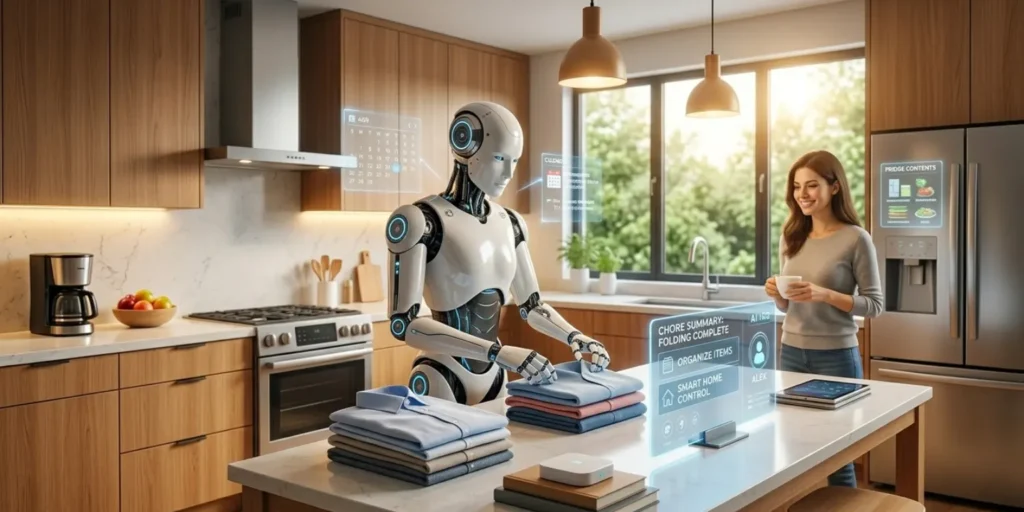
Sunday Robotics reaches unicorn status after raising $165 million to develop AI-powered humanoid robots designed for household tasks.
Sunday Robotics has entered the group of unicorn startups after securing a new round of funding that values the company at about $1.15 billion. The robotics startup shared the news on Thursday, highlighting strong investor interest in companies developing advanced household robots powered by artificial intelligence.
The company raised $165 million in a Series B funding round. The investment was led by Coatue Management, a major technology-focused investment firm. Other well-known investors that joined the round include Tiger Global, Benchmark, and Bain Capital Ventures, showing strong support from the venture capital community.
This funding round gives the company new resources to expand its research, hire engineers, and accelerate product development. Investors believe that humanoid robotics could become a major technology sector in the coming years, especially as artificial intelligence makes machines more capable of understanding and performing everyday tasks inside the home.
A Startup Moving Quickly After Emerging From Stealth
Sunday Robotics operated quietly for much of its early development phase. The company came out of stealth mode toward the end of last year and quickly began attracting attention within the robotics and technology investment community. Its focus on household automation has made it stand out in a crowded startup environment.
Despite being relatively new to the public eye, the company has already generated early interest from potential customers. According to reports from Bloomberg, more than 1,000 people have already joined the waitlist to learn more about the company’s future robot products and potential home assistant technology.
The growing waitlist shows that many consumers are curious about the idea of robots performing everyday chores. Interest has increased as artificial intelligence improves machine learning capabilities, allowing robots to better interpret instructions and understand how to interact with objects and people in normal household environments.
Founders Focused on Building a Home Robot
The company was founded by entrepreneurs Tony Zhao and Cheng Chi, who share a long-term goal of bringing humanoid robots into ordinary homes. Their vision is to build machines that can handle daily chores and reduce the time people spend on routine household work.
Their main project is a humanoid robot called Memo. The robot is designed to assist with basic tasks such as folding laundry, clearing dishes from tables, and helping keep homes organized. The founders believe robots like Memo could eventually become common household helpers.
Building a robot that can safely and reliably work in homes is a complex challenge. Zhao and Chi have said their company is focusing heavily on training systems that allow robots to understand human environments and perform tasks without damaging objects or creating safety risks for people nearby.
The Long Challenge of Building Household Robots
For decades, engineers have tried to create robots capable of performing everyday household tasks. Many researchers imagined robots similar to Rosie, the famous robotic housekeeper from the animated television series The Jetsons, but real-world progress has often been slower than expected.
One major challenge is teaching robots how to handle different types of objects. A robot may need to pick up items that vary widely in size, shape, weight, and fragility. Handling a soft towel requires a very different approach than lifting a delicate wine glass or a ceramic plate.
Because of this complexity, robots must be trained with large amounts of data and advanced control systems. Developers need to teach machines how to apply the right amount of force and grip strength, while also recognizing materials and avoiding damage to household items.
AI Technology Is Changing the Robotics Landscape
Recent advances in artificial intelligence are helping robotics companies overcome some of these long-standing challenges. Improved machine learning models can help robots recognize objects, predict movement, and make decisions more effectively in real-world environments.
These improvements are creating new opportunities for robotics startups. Companies are now experimenting with robots designed for factories, warehouses, hospitals, and homes. Each new generation of machines becomes more capable as computing power and AI training data continue to grow.
As this technology improves, investors and researchers believe that household robots could eventually become a practical product rather than a science fiction idea. Startups like Sunday Robotics are hoping that the combination of robotics engineering and modern AI will finally bring this vision closer to everyday reality.
Looking Ahead for Sunday Robotics
With its new funding and unicorn valuation, Sunday Robotics now faces the challenge of turning its ideas into a working product that can operate reliably inside homes. Developing a humanoid robot that interacts safely with people and objects will require careful testing and continued research.
The company is expected to use the new investment to expand its engineering team and build improved prototypes of the Memo robot. More advanced training systems and simulation tools will likely play a key role in helping the robot learn new household tasks.
If the company succeeds, it could help open the door to a new consumer technology market built around domestic robotics. While widespread adoption may still take time, the growing interest from investors and consumers shows that the idea of helpful home robots is becoming increasingly realistic.
About The Author