
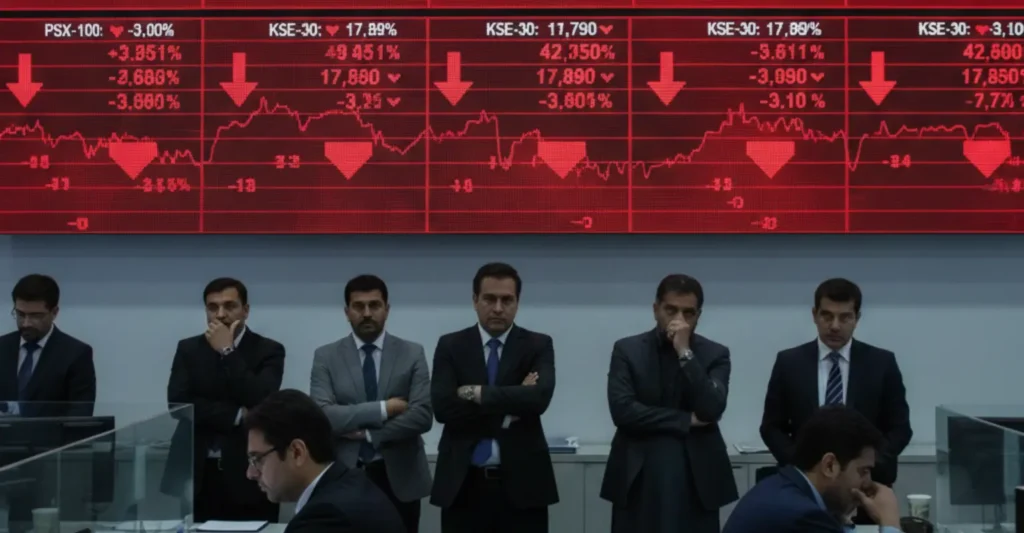
Traders monitor screens at the Pakistan Stock Exchange as the KSE-100 index drops sharply amid continued market volatility.
The Pakistan Stocks Exchange remained under pressure on Monday as ongoing volatility and a lack of positive news weighed on investor confidence. Despite the introduction of a faster settlement system, selling activity continued throughout the session, pushing the benchmark index sharply lower.
Investors stayed cautious due to wider economic concerns and ongoing uncertainty. Many chose to lock in profits after recent gains, adding to the selling pressure. As a result, the market struggled to find support and closed deep in negative territory.
KSE-100 Drops After Wide Intraday Swings
According to Topline Securities Ltd, the KSE-100 index closed at 182,340.38 points, marking a fall of 1,789.20 points by the end of the session. Trading was highly unstable, with sharp swings seen throughout the day.
The index started on a positive note and briefly moved higher before losing momentum. During the session, it reached an intraday high of 185,650.60 points. However, sustained selling pushed the index down to a low of 180,992.80 points, taking it below the 181,000 level at one stage. These large movements reflected nervous market sentiment, as investors reacted quickly to price changes in the absence of strong direction.
Heavyweight Stocks Lead the Decline
The fall in the index was mainly driven by losses in major stocks that carry significant weight in the benchmark. Oil and Gas Development Company, Meezan Bank, Pakistan Petroleum Ltd, United Bank Ltd, and Lucky Cement were among the biggest laggards. Together, these five stocks pulled the index down by around 932 points.
Weakness in the energy and banking sectors played a major role in dragging the market lower, as investors reduced exposure to large-cap names. Some support came from selective buying in a few blue-chip stocks. Sazgar Engineering Works Ltd, MCB Bank, and Nestle Pakistan recorded gains during the session. These stocks added nearly 220 points to the index, but their impact was not enough to offset the broader losses.
Trading Activity Declines Sharply
Market participation also weakened compared to previous sessions. Total trading volume fell by 26.8 percent to around 931 million shares. The decline in volume suggested that many investors preferred to stay on the sidelines amid uncertainty. The total value of shares traded dropped slightly by 2.45 percent to Rs58.8 billion.
This showed that although prices were moving sharply, overall activity remained muted. K-Electric dominated the volume chart, with nearly 302 million shares changing hands. Interest in the stock remained high due to its lower price and strong retail participation.
PSX Shifts to Faster T+1 Settlement System
Monday also marked the first day of the Pakistan Stock Exchange’s transition to a T+1 settlement cycle. Under this new system, trades are settled one business day after execution, replacing the earlier T+2 cycle.
Ali Najib, Deputy Head of Trading at Arif Habib Ltd, said the market opened positively and climbed to an intraday high of 185,651 points before sentiment turned negative. He noted that institutional selling later in the session triggered a sharp pullback. According to him, the shift to the T+1 system was completed smoothly and should be seen as a long-term structural improvement rather than a short-term market driver.
What the T+1 System Means for Investors
The new T+1 settlement system aims to speed up the transfer of funds and securities between buyers and sellers. This reduces settlement risk and improves overall market efficiency. Faster settlements can also enhance liquidity, as investors regain access to their funds more quickly. Over time, this change is expected to align Pakistan’s market practices with international standards.
However, analysts said the system change alone is unlikely to influence market direction in the short term. Broader economic factors and investor confidence will continue to play a larger role in shaping market trends.
Corporate Earnings Offer Mixed Signals
On the corporate front, Meezan Bank Ltd announced earnings per share of Rs 11.88 for the fourth quarter of calendar year 2025. The bank also declared a cash dividend of Rs 7 per share. The results were supported by better interest spreads and growth in deposits. However, weaker income from non-funded sources limited overall profitability.
Allied Bank Ltd also released its quarterly results, reporting earnings of Rs3.29 per share for the same period. The bank announced a dividend of Rs 1.75 per share. Quarterly earnings declined due to higher operating costs and lower non-interest income, although full-year performance showed signs of improvement.
Market Outlook Remains Uncertain
Analysts believe the broader market is currently in a consolidation phase. The KSE-100 index is expected to move within a volatile range of 180,000 to 190,000 points in the near term.
Until there is clarity on economic conditions and stronger positive triggers emerge, volatility is likely to remain high. For now, investors appear focused on risk management, preferring caution over aggressive buying.
About The Author