
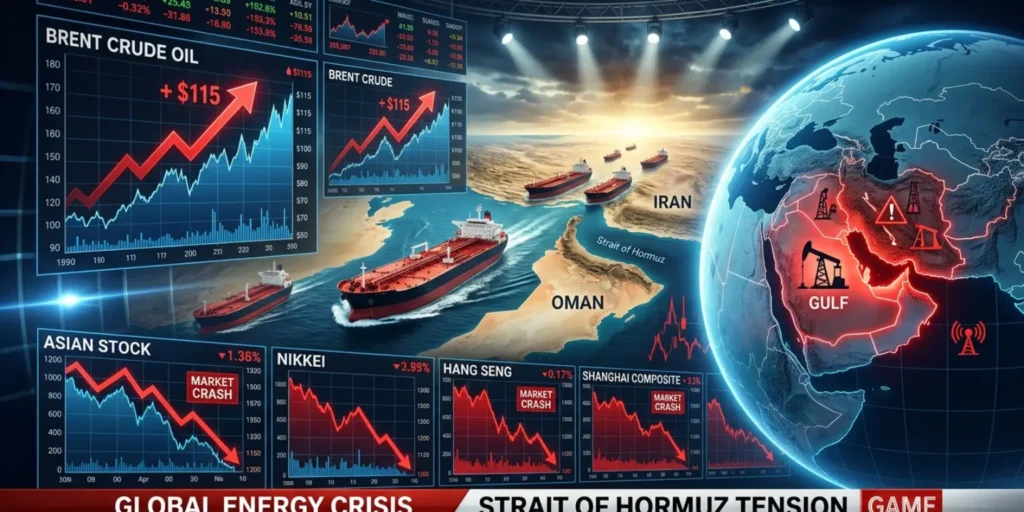
Brent crude surges above $114 with falling Asian stocks, reflecting global market stress from escalating Gulf tensions.
Stock markets in Asia fell sharply on Monday as investors grappled with the growing conflict in the Gulf region, which is already sending oil prices toward record monthly gains. The combination of rising energy costs and prolonged geopolitical tension is pushing inflation higher and increasing the risk of a global recession.
Markets across Japan, South Korea, and other parts of Asia reacted to news of military build-ups, regional attacks, and statements from leaders, showing how intertwined energy prices and regional security have become.
Oil Prices Soar Amid Gulf Conflict
Brent crude rose 2% on Monday to $114.90 per barrel, marking a nearly 59% gain for the month, a surge faster than the spike that followed Iraq’s invasion of Kuwait in 1990. U.S. crude also climbed 1.8% to $101.39 per barrel, representing a monthly rise of 51%.
The rising oil prices reflect the high risk of supply disruptions from the Gulf region, particularly around the Strait of Hormuz, a critical chokepoint through which roughly 20% of global oil shipments pass.
Bruce Kasman, global head of economics at JPMorgan, warned that if the strait remains closed for an extended period, oil prices could spike toward $150 per barrel, severely affecting industrial consumers and global supply chains.
“Energy markets are highly sensitive to even short-term disruptions in the Gulf,” Kasman said. “The longer the Strait remains closed, the sharper the drawdown in buffer supplies, which could trigger dramatic increases in the price of crude oil, natural gas, and other commodities.”
Geopolitical Tensions Escalate
The ongoing conflict has intensified over the past week. Yemen’s Iran-aligned Houthi rebels launched their first attacks on Israel since the start of the conflict, demonstrating that the war risk is spreading beyond the immediate Gulf region.
Meanwhile, Pakistan has offered to host talks aimed at a ceasefire, though Iran has accused Washington of preparing a land assault. U.S. forces continue to build up in the region, heightening concerns about an escalation into a broader conflict.
Former U.S. President Donald Trump stated that the U.S. could seize Kharg Island, Iran’s key oil-export hub, while also suggesting that a ceasefire could be possible in the near term.
Madison Cartwright, senior geo-economics analyst at Commonwealth Bank of Australia, said:
“Iran’s control of the Strait of Hormuz, capacity to disrupt global energy and food markets, and sustained missile and drone capabilities give it little incentive to concede, pressuring the U.S. to escalate. We expect the war to run at least into June, with the risk tilted to a longer conflict.”
The risk of further escalation continues to weigh on global energy markets and investor confidence.
Impact on Asia’s Economies
Asia is particularly vulnerable to rising energy costs because many countries depend heavily on imports from the Middle East.
- Japan saw its Nikkei 225 index drop 3.4% on Monday, bringing March losses to nearly 13%.
- South Korea’s Kospi fell by 3%.
- Chinese blue chips declined slightly by 0.2%.
- The broader MSCI Asia-Pacific index (excluding Japan) lost 1.3%.
Higher oil prices increase the cost of transportation, manufacturing, and electricity, affecting both businesses and households. For countries like Japan and South Korea, which rely on imported energy, this adds significant strain to the economy.
Rising energy costs also feed directly into inflation. Fuel, food, and commodities such as aluminium, gas, and fertilisers have all surged, putting further pressure on governments and central banks to manage prices without stalling growth.
Global Stock Markets React
The ripple effects of rising energy prices were also felt in futures markets.
- S&P 500 futures and Nasdaq futures pared early losses but remained under pressure.
- In Europe, EUROSTOXX 50 futures and DAX futures both fell 0.7%, while FTSE futures dipped 0.4%.
The global sell-off reflects growing investor concern that continued conflict could trigger higher inflation, slower growth, and potential recessions in energy-dependent economies.
Energy prices are especially impactful because they influence multiple sectors. For instance, higher oil costs increase the price of food, transport, chemicals, and plastics. This feeds through to consumers and businesses alike, reducing disposable income and corporate profitability.
Supply Chain Risks
The Gulf conflict is not just an energy issue; it also threatens broader global supply chains.
- Strait of Hormuz: Approximately 20% of global oil shipments pass through this narrow waterway. Any disruption could immediately tighten global supply.
- Global commodities: Gas, fertiliser, plastics, and aluminium prices have already spiked, reflecting higher input costs.
Experts warn that prolonged disruption could strain industrial production and trade globally. For example, a blockade of the Strait of Hormuz or the nearby Bab al-Mandeb Strait near Yemen could reduce oil supply by as much as 10%, creating ripple effects in energy-intensive industries.
Sean Foley, an energy markets expert at Macquarie University, noted:
“Even small disruptions in the Gulf can trigger outsized reactions in global energy markets because the supply is concentrated and critical to multiple economies.”
Historical Context
The current surge in Brent crude surpasses the rapid increase seen during the Gulf War of 1990, when Iraq invaded Kuwait. Oil prices have jumped more than 60% in just over a month, reflecting both supply fears and geopolitical risk premiums.
In contrast to previous crises, today’s energy market is already under stress due to limited spare capacity, high global demand, and low inventories. This combination makes prices more sensitive to disruptions than in the past.
Potential Scenarios
Analysts see several potential outcomes for energy markets and the broader economy:
1. Prolonged Conflict
If fighting continues into June or later, energy prices could rise further. Higher oil costs would fuel inflation, potentially slow global growth, and strain economies dependent on imports from the Gulf.
2. Temporary Ceasefire
A negotiated ceasefire or pause in hostilities could ease oil prices temporarily, though the market would remain jittery. Even minor disruptions in shipping lanes or new skirmishes could reverse gains.
3. Escalation to Wider War
If U.S. or allied forces move to seize strategic hubs, such as Kharg Island, or if Iran retaliates with broader strikes, oil could spike toward $150 per barrel. Such a scenario would significantly disrupt trade, raise inflation, and increase recession risks globally.
Inflation and Consumer Impact
Rising oil and commodity prices hit both households and businesses.
- Transportation: Higher fuel prices raise the cost of goods and services. Airlines, shipping companies, and logistics providers face rising expenses.
- Food prices: Fuel and fertiliser costs translate to higher agricultural production costs, affecting global food prices.
- Household budgets: Consumers spend more on energy, leaving less for discretionary items, slowing economic growth.
The combination of rising inflation and economic uncertainty can reduce consumer confidence, weaken demand, and put additional pressure on markets already stressed by the conflict.
Investor Strategy
For investors, the current environment calls for caution and strategic planning.
- Diversification is crucial to mitigate risks from energy volatility and geopolitical shocks.
- Monitoring developments in the Gulf region is key, as any sudden escalation could rapidly affect portfolios.
- Sectors such as energy, defence, and commodities may offer protection or benefit during conflict-related market volatility.
Analysts warn that reacting emotionally to market swings could be costly. A disciplined approach that considers potential scenarios for oil prices, trade disruptions, and inflation is necessary.
Conclusion
The ongoing Gulf conflict is reshaping global markets, particularly energy and equities. Brent crude is on track for a record monthly gain, while Asian markets continue to feel the effects of rising oil prices and geopolitical uncertainty.
The combination of higher energy costs, strained supply chains, and potential escalation in the Middle East presents significant risks for inflation, growth, and market stability worldwide.
Asia’s reliance on imported energy makes it particularly vulnerable, with Japan and South Korea among the hardest hit by rising fuel costs. Global investors are closely watching developments in the Strait of Hormuz and Kharg Island, as these critical points could determine whether oil prices stabilize or surge further.
Whether through prolonged conflict, temporary ceasefires, or escalation to a wider war, energy markets and global equities are likely to remain volatile. Policymakers, businesses, and consumers alike must prepare for the possibility of extended disruption and higher costs.
As markets brace for further developments, one thing is clear: the Gulf conflict is no longer just a regional issue—it has become a global economic concern with far-reaching consequences for oil, inflation, and growth.
About The Author